Community for Electronics 3D Printing Started by Nano Dimension and Hendsoldt

Hensoldt and Nano Dimension have initiated a platform for designers of additively manufactured electronics (AMEs) through the partners’ joint venture Jetted Additively Manufactured Electronics Sources (J.A.M.E.S.). The FrAMEwork will allow developers of 3D printed electronics to exchange expertise and overcome challenges in a global venue.
“Our mission is to provide a space where anyone across the globe can share stories and ideas about AME, exchange technical know-how and designs and enjoy the benefits of real-time communication with AME enthusiasts and professionals,” said Andreas Müller, CEO of J.A.M.E.S. “AME enables new and visionary applications in electronics that cannot be realized with conventional electronics manufacturing, and we strive to enable members to explore new possibilities in 3D.”
J.A.M.E.S. was formed in 2021 between electronics 3D printer manufacturer Nano Dimension and Hensoldt. With €1.47 billion in revenues, Hensoldt is the former electronics division of Airbus and has used Nano Dimension’s DragonFly PRO to make printed circuit boards. Since then, the venture has added nanomaterials 3D printing startup XTPL and the Fraunhofer Institute for Ceramic Technologies and Systems. Now, through its new community platform, J.A.M.E.S. aims to advance inkjet electronics 3D printing further. Andreas Salomon, CTO of J.A.M.E.S, explained:
“However, this emerging technology can only be taken to a next technical readiness level if we are able to combine different processes, materials and design methods. This is exactly what J.A.M.E.S is ideally suited for: empowering members of the J.A.M.E.S Community to gain experience with inkjet, micro-dispensing, ceramic printing, aerosol printing and all other processes currently on the market. Merging technologies is the future of AME with a huge potential to completely change the traditional way electronics are manufactured.”
The joint venture claims that it has exceeded the limits of 3D printed electronics, 3D printing fully electrified structures. For instance, the company combined a variety of electronics—including a flight controller, four motion controllers, and four motors—into a single drone frame.
“This drone also demonstrates the possibilities of miniaturization with AME,” Müller said. “Since AME 3D printers can print in microns, the size of the electronics can be significantly reduced while maintaining or exceeding current effectiveness.”
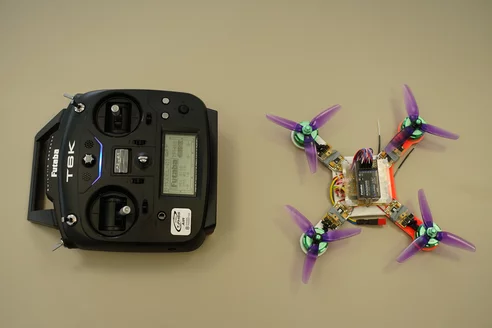
The 3D printed drone from J.A.M.E.S. Image courtesy of J.A.M.E.S.
Now, through the FrAMEwork platform, members at a variety of expertise levels can share ideas and insight into 3D printing electronics. On the J.A.M.E.S. site, you’ll see projects 3D printed by the joint venture alongside ideas for potential 3D printable electronics, such as brushless motors. Members can also access tutorials and research articles dedicated to the technology.
Given the small size yet powerful applications of this niche sector, the community will be one to watch. The most comparable ventures would be the FlexTech Alliance and its Flexible Hybrid Electronics (FHE) Manufacturing Institute (NextFlex), formed with the U.S. Department of Defense. While Nano Dimension has participated at NextFlex events, the institute seems to be primarily a U.S. endeavor, making the fledgling J.A.M.E.S. an AM-focused, European project by comparison. Both will advance electronics 3D printing in their own ways and may even converge at some point; however, we may also expect some rivalry to an extent.
Subscribe to Our Email Newsletter
Stay up-to-date on all the latest news from the 3D printing industry and receive information and offers from third party vendors.
Print Services
Upload your 3D Models and get them printed quickly and efficiently.













You May Also Like
How Should Businesses Build New Business? Dirk Simon Weighs In — Part 1
Dirk Simon had deep experience in materials and chemistry before joining the 3D printing industry. Instrumental in BASF and Farsoon’s market introduction, Dirk has spent a lot of time thinking...
The Frankenservice Part 2: Have Your Cake and Eat it Too
This series of articles delves into a thought experiment. What if we let go of using a few machines very optimally, but instead use lots of different machines to meet...
The Additive Chicken Coop, Part IV: Lemmings
If we look at our past, we can see how making custom machines, incessantly watching ourselves, and our inability to rescope shaped our industry. We have also looked at the...
The Additive Chicken Coop, Part III: Bananas
A friend of mine, Ed Davis, once pointed out the level of strategic replication in additive. I wasn’t aware of it before and haven’t been able to unsee it since....