Indonesia to Start Trial-Run of 3D Printed Buildings

Stories about the use of additive manufacturing (AM) in construction seem to usually be about a handful of nations — especially the United States and China — so it’s always notable when we see another country delving into the technology. Indonesia can now be added to the list of countries getting into additive construction, as was announced by Indonesia’s Public Works and Public Housing (PUPR) Ministry on December 7th.
In a press release, Indonesia’s Minister of PUPR, Basuki Hadimuljono, noted, “The innovation is the collaboration among PUPR Ministry, a state-owned enterprise (BUMN), and an Indonesian youngsters’ start-up company.” Diana Kusumastuti, director general of human settlements at PUPR, noted, “It is hoped that the new technology will continue to be developed for school construction, in accordance with the prototype set by the ministry.”
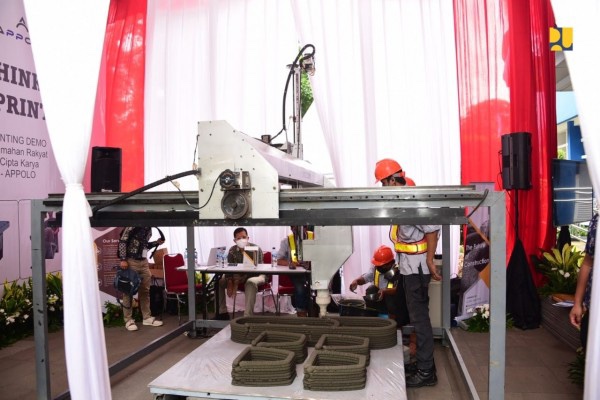
The state-owned enterprise referred to by the PUPR Minister is PT Pembangunan Perumahan (Persero) Tbk, also known as PP Construction & Investment, which is one of Indonesia’s largest construction firms; and the start-up is Autoconz, an additive construction company founded in 2018. This project is part of Making Indonesia 4.0, a blueprint formulated by the government of Indonesian President Joko Widodo in 2018, which calls to transform Indonesia’s economy in alignment with the so-called “Fourth Industrial Revolution”.
As mentioned by Zachary Mannheimer, CEO of American housing 3D printing company Alquist 3D, in a recent press release about two of his projects in Virginia, rural areas face particular challenges in getting new housing built with conventional methods, for a variety of reasons. They’re farther from major distribution hubs, they have much lower population density than urban or suburban areas, and the difficulty in building a number of structures at scale, in general, makes costs higher than they would be if the same structures were built in more highly-developed locales. This is of great significance to the developing world in general, where a higher percentage of the population tends to live in rural areas than is the case in the rest of the world, and certainly true for Indonesia, in particular, where over 40 percent of the population is rural.

It’s especially significant, moreover, that schools will be used as the prototype for this project, since that will add not just new construction and jobs to Indonesia’s economy, but, in addition, constitutes a long-term investment in the nation’s infrastructure. It could also be a model worth following by other nations with similar economies, highlighting that it’s possible to advance the national economic base without turning to international investment. Keeping everything “in-house”, so to speak, is difficult to pull off, but has the potential to pay far more dividends for the nation in question on a variety of levels than projects involving international capital and transnational firms. Even just displaying that this is possible would be a huge victory, and could inspire other companies in Southeast Asia, Africa, and Latin America to act similarly.
Images courtesy of PUPR and Autoconz.
Subscribe to Our Email Newsletter
Stay up-to-date on all the latest news from the 3D printing industry and receive information and offers from third party vendors.
Print Services
Upload your 3D Models and get them printed quickly and efficiently.












You May Also Like
3D Printing News Briefs, November 27, 2025: Awards, Sand Binder Jetting, Tabletop Gaming, & More
To all those who celebrate, happy Thanksgiving! In today’s holiday 3D Printing News Briefs, we’re starting off with some exciting news: the winners of this year’s Formnext Awards! Then, we’ll...
3D Systems New Product Releases at Formnext 2025: SLA Printer, Materials, & More
3D Systems (NYSE: DDD) reported that its Q3 numbers showed signs of stabilization, even with lower revenues, and CEO Jeffrey Graves told investors that a “strong pipeline of new products positions us...
Sintokogio Buys Bosch’s Ceramics Unit, Plans Global AM Expansion
Japan’s Sintokogio Group is buying Bosch Advanced Ceramics to expand its work in 3D printed technical ceramics. The agreement was signed on November 18 and formally announced at the Formnext...
3D Printing News Briefs, November 22, 2025: Rebranding, Integration, Electronic Eyes, & More
We’ll start with a new software tool from AON3D in today’s 3D Printing News Briefs, and then we’ve got a lot of business, from Conflux Technology and Prima Additive to...