AM Investment Strategies Profile: Stratasys


Stratasys CEO Yoav Zief will be taking part in the SmarTech Stifel AM Investment Strategies event on September 9th. We’re incredibly proud that we’ve got a set of very exciting industry leaders together for that event.
Zief will be there representing Stratasys, a publicly traded firm responsible for inventing and commercializing material extrusion 3D printing technology, also called fused deposition modeling (FDM). For a large part of its 32-year existence Stratasys relied on FDM as its single technology pillar. Then, it merged with Israeli company Objet with its PolyJet 3D printing technology. Where FDM is not so detailed and smooth, PolyJet is. But while PolyJet parts are rather fragile, FDM parts are strong and tough. These two complimentary processes where developed and deployed worldwide through a global reseller network.

Origin’s DLP process.
Very recently, Stratasys acquired Origin, a digital light processing (DLP) technology firm with open materials and a focus on large batch manufacturing. This means that it has a competitive, fast machine to make detailed resin parts for casts, molding, hearing aids, thermoforming inserts, and other small parts that are being used in their millions.

Stratasys also bought RPS a large stereolithography (SLA) company that has made high speed SLA machines for Formula 1 teams and other clients. This means that the firm can now also offer large resin parts for casting, end-use parts, and prototyping. Stratasys also invested in inkjet head maker Xaar, whose print heads are being used for Selective Absorption Fusion (SAF), a high throughput powder bed fusion (PBF) technology that Stratasys is in the process of commercializing.
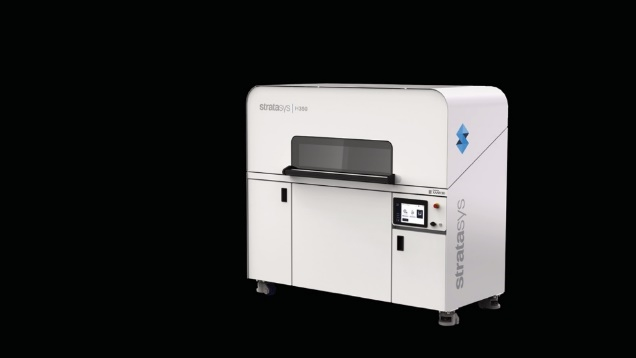
Stratasys now has machines in all of the mayor polymer 3D printing technologies. At the same time, it also runs a service, Stratasys Direct Manufacturing, which allows companies to 3D print parts. 3D Systems has just sold its service division and seems to be pivoting towards healthcare. Stratasys, on the other hand, is coming out with many application-specific machines; a dental version of a PolyJet printer optimized for dental users, for example. While it is keen to be active in and expand its aviation and space segments, it seems to be broadly focused on all of the relevant industries and applications.
What it does not yet do is metal printing. The company has invested in some metal printing and told the world about its Layered Powder Metal technology in 2018. It’s unclear if and when this will be released. Stratasys’s MakerBot subsidiary unit also makes professional material extrusion printers around the $5,000 mark. That unit can still grow as a well if it takes on more enterprise customers. The firm’s entry-level MakerBot offering has become much more reliable recently and could find its way into more offices.
Stratasys has a huge advantage in my mind. It has a good, trusted global reseller network. These can now cross-sell their existing customers an array of products. Existing resellers can also now expand their businesses in dental, hearing aids, and other areas because of the new technologies that they can offer. This is a significant opportunity for the firm.
In the same vein, I think that post-processing can be a huge opportunity for the firm. Support removal, de-powdering, and surfacing models is a huge spend for the industry. A significant share of part costs are to be found in post-processing. Offering these machines to its network would make more business cases possible, reduce part costs and be a new source of revenue.
With regards to the several 3D printing processes, there is a risk that the company has to now spread its R&D budget over a number of different technologies. Will they have the spend to advance them all simultaneously? It is also making maintenance and service much more complex than it used to be through adding dozens of machines and different technologies. The company has a made a series of bold moves in the past few years. Its new product lineup and technology offering will take time to crystallize and spread around to its partners. But, then we can see if the company has found a new font for long term growth.
Stratasys CEO Yoav Zief will take part in the SmarTech – Stifel AM Investment Strategies 2021 summit on September 9, 2021, where he will be able to shed more light on the overall market and his company’s role in it. Register for free here.
Subscribe to Our Email Newsletter
Stay up-to-date on all the latest news from the 3D printing industry and receive information and offers from third party vendors.
Print Services
Upload your 3D Models and get them printed quickly and efficiently.












You May Also Like
3D Printing Financials: Medical Becomes the Driving Force Behind Materialise
Materialise (Euronext Brussels & Nasdaq: MTLS) is seeing continued growth in its medical 3D printing business and signs of a recovery in manufacturing, but that progress has not been enough...
3D Printing Financials: 6K Additive’s Orders Surge as Revenue Climbs 61%
6K Additive (ASX: 6KA) reported higher revenue and a record order backlog in its latest quarterly results, as growing demand for metal powders continues to push the company to expand...
3D Printing Financials: Prodways Printer Revenue Jumps 130% in Q3
French 3D printing company Prodways (EPA: ALPWG) reported a 130% increase in printer revenue in the third quarter of 2026, driven by growing demand for its MOVINGLight technology for ceramic...
3D Printing Financials: New Money Flows Into Medical, Industrial and AI 3D
Money continued to move into 3D printing in the second half of August. Hike Medical raised $22.5 million as it grows its 3D printed custom medical device business. Swiss additive...