Schiner 3D Repro Prints Accurate Human Body Models for Medtech Companies

Austrian printing company Schiner 3D Repro has started providing medical technology companies with hyper-realistic printed digital anatomy models, made via their Stratasys J750 Digital Anatomy. It’s one of the latest use-cases for the popular biomedical printer.
Traditionally, medtech companies looking to test new products face a big barrier: the wait for new testing cadavers. This wait gets even longer when they need bodies with specific illnesses or problems to test how an assistive device might work with them. The big advantage of 3D printing is that you can print multiple body parts at once, and you can print them with the pathologies your device is meant to solve. But to test your devices on printed body parts, the parts need to be detailed, accurate, and extremely replicable.

The J750 Digital Anatomy 3D Printer.
Schiner’s medical department is one of the first in the region to solve that problem with Stratasys’s J750 Digital Anatomy 3D. Developed in 2019, the printer works with software that allows it to print directly from DICOM data (medical files like MRI and CT scans).
Schiner is also using Stratasys’s trio of printing materials that mimic human body parts: TissueMatrix for organs, BoneMatrix for bone structures, and GelMatrix for circulatory structures. BoneMatrix underwent a set of improvements in 2020, and a team at Israel’s Technion Institute of Technology’s Materials Science and Engineering Laboratory found that spines printed with the material performed accurately to real human spines. The same year, researchers looked at breast phantoms printed in TissueMatrix to see if they could be used as biopsy training for radiologists.
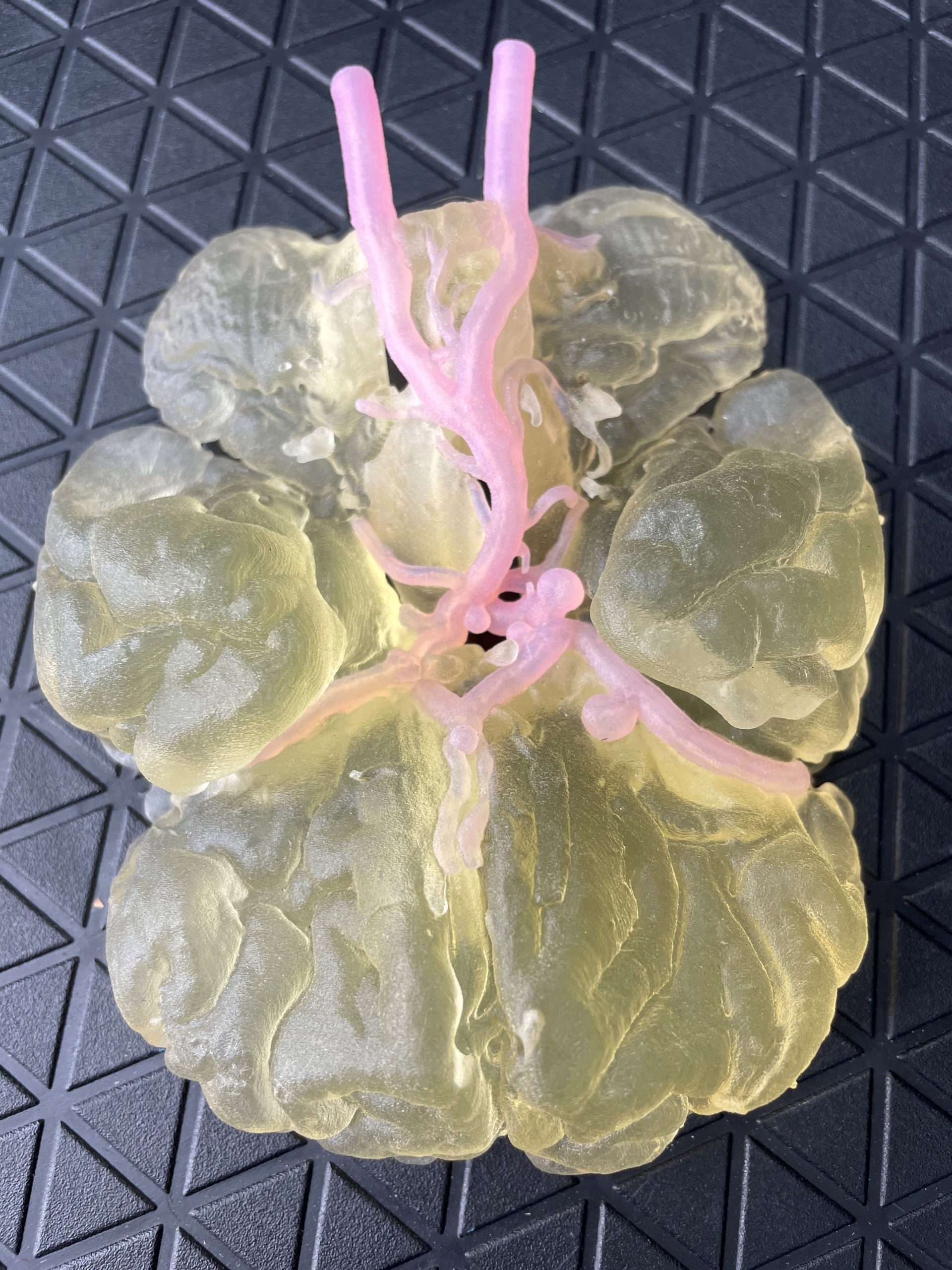
A model of a brain base, printed in TissueMatrix, on the Digital Anatomy printer (Image via Schiner).
“With the Tissue Matrix material, we have the softest material on the market with A Shore hardness,” said Scott Drikakis, Stratasys Medical Segment Leader, when the materials were released. “With Bone Matrix, we can make a rib that I can snap. We can replicate the external features of bone as well as the internal features across different types of bone.”
Since their acquisition of the J750, Schiner has been getting a significant volume of orders for biomechanical models, from catheter models to complex brain models for microscope training. In one recent project, they printed a vascular model for a customer who wanted to test out a product related to blood flow.
“The vascular structures were only 1.5mm in diameter, which would literally be impossible to produce using other technologies,” said Oliver Simon, Project Manager of Schiner’s Medical Branch. “Thankfully we were able to 3D print the model for the customer, which opens up additional opportunities in design validation and optimization of the medical device for them.”
Because of this increased demand from medical technology companies, and ongoing contracts with Austrian and German universities, Schiner 3D Repro expects its medical branch of its business to grow up to 30% this year.
Subscribe to Our Email Newsletter
Stay up-to-date on all the latest news from the 3D printing industry and receive information and offers from third party vendors.
Print Services
Upload your 3D Models and get them printed quickly and efficiently.












You May Also Like
3D Printing News Briefs, November 27, 2025: Awards, Sand Binder Jetting, Tabletop Gaming, & More
To all those who celebrate, happy Thanksgiving! In today’s holiday 3D Printing News Briefs, we’re starting off with some exciting news: the winners of this year’s Formnext Awards! Then, we’ll...
EOS Launches M4 ONYX 3D Printer at Formnext 2025
EOS is steadily establishing itself as an expert in developing dual-use technologies. Now, as I mentioned in a recent interview with Greg Hayes, the Senior VP Global Additive Minds at...
Post-Processing at Formnext 2025: Unpacking, Depowdering, Resin Removal, & More
This week, the additive manufacturing (AM) industry will travel en masse to Frankfurt, Germany, to attend Europe’s premier AM industry trade show, Formnext. There already have been, and will be...
Join Us This Week for Our Free AM Investment Strategies 2025
Additive Manufacturing Research (AM Research) recently reported that the global additive manufacturing (AM) market reached $3.9 billion in Q2 of 2025: an 8.8% year-over-year increase. There’s a lot to unpack,...