Arkema, Texas Instruments Back Adaptive3D’s 3D Printing Photoresins in Series B Funding


Texas-based additive manufacturing polymer resin supplier Adaptive3D wants to use optimized materials, such as its extremely high-strain photopolymer and flagship Elastic ToughRubber 90 elastomer, to empower high-volume manufacturing and 3D printing, and provides its specialty polymers to customers around the world in the consumer, healthcare, industrial, oil and gas, and transportation industries. This past winter, the company completed a Series A investment round, and has now announced the securing of Series B financing, which will help Adaptive3D continue on its mission.
“Challenging the aging model of injection-molded rubbers and polyurethanes, Adaptive3D is now scaling production and distribution to deliver shelf-stable, print-stable, one-part photoresins that yield superior, manufactured end parts. Our resins enable customers to topologically optimize and micro-architect their polymeric products to provide a sustainable competitive advantage now,” Adaptive3D’s President and CEO Walter Voit, PhD, stated in a press release sent to 3DPrint.com.
The investment came from a syndicate that was led by the Arkema Group, which knows a thing or two about AM materials science itself, having announced an increased focus on 3D printing materials five years ago and living up to it ever since.
“Arkema is a global leader in supplying specialty materials to enable sustainable, innovative solutions to manufacturing technologies. Adaptive3D photoresins, based on Arkema materials and now validated in the market, further our customer-focused mission to reach into new application spaces with 21st century materials,” said Sumeet Jain, the Senior Director of 3D Printing worldwide at Arkema.
According to Adaptive3D, its versatile photopolymer resins have “unmatched” mechanical properties, and allow for the 3D printing of tough, tear-resistant, and strain-tolerant plastic and rubber parts, like what its Elastic ToughRubber 90 (pictured below) can achieve, that are created in open-air environments. The company has accumulated several patents that are focused on materials studies, and its photoresins have been enhanced for high-throughput 3D printing of complex parts.
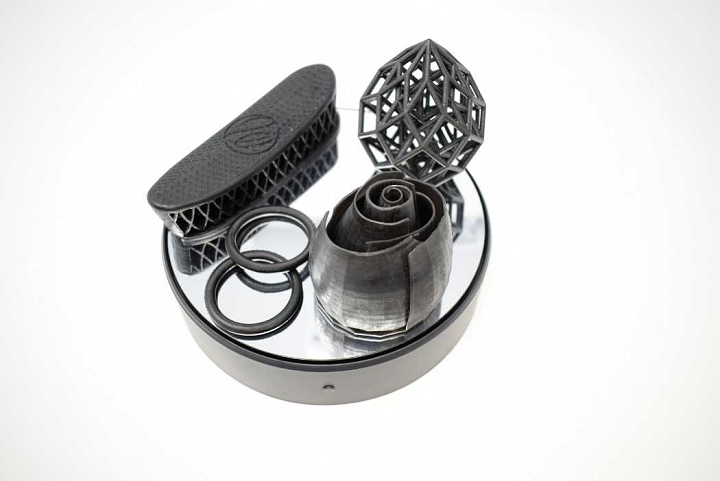
Elastic ToughRubber 90
The Arkema-led syndicate that participated in this round of funding was joined by current investors of the company, including Applied Ventures and the founding family of Texas Instruments, along with new investors Clear Fir Partners and West Pharmaceutical Services. According to Adaptive3D’s press release, together West Pharmaceutical Services and the Arkema Group “exemplify the potential end points” of a total AM ecosystem, all the way from developing materials and scaled resin manufacturing to the completion of functional end-use parts.
“At West, we see the potential of additive manufacturing to create differentiated, novel components and solutions for the healthcare sector. We understand well the challenges of commercializing new materials for the pharmaceutical packaging space, from innovation to validation to manufacturing at scale,” explained Scott Young, PhD, VP Research Innovation & Technology at West Pharmaceutical Services. “We are impressed with the science and expertise at Adaptive3D. We are excited about their current and future engineered photo resins and look forward to working with Adaptive3D to push forward the technology boundaries of pharmaceutical packaging services.”
(Source/Images: Adaptive3D)
Subscribe to Our Email Newsletter
Stay up-to-date on all the latest news from the 3D printing industry and receive information and offers from third party vendors.
Print Services
Upload your 3D Models and get them printed quickly and efficiently.













You May Also Like
50,000 Orders and Counting: EPlus3D & Chinese AM Services Provider Are Scaling Liquid Cooling Solutions for AI Servers
An under-appreciated story driving the additive manufacturing (AM) industry this year has been the divergence between what’s driving the market in China and what’s driving it everywhere else. Let’s start...
Additive Manufacturing Has a Major Growth Opportunity; Trust Will Decide Who Captures It
After years of overpromising, the next phase of AM growth will be won by companies that consistently deliver what they say. When I entered additive manufacturing in 2014, after 15...
Seven Trends Reveal What’s Next for 3D Printing at TCT Shenzhen 2026
TCT Shenzhen 2026 opened on October 14 in Hall 15 of the Shenzhen World Exhibition & Convention Center in Bao’an, and ran through October 16. The event brought together equipment...
AM Investment Strategies 2026 Sets the Stage for AMS 2027
AM Investment Strategies 2026 Nov. 5 · 12 p.m. ET · Free online event RESERVE YOUR SPOT ↗ A one-hour online discussion featuring some of the biggest names in 3D...