3D Printing News Briefs: November 15, 2019

In today’s 3D Printing News Briefs, we’re sharing stories about new partnerships, a new material, and a new system for safe powder handling. EOS and AMFG have announced a partnership, while Biogelx is collaborating with Regemat3D. Adaptive3D is introducing a new elastic material at next week’s formnext. Finally, piab has developed a vacuum conveyor for safe handling of AM powders.
EOS and AMFG Partnering Up for AM Machine Connectivity
 A major barrier to 3D printing adoption is the lack of workflow connectivity. That’s why industrial 3D printing supplier EOS and AMFG, a provider of Manufacturing Execution System (MES) software for additive manufacturing, are partnering up to enable machine connectivity and end-to-end workflow automation for AM. The two companies are working to set up a fully connected AM workflow, and EOS 3D printer users will now be able to connect directly with their machines, and manage their AM operations, through AMFG’s MES software. EOS customers can set 3D printing parameters and prepare build jobs, and in the future, possibly even monitor and receive real-time machine data.
“EOS is a global leader when it comes to 3D printing technologies and we’re thrilled to collaborate with such an esteemed partner,” stated Keyvan Karimi, the CEO of AMFG. “Our partnership not only makes machine control a reality, but it is also a major step towards establishing AM operations that are automated and scalable.”
You can visit both companies at next week’s formnext in Frankfurt: EOS will be at Stand D31 in Hall 11.1, while AMFG will be at Stand G81 in Hall 12.1
Biogelx and Regemat3D Announced Strategic Collaboration
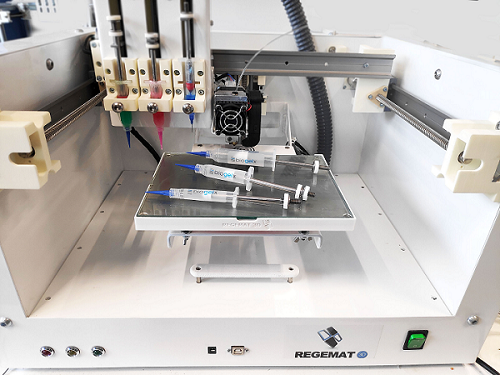 University of Strathclyde spin-out company Biogelx develops tunable, synthetic materials for use in 3D cell cultures and 3D bioprinting applications. Now, it’s announcing a strategic R&D and distribution collaboration with bioprinting systems, materials, and regenerative medicine solutions provider Regemat3D. Founded in 2011 by Jose Manuel Baena, PhD, Regemat distributes a large range of biomaterials. As part of the collaboration, the two biotech companies will offer research institutes around the world with complete 3D bioprinting solutions, and Regemat will develop a new skin model and add the first biomimetic synthetic bioink product range to its portfolio.
“We are excited to see future tissue models using Biogelx-INKs,” said Sandy Bulloch, the Director of Strategic Alliances for Biogelx. “We believe that this strategic partnership will expand the distribution of our novel peptide-based bioink products to new and existing customers worldwide and provide Regemat3D with an extended platform to provide their customers a robust synthetic bioink for use with their very successful range of bioprinters.”
Adaptive3D Introduces Elastic ToughRubber 90 Material

ETR Door Boot
At next week’s formnext, polymer resin materials provider Adaptive3D will introduce a new material: Elastic ToughRubber 90 (ETR), a high tear-strength direct curing rubber elastomer. The new photoresin was designed for DLP 3D printing of flexible end parts in the transportation, medical, industrial, and footwear sectors. ETR is a one-part system that’s pot stable, which means that leftover resin can be used in other print jobs, and doesn’t need mixing. It offers excellent performance, and has been optimized for the quality requirements and processing needs of the manufacturing environment.
“Elastic ToughRubber™ 90 is a tough printable elastomer for all seasons, with stable performance at cold temperatures, a tear strength of 46 kN/m, greater than 200% elongation, and ease of processing, Elastic ToughRubber unlocks the benefits of 3d printing to those who manufacture and sell rubber, polyurethane and foam parts,” said Adaptive3D CEO Walter Voit, PhD.
Visit Adaptive3D’s formnext Booth G01, in Hall 12.1, to see 3D printed parts made from its new Elastic ToughRubber 90.
Piab Offering Safe Powder Handling for 3D Printing
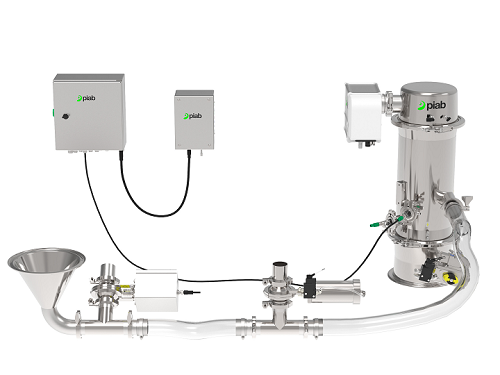 Many in the 3D printing industry are striving for automation, but there are still some parts of the process that are manual, such as powder loading. Smart solutions provider Piab, which has pioneered vacuum automation since the 1960s, is a supplier for the chemical, food, and pharmaceutical industries, and knows that vacuum conveying technology, and an ergonomic workplace design, can help protect people, the environment, and the product in question. That’s why it developed the piFLOW SMART vacuum conveyor, a closed system that helps ensure a clean working environment thanks to many filters.
The new piFLOW SMART vacuum conveyor has an auto-tuning feature, which automates powder and bulk conveying, and the system is pre-programmed to get rid of complex manual timer settings, while also allowing for, as the company wrote, “the continuous adaptive automatic fine tuning of the conveying process.” The system also has advanced sensor technology for optimizing and increasing throughput, energy-efficient automatic shutdown of the vacuum pump when the system is idling, and uses its vacuum conveyors to return excess powder back to the production cycle by way of a suction feed and sieve.
Discuss these stories and other 3D printing topics at 3DPrintBoard.com or share your thoughts in the Facebook comments below.
Subscribe to Our Email Newsletter
Stay up-to-date on all the latest news from the 3D printing industry and receive information and offers from third party vendors.
Print Services
Upload your 3D Models and get them printed quickly and efficiently.












You May Also Like
Flashforge Bets on Meshy AI as Desktop 3D Printing Battle Intensifies
Competition in desktop 3D printing is brutal. Whereas before, firms competed through value engineering, Prusa clones now have an integrated hardware, sensor, and software setup that is making all the...
Ford Uses Binder Jet 3D Printing to Make Boat Propellers for Sharrow Marine
Ford’s Advanced Industrial Technology and Platforms (ATP) group has helped Sharrow Marine make a boat propeller in two weeks rather than 130 days. Thanks to the Michigan Central program, Ford...
Skuld to Work on DARPA’s Rubble to Rockets (R2R) Program
Skuld will work on the Defense Advanced Research Projects Agency’s (DARPA) Rubble to Rockets (R2R) Program, which turns scrap metal into missile components. Skuld will help with alloy design, characterization, and...
From “Magic” to Metal: How Intrepid Automation Wants to Make 3D Printing Matter at Scale
Ben Wynne still talks about 3D printing the way people do when they’ve felt that “wow” moment up close. Back in the early 2000s, he was working at HP’s advanced...