
3D Printing for Nerve Regeneration: Gelatin Methacrylate-Based Nerve Guidance Conduits

Chinese researchers delve deeply into tissue engineering, releasing the findings of their recent study in ‘3D printing of gelatin methacrylate-based nerve guidance conduits with multiple channels.’
While there have been incredible strides forward in the worlds of bioprinting and tissue engineering, there has been much challenge too. Areas such as bone regeneration are known to be particularly difficult, along with basic premises like sustainability and viability of cells, but in this study, nerve tissue and peripheral nerve regeneration are the focus as the scientists develop a new bioink.
Usually, the result of trauma or a birth defect, peripheral nerve injury (PNI) is a serious medical issue in patients who may also lose sensory and motor function. Hundreds of thousands of nerve repair surgeries are performed around the world each year, with nerve autografts being common:
“However, limited supply, permanent donor site morbidity, size and geometrical mismatch, and additional surgical procedures restrict clinical alternatives,” stated the researchers.
“Mixed results yielded using this technique are another disadvantage, with most patients restoring limited function after the procedure. Thus, artificial alternatives to replace autografts with appropriate mechanical and biological properties need to be developed.”
As fabrication on the micro-scale has become possible via 3D printing, nerve guidance conduits have become a greater possibility over the autologous nerve graft. These tubular bridging sets provide cues for regeneration of axons, preventing scar tissue in situ, along with keeping nerves that are regenerating from being compressed.
So far, both extrusion and laser-based 3D printing have been used in creating NGCs—with extrusion-based printing being more preferred due to biocompatibility and versatility; however, the researchers point out that there are issues with such methods, like challenges with speed, stability in structures, and inferior resolution. Stereolithography (SLA) was investigated for use also, but still presented issues with speed:
“Therefore, a suitable 3D printing technique that can fabricate NGCs with complex architectures in a rapid and efficient manner urgently needs to be developed,” stated the researchers.
Digital light processing (DLP) offers superior performance, especially as the digital micro-mirror device (DMD) encourages crosslinking in a complete layer—as opposed to the SLA technique with just a single dot. In comparing the two, however, printing time is the same. There are other challenges too as biomaterial inks may not be suitable.
In this study, DLP 3D printing was used with gelatin methacrylate (GelMA) for ink. The researchers sought to optimize parameters in DLP printing in order to fabricate ‘high-quality bionic 3D structures.’ Samples were then tested for mechanical strength, biocompatibility, and neuronal differentiation.
Molds were designed in SolidWorks, sliced with Creation Workshop, and 3D printed on a commercial DLP 3D printer manufactured by Suzhou Intelligent Manufacturing Research Institute.
DLP-based printing of GelMA-based nerve guidance conduits (NGCs). (A) A schematic illustrating the fabrication of NGCs with pure GelMA. (B) Rheological characterization of GelMA: (I) viscosity-shear rate of water and 13.3% GelMA and (II) shear modulus- step times of 13.3% GelMA.
Benefits of using DLP included:
- Greater homogeneity
- Printing speed
- Output
The researchers experimented with parameters to assess the potential for GelMA NGCs with a 4-channel design. NGCs were influenced by the exposure, light, and layer thickness while 3D printing.

Manufacturing processes of GelMA-based nerve guidance conduits (NGCs). (A) Multichannel pattern photocrosslinked with different exposure times. (B) NGCs with varying inner diameters, fabricated using an appropriate exposure time.
“The results demonstrate the feasibility of printing customized NGCs with pure GelMA,” concluded the researchers.
“The fabricated NGCs can support the survival, proliferation, and migration of PC-12 cells and induce NCSCs to differentiate into neurons. Therefore, using DLP printing in neural tissue engineering can develop GelMA NGCs that mimic natural architecture of the nerve and exhibit great potential for nerve regeneration.”
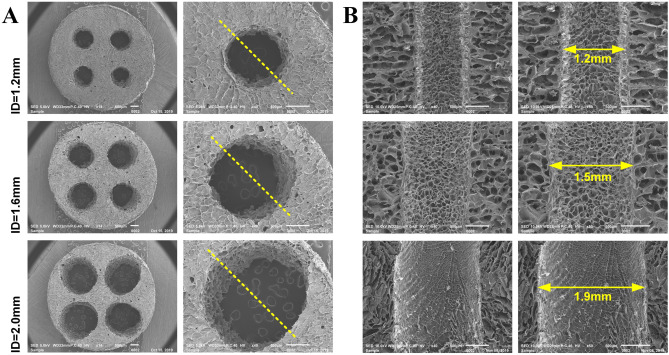
Scanning electron microscopy images of nerve guidance conduits. (A) Low-magnification images (14×) showing the transverse section (dotted yellow line of the image on the right showing the plane where the samples were cut to acquire longitudinal images). (B) Low-magnification images (40×) showing the longitudinal section (double side arrow of the image on the right showing the diameter of the channel). (For interpretation of the references to colour in this figure legend, the reader is referred to the web version of this article.)
What do you think of this news? Let us know your thoughts! Join the discussion of this and other 3D printing topics at 3DPrintBoard.com.
[Source / Images: ‘3D printing of gelatin methacrylate-based nerve guidance conduits with multiple channels’]Subscribe to Our Email Newsletter
Stay up-to-date on all the latest news from the 3D printing industry and receive information and offers from third party vendors.
Print Services
Upload your 3D Models and get them printed quickly and efficiently.













You May Also Like
10 Years of Multi Jet Fusion: Onsite at HP’s Vancouver, Washington Facility
At this year’s RAPID event in Boston, HP Additive Manufacturing Solutions celebrated ten years in the additive manufacturing (AM) market. The company ushered in the milestone with several innovations, including...
These 3D Printed Lattices Can Sense Damage Before Failure
A new paper, “Full-Field Damage Monitoring in Architected Lattices Using In situ Electrical Impedance Tomography,” points to lattices being able to detect damage. This could really help composites in critical...
3D Printing News Briefs, October 3, 2026: Hypersonics, Hotends, & More
We’re starting off with defense in this weekend’s 3D Printing News Briefs, as Titomic was awarded a $5 million U.S. defense contract, and VulcanForms announced a partnership with Specter Aerospace...
3D Printing News Briefs, October 1, 2026: Defense, Enclosures, & More
In today’s 3D Printing News Briefs, we’re starting with defense news, first from Massivit and then from AML3D. Then we’ll move on to U.S. manufacturing of a new large-format LPBF...

























































