EOS Brings Additive Manufacturing Expertise to Brazil’s BIZU Space


EOS is working with BIZU Space on space propulsion. Brazil-based BIZU Space makes liquid rocket engines and is involved in the MLBR (Brazilian Microlauncher), an independent Brazilian path to Low Earth Orbit (LEO) launch capabilities. Bizu Space’s staff will be able to take the Design for Additive Manufacturing (DfAM) courses through EOS’ Additive Minds Academy. Additionally, Additive Minds consultants will be made available to help the firm. The focus will be on propulsion, specifically things like combustion chambers, closed-cycle turbopumps, and engine parts.
EOS’ Michael Wohlfart, Team Manager, Business Development and Academy, said,
“The most successful additive manufacturing programs combine technology with education. Our goal is to help engineers develop a deep understanding of Design for Additive Manufacturing, so they can fully leverage the advantages of industrial 3D printing for demanding applications such as space propulsion.”
BIZU Space Co-founder Raphael Galate stated,
“Brazil’s space sector is entering an exciting phase of growth, creating new opportunities to develop technologies locally and strengthen the country’s space capabilities. As we continue to advance propulsion technologies, additive manufacturing is playing an increasingly important role in how complex aerospace components are developed. Working with EOS and the Additive Minds Academy will help us further strengthen the expertise needed to support future space applications.”
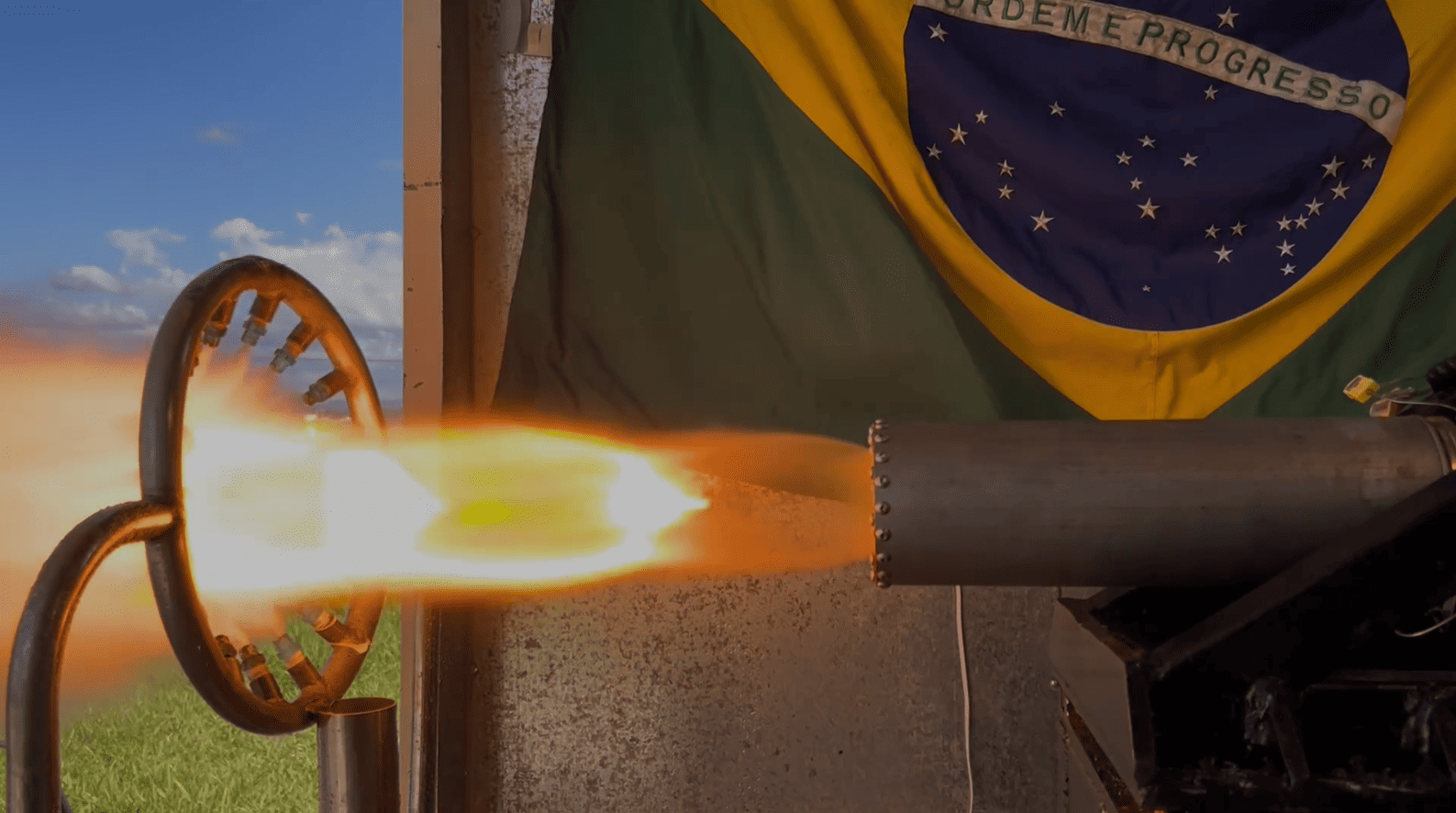
Bizu performs a hot-fire test. Image courtesy of Bizu Space.
With many countries worldwide seeking a sovereign space capability, this is an astute move for EOS. Brazil has a lot of talent, and we must not forget that $2.2 billion Embraer is a relative minnow compared to Boeing and Airbus, but it is the third-largest passenger jet maker worldwide. In the small regional jet category, Embraer is really strong. Additionally, the country makes its own missiles with Avibras; it has an Airbus helicopter subsidiary, Helibras; an ELBIT Systems-owned cockpit systems firm; AEL Systems; Embratel, the largest Latin American satellite operator; and XMobots, a drone firm. Almost the entire Brazilian aerospace industry, generating 15,000 jobs and over $8 billion in revenue, is in one town, São José dos Campos. That concentration makes the area a very interesting one for investment.
Also, as miniaturization and better chips march onward, smaller payloads will continue to become more powerful. In fact, along with AM, this could mean that cubesats and picosats could become very disruptive to legacy platforms and established constellations. For example, it could be possible to offer a data service locally much more cheaply than a constellation would. And coupled with low-cost launch, more payloads could make it to orbit that were not viable before. Rather than a long-term, huge satellite, you could consider something with a much shorter lifespan that does the trick quite well for a few months, for example. Or you could experiment more and develop payloads that really push the envelope. Or you could force a slew of startups to offer alternatives to established services. So imagine a Starlink but only for São Paulo state? Personalized and made just for the people there, controlled by them. Starlink has around 10 million subscribers globally; São Paulo has 46 million citizens. So what first looks rather fanciful could actually work. Brazil also has huge landholdings, plus large mining and energy operations. Some of these may benefit from their own specific satellite coverage. One cattle farm in Goiás, Fazenda Nova Piratininga, has over 100,000 cows, 970 kilometers of roads, and spans up to 200,000 hectares, or 2000 square kilometers, or 495,000 acres. That’s an area larger than London and around the same size as Tokyo. For such a huge remote site, a dedicated satellite providing granular weather coverage could be very valuable.
Given Brazil’s market potential, this is a smart exploration by EOS. The company should do more to engage Brazil’s aerospace sector, as it may yet produce cost-effective solutions for many potential customers.
Subscribe to Our Email Newsletter
Stay up-to-date on all the latest news from the 3D printing industry and receive information and offers from third party vendors.
Print Services
Upload your 3D Models and get them printed quickly and efficiently.












You May Also Like
3DPOD 318: 3D Printing at ORNL, Part II – Thomas Feldhausen
Thomas Feldhausen works at Oak Ridge National Laboratory (ORNL) on hybrid manufacturing, DED, digital twins, and new manufacturing solutions. For years, he’s tried to marry traditional subtractive manufacturing with additive...
Push Button Metal: SnowX
In addition to MetalBase and ScrapLabs, we now have a new competitor in the low-cost LPBF space. Chinese firm SnowX aims to release its SnowPod through Kickstarter. The 80 ×...
Solukon Goes Big with New SFM-AT850 Depowdering System
Solukon has released the SFM-AT850 depowdering system. The German depowdering specialist has updated its product line, and this machine replaces the SFM-AT800-S and SFM-AT1000-S. Rather than many small parts, this...
The Hidden Economics of Powder Bed 3D Printing: Closing the Loop in Powder Management
Automation is a very topical thing in additive manufacturing at the moment. With renewed scale, some clients are fervently looking to automate production. Other business cases only make sense with...