The Shield of Achilles: Greek Students Enjoy Learning Program Integrating 3D Printing Studies & Classical Studies


Angelopoulos and E. Solomou have authored ‘The Shield of Achilles using 3D Technologies to Support Teaching Scenarios of Homeric Epics,’ describing a recent interdisciplinary school program centered around the Homer’s Iliad, and an Informatics class. This new method of teaching occurred at the 1st Junior High School of Vrilissia, Athens (2017-2018 school year) as students aged 13-14 of the B grade created a 3D design project called ‘Shield of Achilles.’
It is a pretty well-known fact within educational circles that the need to involve more children in STEM learning is great. Classical subjects need more attention these days too, along with new and innovative teaching methods for teachers. Both types of studies complement each other perfectly:
“Students interested in classical subjects do not use scientific thinking, computational thinking, practice and methodologies based on the understanding of STEM subjects,” said the authors. “Also, students with interest in STEM subjects are less interested in classical studies which lessens their chances of developing comprehensive knowledge and literacy on issues such as history, philosophy, languages, religions, etc.”
The new learning program looks toward the year 2030 as teachers combine STEM, social science, humanities, arts, and classical disciplines; and while students who follow STEM-related careers usually end up with myriad options later, such classes are historically lacking in female students as well as the overall popularity desired by educators and prospective employers who would like to see the pool of prospective young graduates expanding for ongoing needs in the workforce.
“Connecting STEM and Classical subjects (Informatics and Ancient Greek in our case) is vital in ensuring that the general knowledge sector will benefit of much needed new talent in its various fields, and that students think and act not only like scientists-experts in their field, but also as integrated personalities, weighing evidence to draw conclusions, and learning how to navigate the claims bombarding us in our everyday lives,” stated the authors.
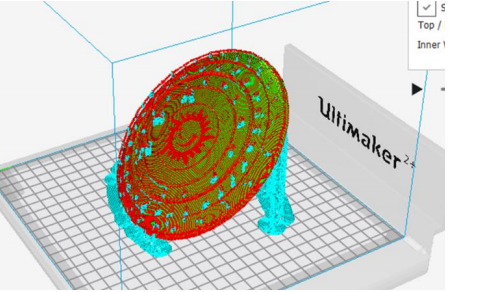
Model of the Shield of Achilles made by students in Layer view
The “Shield of Achilles” program is meant to offer the following:
- Create a ‘community of practice’ between the STEM and classical learning disciplines
- Implement integrated models
- Monitor acquisition of skills, student participation and performance, and enthusiasm level of students
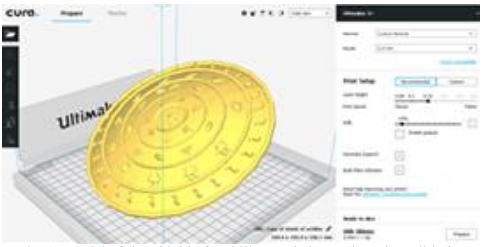
For the Informatics class, the students were able to work on an Ultimaker 2+ 3D printer that had been donated to the school two years previously. Students also learned how to use both Tinkercad and Cura as they fabricated their own Achilles’ shield, encouraged to ‘freely express themselves and produce their own creation’ in 3D.
Upon completing a questionnaire at the end, students and teachers expressing having fun, although students would have liked ‘subjects to be taught in an interdisciplinary way together with IT and the support of 3D printing and designing technologies.’ They did, however, enjoy the cross-teaching approach integrating 3D design and printing. Students also expressed having a ‘positive view’ about Ancient Greece.
“Since the implementation of the program, it has been shown that students’ interest in both IT subject and the cognitive subject of Ancient Greek, was highly increased. In particular, enhancing interest was much greater for weak students in both Homer’s Iliad and IT,” concluded the authors.
“The use of three-dimensional technologies can make cognitive subjects more attractive to students, enhance the quality of teaching subjects, increase students’ interest in them and acquire skills [13] such as: problem solving, digital skills, teamwork, communication with my classmates, learn how to learn on my own, etc., skills that are necessary to improve the personality and education of the students.”
3D printing within educational systems around the world is playing a large role in how students shape their perception of STEM learning, and consequent careers in related fields. Teachers and students are often able to learn together regarding new technology, and classrooms are producing everything from prosthetics for animals to robotics, and far more.
[Source / Images: ‘The Shield of Achilles using 3D Technologies to Support Teaching Scenarios of Homeric Epics’]
Subscribe to Our Email Newsletter
Stay up-to-date on all the latest news from the 3D printing industry and receive information and offers from third party vendors.
Print Services
Upload your 3D Models and get them printed quickly and efficiently.












You May Also Like
NodeZERO: SPEE3D Plans 50-Site Metal AM Network Across Asia-Pacific Region
Earlier this year I wrote about SPEE3D‘s expeditionary manufacturing case study, in which it collaborated with the Tennessee Army National Guard. My take was that this was a perfect example...
Bringing LAIKA’s Stop-Motion Animation Characters to Life with Full-Color 3D Printing
It is a labor of intense love and hard work to make a stop-motion animation film. They are created frame by frame, with the objects and characters in the frame...
3D Printing News Briefs, November 7, 2026: Repair, Acquisition, 3D Models, AI, & More
We’re starting off this weekend’s 3D Printing News Briefs with military news, then on to business and compliance. We’ll end with a 3D model partnership. Read on for all the...
Mosquito Dreams Part 4: Airbus Finally Makes Sense
An iconic cafe chair helped usher in an era of composite manufacturing and bent wood. The resulting Mosquito bomber, fighter, multirole everything, was an enormous success. This led to waffling...