Researchers 3D Printing for Contaminant Removal with 3D Printed Zeolite Monoliths

International researchers explore methods for removing contaminants in their recently published ‘Nuclear wastewater decontamination by 3D-Printed hierarchical zeolite monoliths.’ Focusing on the radioactive cationic species, 137Cs+ and 90Sr2+, this study brings greater exposure to the need for selective removal of radionuclides.
Harkening back to the disasters that occurred at Chernobyl in 1986 and the Fukushima Daiichi plant in 2011, the research team reminds us of the intense need to handle nuclear waste properly. The two radionuclides, 137Cs and 90Sr, are the ‘most likely to contaminate water bodies’ – with 137Cs being a large part of the Fukushima cleanup; however, aluminosilicate zeolites play a huge part in treatment—and removal of contaminants.
“Nuclear waste treatment can be demanding, in some cases the radionuclides must be removed from highly radioactive solutions that are also extremely acidic or caustic, where natural zeolites suffer due to their nature as aluminosilicates,” explain the authors. “Various synthetic materials such as titano-, zircono-silicates or metal oxides have been developed and proved more useful in these cases.”
Stating that they have created a ‘breakthrough solution,’ the authors present a method for 3D printing ion exchanger monoliths. Pointing out that the technology has been used in numerous applications to fabricate nanotubes, nanoparticles, and a variety of piezoelectric products, 3D printing is also used in dry applications regarding gas absorption, separation, and more.
“To date, no 3D-printed zeolite monoliths have been produced specifically for ion exchange of aqueous media where they would need to be both insoluble and stable with regards shape retention over time when exposed to water,” stated the researchers.
Digital light processing (DLP) was used in this work, allowing for the required customization and control over issues like porosity. The research team mixed photopolymerizable monomers with zeolite powder, taking advantage of the ability to modify the binder’s properties in terms of:
- Stretchability
- Temperature responsivity
- Hydrophobicity
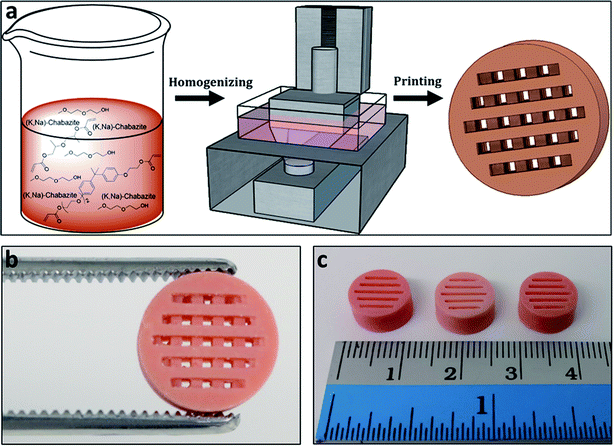
(a) Schematic overview of the printing process; first dispersion of the zeolite was formed within the polymerizable monomers and porogenic solvent, then the formulation was 3D printed by the DLP method. (b and c) The printed zeolite-embedded monolithic structures.
Two cylindrical zeolite samples were printed, in the form of synthetic chabazite and commercial zeolite 4A. It was critical for the 3D printed zeolite to allow the solution to flow through the column, with the polymeric matrix providing access for the cations.
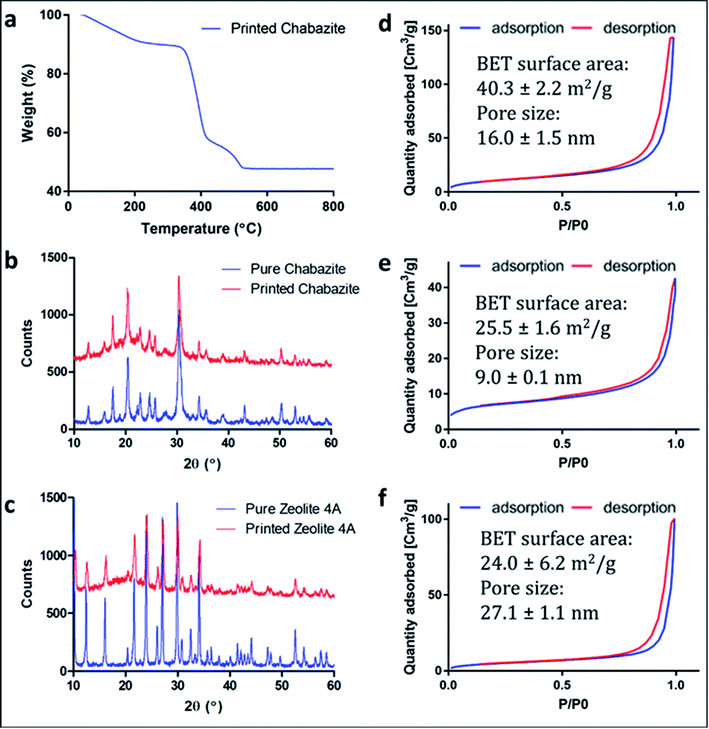
(a) TGA curve of 3D-CHA. (b and c) Comparison between the PXRD of zeolite powders and the zeolite embedded printed structures (b) 3D-CHA and pure chabazite powder; (c) 3D-4A and pure zeolite 4A powder. The patterns of the printed systems have been offset for clarity. (d–f) N2 adsorption isotherms of (d) 3D-CHA; (e) the pure chabazite powder; (f) the printed polymer.
With the ultimate goal being the ability to remove Cs or Sr, the team tested the samples for ion exchange (using SEM-EDX, Infinite Focus Microscopy (IFM), XRD and X-ray Fluorescence (XRF) spectroscopy).
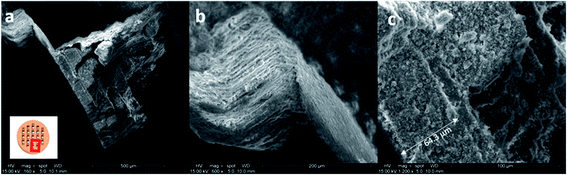
SEM images of Cs-exchanged 3D-printed monolith (a) an overview (b) side view (c) top view of the rod taken from the grid.
Overall, the monoliths exhibited ‘good mechanical stability, and the researchers confirmed that DLP 3D printing offered the required control necessary—also allowing them to create the proper degree of porosity and good internal matrix structure.
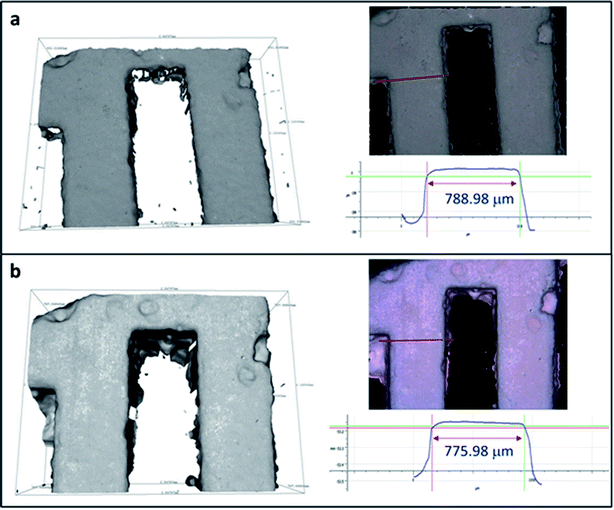
IFM images of 3D-printed monolith (a) before and (b) after Cs ion exchange and their profile measurements.
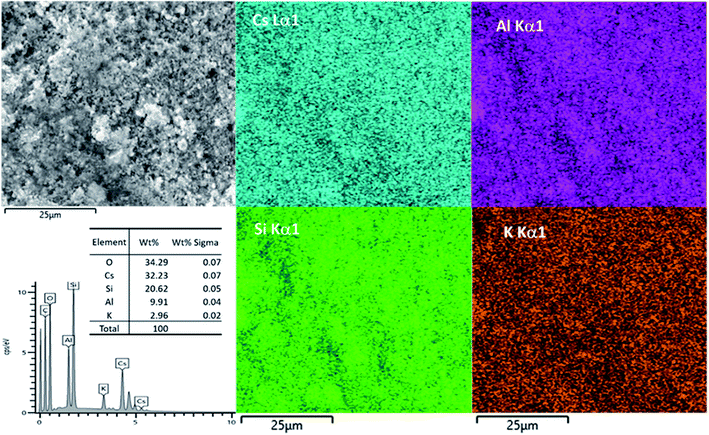
SEM image, EDX results and elemental mapping of Cs-exchanged 3D-CHA.
“In the case of nuclear waste treatment, in addition to the above-mentioned advantages, the printed columns enable simple and safe handling of the contaminated ion exchanger and may significantly reduce the risks and difficulties that rise when dealing with radioactive contaminated powders,” concluded the researchers. “We have not tested the radiological stability of the polymer matrix, but as the radioactive cations are trapped within the inorganic zeolite particles, we would not expect any release of these into the environment even with polymer degradation.
“The polymer should also not significantly interfere with the thermal conversion of the spent exchangers into ceramic or vitreous wasteforms as it would be readily oxidized during the process without release of any radionuclides.”
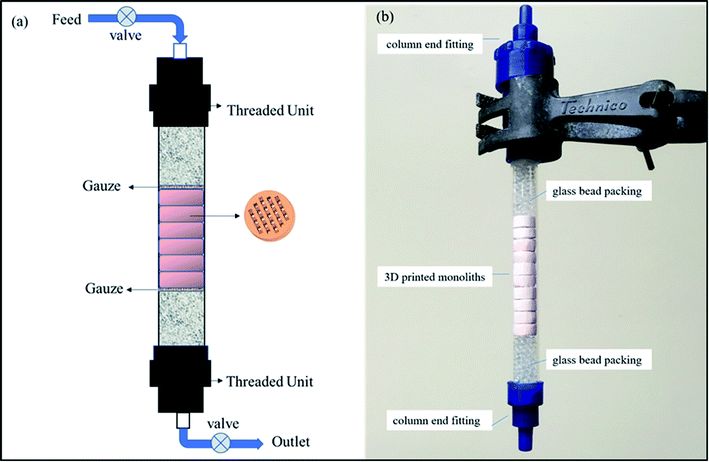
(a) Schematic diagram of an ion exchange column, (b) photograph of a packed column.
What do you think of this news? Let us know your thoughts; join the discussion of this and other 3D printing topics at 3DPrintBoard.com.
[Source / Images: ‘Nuclear wastewater decontamination by 3D-Printed hierarchical zeolite monoliths’]Subscribe to Our Email Newsletter
Stay up-to-date on all the latest news from the 3D printing industry and receive information and offers from third party vendors.
Print Services
Upload your 3D Models and get them printed quickly and efficiently.











You May Also Like
The Hospital Factory: Mayo Clinic’s In-House 3D Printing for the OR
“At Mayo Clinic, 3D printing isn’t a side project, it’s a patient-specific service that runs on hospital time, helping surgeons plan and act with confidence,” says Dr. Jonathan Morris, a...
3MF Becomes ISO Standard
The 3MF file format has become an ISO Standard, becoming part of ISO/IEC 25422:2025. The file format is still open source, and it is hoped that this move will build...
Children’s Nebraska Joins Insight Surgery to Bring 3D Printing to the OR
Children’s Nebraska is teaming up with UK-based Insight Surgery to bring personalized surgical planning and device manufacturing in-house. This move could reshape how the hospital prepares for complex procedures. By...
ASTM International Launching New Manufacturer Certification Program for 3D Printing Industry
Eight years ago, standards organization ASTM International announced that it was looking for partners to help set up a center of excellence (CoE) in the additive manufacturing field. The resulting Additive Manufacturing...