Velo3D’s $32.6M Defense Contract Highlights Why U.S.-Made 3D Printing Is Suddenly Critical


When the U.S. government talks about supply chain security, it’s no longer theoretical. It’s now written directly into law and into defense contracts.
That detail matters for Velo3D, which this week announced a $32.6 million contract with the U.S. Department of Defense‘s (DoD) innovation arm to help replace slow, traditionally manufactured metal parts with qualified 3D printed alternatives for a critical weapons program.
The deal comes just days after the U.S. government formally banned the DoD from using or procuring 3D printers made in, or digitally connected to, China, Russia, Iran, or North Korea under the newly signed National Defense Authorization Act (NDAA) for Fiscal Year 2026.
Together, these two developments show that where defense 3D printers are made now matters as much as what they can do.
A Manufacturing Bottleneck the Pentagon Wants Gone
Velo3D’s contract was awarded through the Defense Innovation Unit (DIU), which is part of the DoD, under a program called Project FORGE.
Certain defense platforms still rely on traditionally manufactured metal parts that are slow to produce and difficult to scale. These bottlenecks limit how fast the military can increase production when demand goes up.
Under the agreement, Velo3D will work with the DIU, the U.S. Navy, and a major defense prime contractor to prototype and qualify additively manufactured metal parts that can replace parts which are slow and difficult to produce.
If successful, the approach could allow the DoD to scale production faster, with fewer supply chain risks.
“We are excited for the collaboration between DIU and industry partners like Velo3D to develop and qualify the AM solution needed to resolve a critical production backlog,” said DIU Program Manager Derek McBride. “The combination of DIU’s expertise in rapidly responding to some of the DoD’s most difficult challenges and Velo3D’s capabilities as an advanced additive manufacturer is the type of close collaboration we need with our Defense Industrial Base to support the warfighter.”
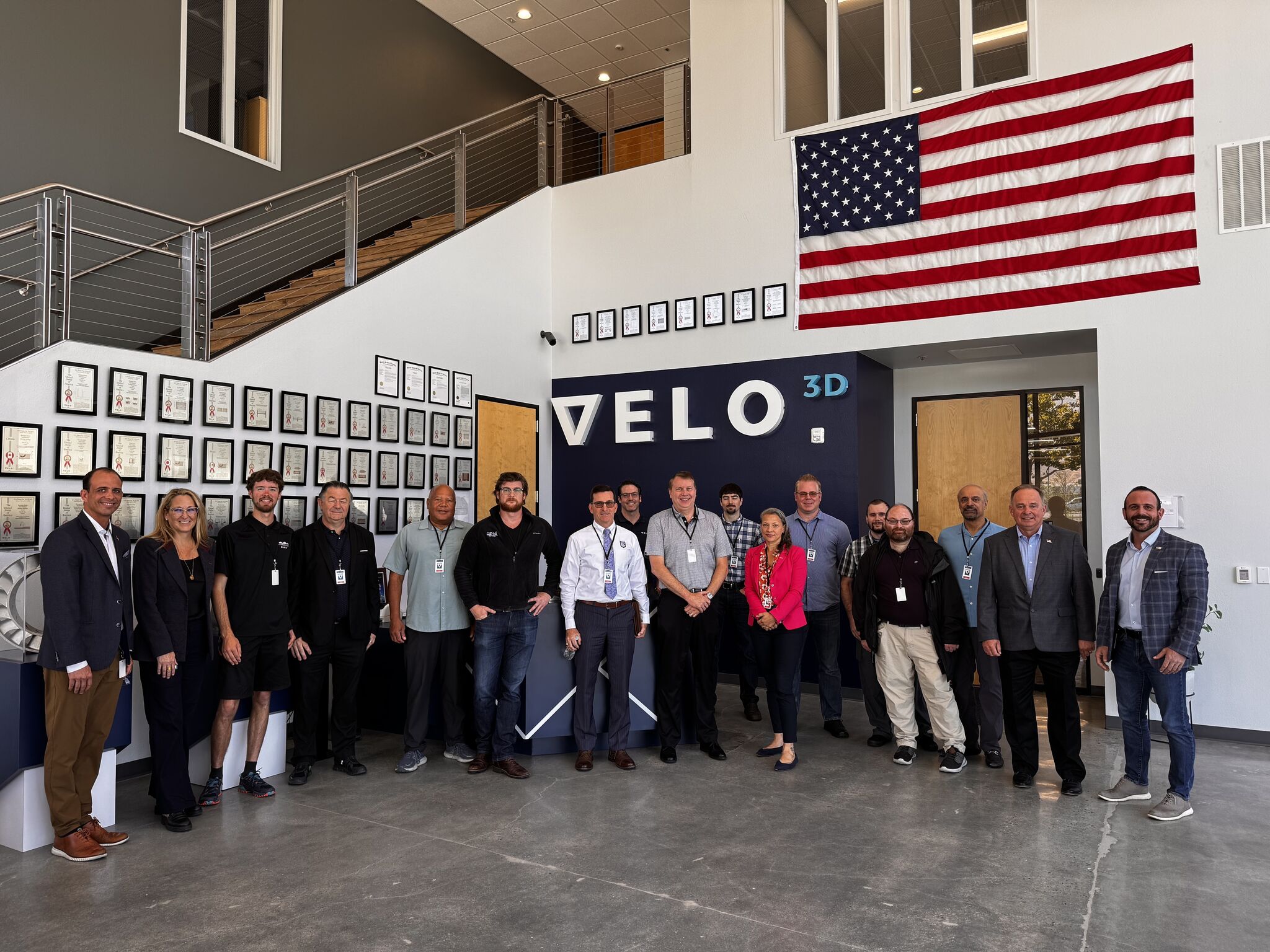
Velo3D’s AM facility in Fremont, California. Image courtesy of Velo3D via LinkedIn.
Why “Made in the USA” Suddenly Became Non-Negotiable
Just three days before Velo3D’s announcement, President Trump signed the FY2026 NDAA into law. For the first time, additive manufacturing is treated as critical defense infrastructure.
Under the new rules, the DoD and its suppliers are prohibited from operating or buying 3D printers that are manufactured in, have software developed in, or are networked through China, Russia, Iran, or North Korea, unless a rare national-interest waiver is granted. The law also blocks the renewal of existing contracts tied to those systems.
This means defense contractors must now carefully scrutinize not only where their machines are built, but also where the software originates and where data flows.
The result is fewer supplier options and a stronger focus on U.S.-based additive manufacturing.
Why Velo3D Qualifies Under the New Rules
Velo3D already meets the NDAA’s new restrictions. The company explained that it is the only U.S.-based industrial-scale OEM with domestically developed laser powder bed fusion technology. Its Sapphire metal 3D printers are assembled in the United States, meet DoD cybersecurity standards, and can connect securely to military networks. And that matters now more than ever.
“As the only U.S.-based industrial-scale OEM with domestically developed Laser Powder-Bed Fusion technology, Velo3D is absolutely honored for the opportunity to collaborate with the DoW, DIU, and the Navy to ultimately deliver a solution that supports the warfighter,” said CEO Dr. Arun Jeldi. “Through our Rapid Production Solution, we are providing faster part delivery, enhanced reliability, and the surge capacity needed to meet evolving defense demands.”
The contract also includes an option to explore the largest-format LPBF capability in the U.S., potentially expanding domestic production without relying on foreign systems.
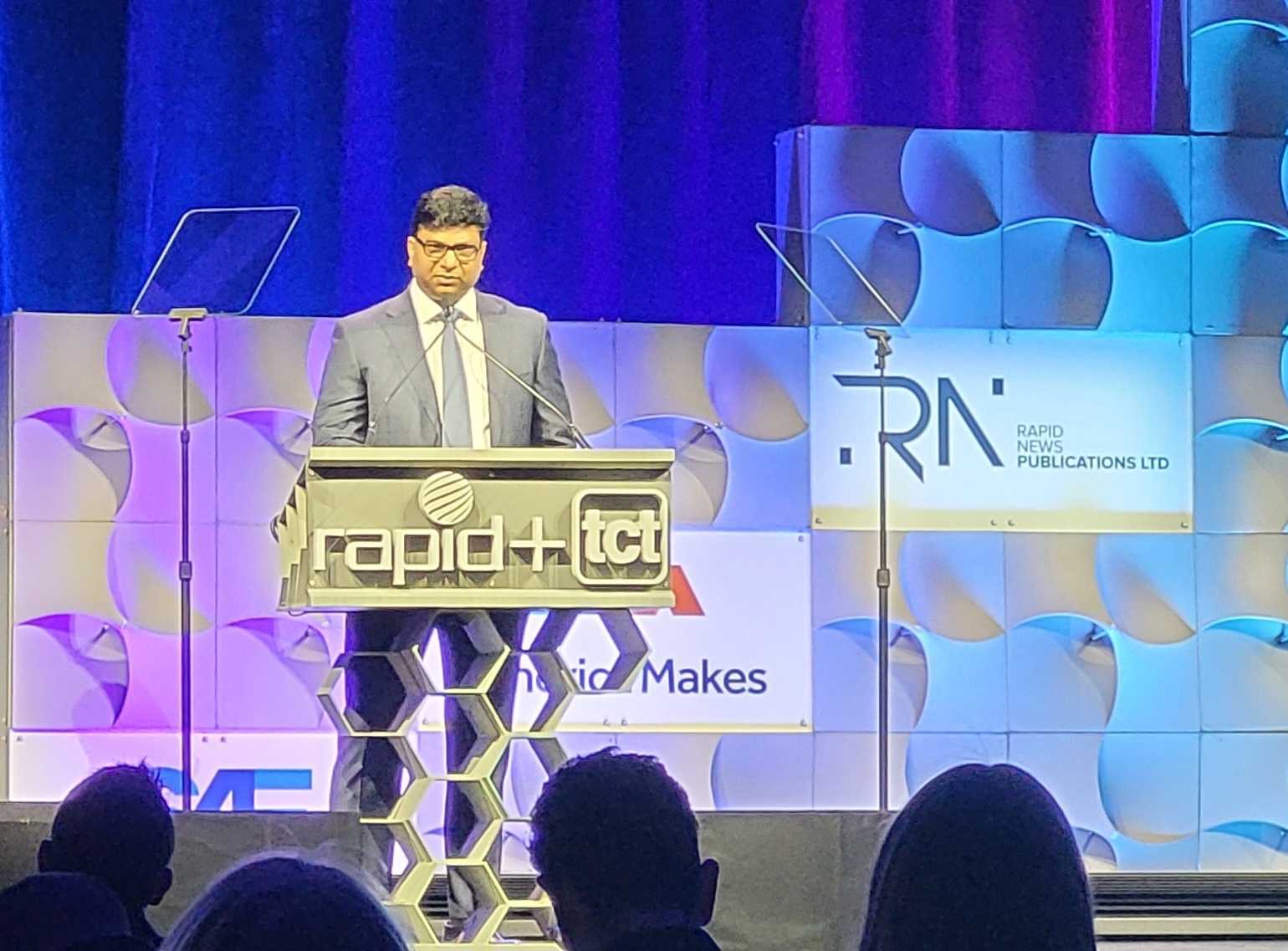
Velo3D’s Arun Jeldi at Rapid+TCT. Image courtesy of Velo3D.
The NDAA doesn’t just restrict foreign-made machines; it also pushes the DoD to dramatically expand its use of additive manufacturing.
The law calls for qualifying up to one million additively manufactured parts by 2027, including components for drones, logistics systems, and ground combat vehicles. It also prioritizes replacing parts affected by long lead times and shrinking supplier bases.
That combination of more additive manufacturing and fewer foreign suppliers creates a powerful incentive to build more capability at home. In fact, Velo3D’s contract proves that this shift is already taking shape, ensuring that the U.S. military can produce critical hardware quickly, securely, and without dependence on adversaries.
Subscribe to Our Email Newsletter
Stay up-to-date on all the latest news from the 3D printing industry and receive information and offers from third party vendors.
Print Services
Upload your 3D Models and get them printed quickly and efficiently.













You May Also Like
Apple’s 3D Printed Hinge Cover & the Inauguration of the Ternus Era
Marc Andreessen notwithstanding, it turns out that hardware is, in fact, eating the world. Perhaps after being starved for so long, the hardware side of tech innovation is now overcompensating,...
The Exploration Company Raises $450M to Rival SpaceX
The space industry is currently worth about $650 billion globally, growing nearly 50 percent since 2020, which is certainly impressive. But over the next decade, the total market opportunity in...
3D Printing News Briefs, September 10, 2026: Tax Credits, Polymer Research, Microneedles, & More
We’re starting off this week’s 3D Printing News Briefs with a little business from Axtra3D and Beehive Industries, before moving on to a scientific collaboration agreement between Roboze and a...
The Formlabs Shuffle
For the latest development on 8/31/26, please see an update at the end of this article. Formlabs is doing a management shuffle, pointing the firm even more surely towards an...