3D Printing to Study Behavior of 3D Miura-Ori Column Structures

In the recently published ‘Study on the compressive behavior of Miura origami column structure,’ authors I.G.R. Permana, M. Rismalia, S.C. Hidajat, A.B. Nadiyanto, and F. Triawan explored the mechanical properties of Miura-origami patterns. Because their versatility—mainly in foldability—is a source of continued fascination, the researchers chose to study the mechanical behavior when 3D printed.
An ancient Japanese art that is both a source of fascination and reverence around the world, origami is becoming increasingly more popular in engineering applications due to its potential for design in aerospace, energy (such as solar panels), robotics, and more. Some research has also reviewed its potential for energy absorption devices like automotive crash boxes. And while there is little prior knowledge of how Miura-Ori structures function under compressive load, this study investigates the mechanical properties of column structures.
“The Miura-Ori pattern is constructed with four repeating parallelograms panels which are arranged along the alternating mountain and valley folds as shown in figure 1. The size of each parallelogram for all specimens were kept constant where b = 11 mm and c = 8.66 mm. In this study, the Miura origami column was designed with three folding angle variation (θ = 70o , 90o , 110o ) and two thickness variation (t = 1 mm and 2 mm).”
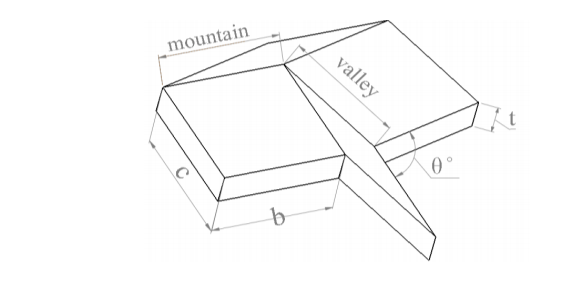
The unit cell of Miura-Ori pattern.
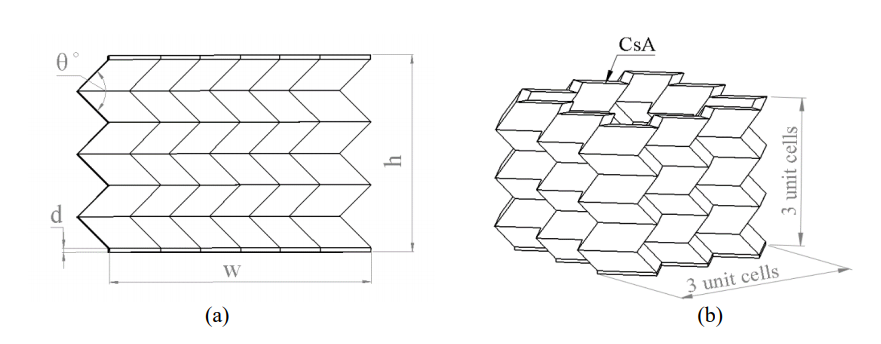
Front (a) and isometric (b) view of Miura-Ori column structure.
3D printing samples for the research study with PLA, the authors examined variations with both angles in folding and wall thickness of prints. After that, they looked at the energy absorption capacity also. Specimens were comprised of three layers, with compression testing performed and data recorded afterward regarding load and displacement curve.
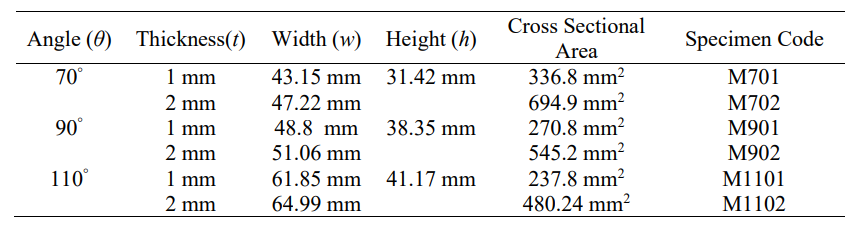
Specimen dimension.
The researchers discovered that they were able to make the structure stronger by increasing the folding angle of the pattern, realizing that while a low peak force was necessary for the best energy absorption, a high mean crushing force was also required.
“However, due to its geometric constraint, the result showed that the wider folding angle could reduce the energy absorption capacity of the structure,” concluded the researchers. “Finally, the structure with 2 mm wall thickness exhibits higher yield stress, compressive modulus, and energy absorption capacity compared to the 1 mm structure. As a future work, the development of finite element model (FEM) to understand comprehensively the behavior of Miura-Ori column structure will be done.”
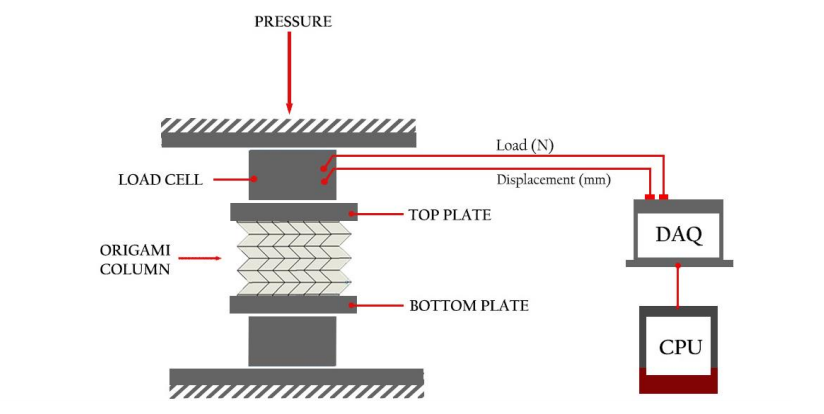
Schematic diagram of the compression test.
You might be surprised to find out how often the Japanese inspiration of folding structures and patterns like origami and 3D printing cross paths, from fabrication of metamaterials resulting in a tunable Miura-ori tribe, to expandable structures for engineering applications to mechanisms for creating robots. What do you think of this news? Let us know your thoughts! Join the discussion of this and other 3D printing topics at 3DPrintBoard.com.
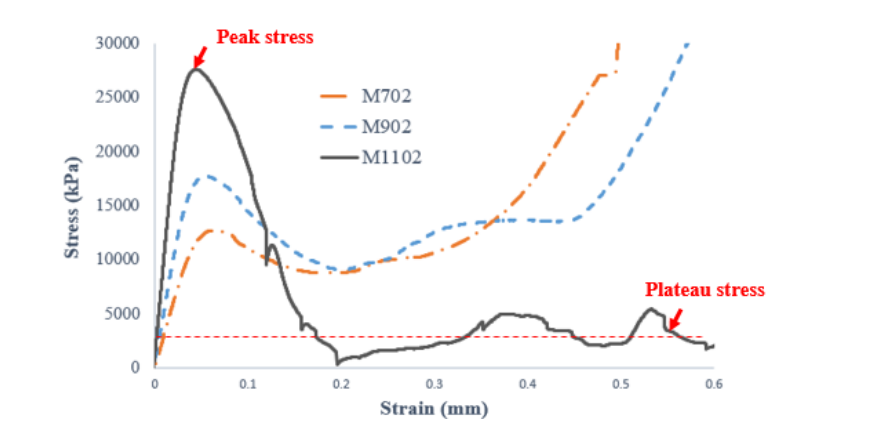
Stress-strain curves of Miura-Ori column with 2 mm thickness
Subscribe to Our Email Newsletter
Stay up-to-date on all the latest news from the 3D printing industry and receive information and offers from third party vendors.
Print Services
Upload your 3D Models and get them printed quickly and efficiently.











You May Also Like
Killer 3D Printing Applications: Car Seating
Bicycle seats are a 3D printing success story. Often made using Carbon’s technology, high-end road bike saddles are now on offer from most premium bike saddle brands. Retailing for over...
3D Printing News Briefs, November 22, 2025: Rebranding, Integration, Electronic Eyes, & More
We’ll start with a new software tool from AON3D in today’s 3D Printing News Briefs, and then we’ve got a lot of business, from Conflux Technology and Prima Additive to...
Formnext 2025: New Metal PBF 3D Printer, Serial Production Applications, & More
It’s Day 2 of Formnext 2025, where over 800 exhibitors from around the world have converged in Frankfurt for Europe’s premier additive manufacturing (AM) trade show. From exciting new printers...
Filtration System, AI-Driven Software, Photogrammetry, & More at Formnext 2025
Europe’s premier AM industry trade show, Formnext, began today in Frankfurt, Germany. From 3D printers to post-processing and more, we’re here to make sure you don’t miss a single announcement from...