Using a Combined 3D Printing Method to Create Stretchable Electronics

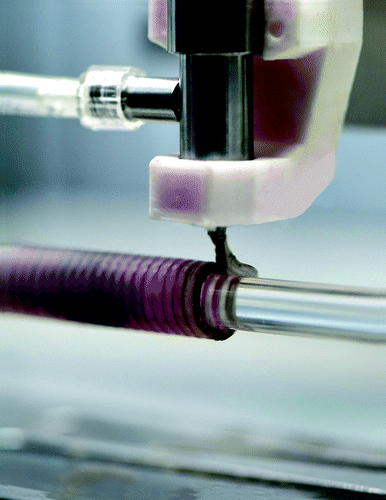 Stretchable electronics have a lot of potential for applications in wearable devices, soft robotics, artificial skin and more. To create stretchable electronics, 3D printing is a fast, accurate technology that can built circuits and structures from liquid metal. Recently, researchers have been interested in stretchable electronics based on Ga-based liquid metals (GLMs), which are nontoxic liquids with low viscosity. Due to their high surface tension, however, GLMs are difficult to directly print. In a paper entitled “Three-Dimensional Coprinting of Liquid Metals for Directly Fabricating Stretchable Electronics,” a group of researchers develops a coprinting method in which GLMs are printed together with elastic materials to overcome their poor printability.
The researchers used a coaxial nozzle for the process; the outer nozzle was used to extrude a flexible silicone material, while the inner nozzle extruded the liquid metal.
“The principle of this method is that the continuous contact and extrusion of the external highly viscous cure sealant with its internal liquid metal inhibits the balling of liquid metal, ensuring the continuous outflow of liquid metal and achieving the liquid metal 3D printing successfully,” the researchers explain. “At the same time, the flexible silicone material also plays an important role in isolating the air, preventing degradation of the liquid metal properties and being a flexible encapsulating material for flexible circuits. Appropriate process parameters are selected to ensure a successful printing process. Compared with other methods, this method can be used to quickly print desired structures with a programmed path.”
The core components of the system were a desktop 3D printer, the coaxial nozzle, and injection pumps.

“To fabricate the stretchable electronics, we performed the following steps,” the researchers continue. “First, the injection pumps extruded out GLMs into the inner blunt syringe needle of the nozzle at a suitable flow rate Q1 (above 0.25–0.75 mL/s) and extruded cure sealant into the outer cavity of the nozzle at a flow rate Q2 (above 2–4 μL/min) to make the coaxial fiber. Then, the G-code was input into the computer to control the XY stages of the desktop 3D printer to print the desired electronic circuit. What is more, the motorized Z stage can work with the XY stages to stack the planar electronic circuit into 3D structure. In addition, the motorized Z stage can be used to install other auxiliary devices for the construction of special 3D structures.”
The researchers used their technique to 3D print a spiral coil inductor. They then pasted both ends of the inductor onto the end effector of an endoscope to measure the spatial motion of the endoscope. When the handle was turned, the inductance of the sensor changed regularly. In addition, the inductive response of the sensor was highly sensitive, showing that the sensor has a good dynamic response and can be used to assess the idle stroke of endoscopic monitoring.
The problem with printing liquid metal is that it comes out as a ball rather than a stream; however, printing it so that it came in continuous contact with viscous elastic materials inhibited that balling. This allowed the researchers to 3D print stretchable electronic components that showed excellent performance when tested. According to the researchers, this is the first production of a new type of multifunctional stretchable inductance sensor.
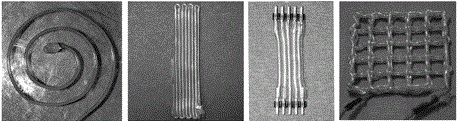
“Compared with resistance sensors and capacitive sensors, inductance sensors are more reliable and have lower technological requirements because the detection performance of an inductance sensor only depends on the geometric parameters and turn numbers of a spiral pipe and is not affected by conductivity changes of liquid metal,” the researchers state.
Authors of the paper include Yong He, Luyu Zhou, Junfu Zhan, Qing Gao, Jianzhong Fu, Chaoqi Xie, Haiming Zhao, and Yu Liu.
Discuss this and other 3D printing topics at 3DPrintBoard.com or share your thoughts below.
Subscribe to Our Email Newsletter
Stay up-to-date on all the latest news from the 3D printing industry and receive information and offers from third party vendors.
Print Services
Upload your 3D Models and get them printed quickly and efficiently.












You May Also Like
3D Printing News Briefs, November 29, 2025: Submarine Industrial Base, Running Shoe, & More
In this weekend’s 3D Printing News Briefs, we’ve got more news from Dyndrite, which has launched the NXG Slice Viewer for Nikon SLM Solutions. Farsoon Europe has news to share...
3D Printing News Briefs, November 27, 2025: Awards, Sand Binder Jetting, Tabletop Gaming, & More
To all those who celebrate, happy Thanksgiving! In today’s holiday 3D Printing News Briefs, we’re starting off with some exciting news: the winners of this year’s Formnext Awards! Then, we’ll...
3DPOD 281: Freemelt CEO Daniel Gidlund on E-Beam PBF Metal AM
Daniel Gidlund leads Freemelt, a company that has been steadily establishing its place in metal AM with open-source thinking and a clear technical vision. In this episode, he walks us...
3D Printing News Briefs, November 22, 2025: Rebranding, Integration, Electronic Eyes, & More
We’ll start with a new software tool from AON3D in today’s 3D Printing News Briefs, and then we’ve got a lot of business, from Conflux Technology and Prima Additive to...