DNV GL Releases First Class Approval of Manufacturer Program For 3D Printing Manufacturers


For safety purposes, it’s important to follow rules, regulations, standards, and guidelines set down by various agencies when it comes to 3D printing. Just like 3D printed implants and pharmaceuticals in the US must be approved by the FDA, so too must the FAA approve 3D printed aircraft components, and so on and so forth.
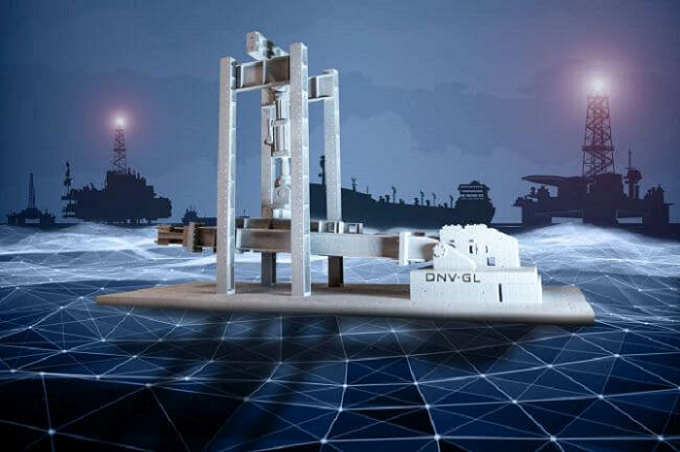
Since 2014, global quality assurance and risk management company DNV GL, a classification society headquartered in Norway, has been investigating the potential challenges and opportunities offered by 3D printing. The company provides classification, technical assurance, software, and independent expert advisory services to the renewables, power, maritime, and oil and gas industries, and is part of multiple consortiums that are using 3D printing.
 Last year, DNV GL published the first classification guideline for the use of additive manufacturing in the maritime and oil and gas industries, just days after it signed an agreement with Aurora Labs to certify metal 3D printed parts. This winter, the company opened the Global Additive Manufacturing Centre of Excellence in Singapore, which is an incubator and test bed for 3D printing research and development in the oil and gas, offshore and marine (O&M) sector.
As the World Economic Forum estimated that 3D printing could save oil and gas companies $30 billion in cost and time. Because adoption of the technology is still relatively slow in this field, DNV GL has big plans for its new 3D printing center. But at the moment, the classification society is working on another important AM project.
“AM is a technology that holds a great deal of promise for the maritime industry. Our responsibility as the world’s leading classification society is to give manufacturers a clear path they can take to offer their innovative products, while ensuring that our customers can have the same confidence in an AM product as they do in any other that has undergone approval by class,” said Knut Ørbeck-Nilssen, the CEO of DNV GL – Maritime.
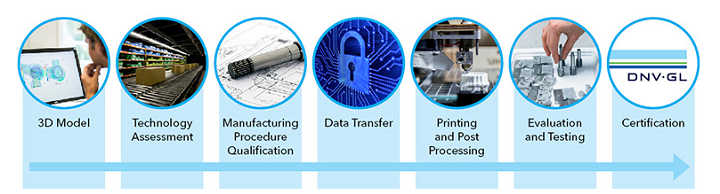
DNV GL has just released the first class approval of manufacturer (AoM) program designed for 3D printing manufacturers that want, and need, to produce products that will comply with all of its AM standards and rules.
Ørbeck-Nilssen explained, “The release of the AoM programme opens up new opportunities for both producers and users of these products, creating potential efficiencies in logistics and supplies chains, as well as in on-board maintenance and repair. Above all, however, we must ensure that safety and quality standards are upheld, and this new programme allows producers to demonstrate their fitness to the shipping industry.”
In order to apply for DNV GL’s new AoM program, manufacturers will first need to demonstrate the feasibility of their products and technology by undertaking a proof of concept. Their ability to consistently produce products and materials to given specifications, as well as ones that are in accordance with the rule requirements set down by DNV GL, will be verified by the company’s new AoM program.
What do you think? Discuss this news, and other 3D printing topics, at 3DPrintBoard.com or share your thoughts in the Facebook comments below.
Subscribe to Our Email Newsletter
Stay up-to-date on all the latest news from the 3D printing industry and receive information and offers from third party vendors.
Print Services
Upload your 3D Models and get them printed quickly and efficiently.













You May Also Like
Apple’s 3D Printed Hinge Cover & the Inauguration of the Ternus Era
Marc Andreessen notwithstanding, it turns out that hardware is, in fact, eating the world. Perhaps after being starved for so long, the hardware side of tech innovation is now overcompensating,...
The Exploration Company Raises $450M to Rival SpaceX
The space industry is currently worth about $650 billion globally, growing nearly 50 percent since 2020, which is certainly impressive. But over the next decade, the total market opportunity in...
3D Printing News Briefs, September 10, 2026: Tax Credits, Polymer Research, Microneedles, & More
We’re starting off this week’s 3D Printing News Briefs with a little business from Axtra3D and Beehive Industries, before moving on to a scientific collaboration agreement between Roboze and a...
The Formlabs Shuffle
For the latest development on 8/31/26, please see an update at the end of this article. Formlabs is doing a management shuffle, pointing the firm even more surely towards an...