
China Develops New Metal 3D Printing Technology, Combining Old and New Manufacturing Techniques

 There have been a lot of interesting developments in additive manufacturing coming out of China recently – in the areas of architecture, in space travel, in medicine, and even in environmental protection. The Chinese 3D printing industry is growing fast after a long period of stagnation. As we all know, one of the biggest keys to continued growth in the 3D printing market is the continued development of metal 3D printing, and it looks as though China is right on top of that area as well. At the end of last week, researchers from Huazhong University of Science and Technology announced that they have developed a new method of metal 3D printing – one that could eliminate several of the issues that still plague much of the technology.
Zhang Haiou, leader of the 3D printing technology research team at the university, has been developing the method for over a decade along with his fellow researchers. Dubbed “intelligent micro casting and forging,” the technique combines aspects of traditional metal casting and forging technology along with 3D printing to create stronger, more ductile and stable parts. According to Zhang, the method eliminates common problems such as porosity, cracking, and the crumbling or dropping of fused materials due to gravity or rapid heating and cooling.
“In the past, conventional 3D printing has been fatally flawed in the following areas. First, without forging, metal parts have a serious chance of wearing. Second, the performance of 3D printed parts has not been high. A third problem is the presence of pores and unfused portions and the fourth is that using a laser or electron beam as a heat source is very costly,” he said.
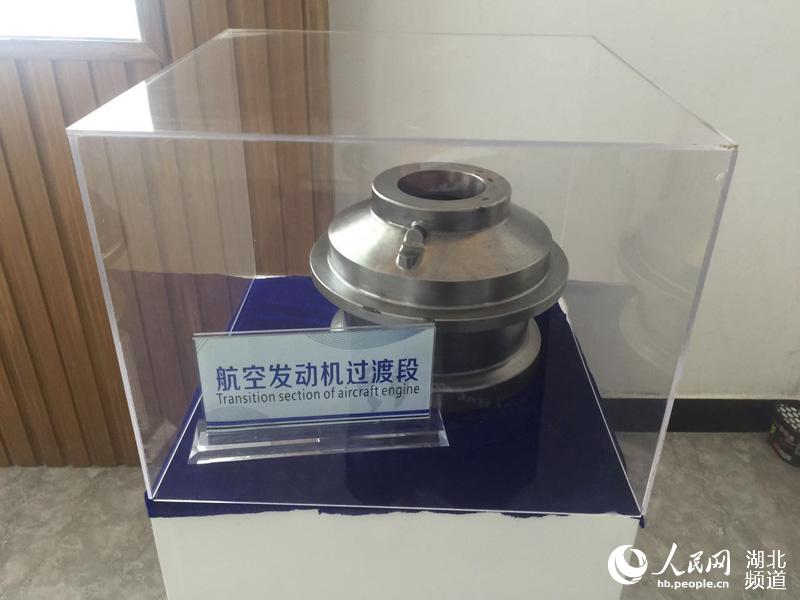 The printer, called the Micro Forging & Casting Sync Composite Device, is already being used to make parts – namely, titanium joints – for China’s stealth jet fighter planes. The research team expects that the technology, which can also be used to make thin-walled parts without excess material, will have a big impact on the aerospace industry, as well as the automotive, medical and general manufacturing sectors. It should deliver a significant boost to the Made in China 2025 initiative, which aims to update and overhaul the country’s manufacturing industry with a focus on advanced and green technology.
According to the team, intelligent micro casting and forging uses metal wire that is 90 percent cheaper than the powders used in most metal 3D printing techniques. It’s also 80 percent more efficient than SLM printing, and can create parts up to 5.5 x 4.2 x 1.5 m, with a surface roughness of 0.02 mm.
While several hybrid technologies have been developing recently, combining 3D printers with CNC machines and other methods of production, this appears to be the first time 3D printing has been merged with forging and casting. Parts created with the intelligent micro casting and forging technology will be more reliable and longer-lasting, the team says, and they’ve already been awarded multiple patents, both in China and internationally. We’ll certainly be keeping an eye on this new technology as more information becomes available. Discuss this new technology further in the Micro Forging & Casting Sync Composite Device forum over at 3DPB.com.
[Source/Image: People’s Daily – Hubei Channel]
Subscribe to Our Email Newsletter
Stay up-to-date on all the latest news from the 3D printing industry and receive information and offers from third party vendors.
Print Services
Upload your 3D Models and get them printed quickly and efficiently.













You May Also Like
AI Design and Point-of-Care Integration Headline ADDITIV Medical 2026
Medical additive manufacturing is expanding rapidly inside major healthcare institutions. In 2026 alone, hospital systems including Indiana University Health and Sheffield Teaching Hospitals launched dedicated point-of-care 3D printing facilities to...
GKN Aerospace’s UAV Demonstrator with 3D Printed Engine Avoids ITAR Regulations
The US CIA director recently made an unannounced visit to Moscow that has naturally raised much speculation, while the EU and NATO have now officially accused Russia of being behind...
The Business Case for 3D Printed Stents
A new 3D printed stent developed at New York University (NYU) does not look like the devices doctors typically use today. Instead of a simple tube, the prototype resembles a...
3D Printing Financials: 3D Systems, Prodways, and Align Build on Positive Momentum
The latest earnings from 3D Systems (NYSE: DDD), Prodways (EPA: ALPWG), and Align Technology (Nasdaq: ALGN) show that the 3D printing market continues to move forward. Some businesses are growing...

























































