Pollen Introduces Pam, Their New Professional-Grade Multi-Material 3D Printer


 As many of us in the 3D printing industry can attest to, one of the most daunting obstacles to overcome in order to continue expanding and progressing additive manufacturing is the ability to efficiently print with multiple materials. A number of industry leaders have already began chiseling away at this issue, as companies like Stratasys and Airwolf 3D have recently released their own printers with multi-material 3D printing capabilities. Now, after five long years of tireless R&D work, a relatively unknown company based in France, called Pollen, is looking to make their mark on the multi-material 3D printing circuit.
The new delta 3D printer released by Pollen, which is named Pam, isn’t quite engineered for the consumer market. Instead, the fresh-faced 3D printing company is targeting their ‘luxury’ 3D printer towards the professional crowd, aimed at businesses looking to produce functional products in a multitude of materials. Pam is capable of printing with up to four different materials during a single process, mixing two materials together on the go, and is also compatible with a wide range of materials, including natural fibers, carbon, minerals or metal particles.
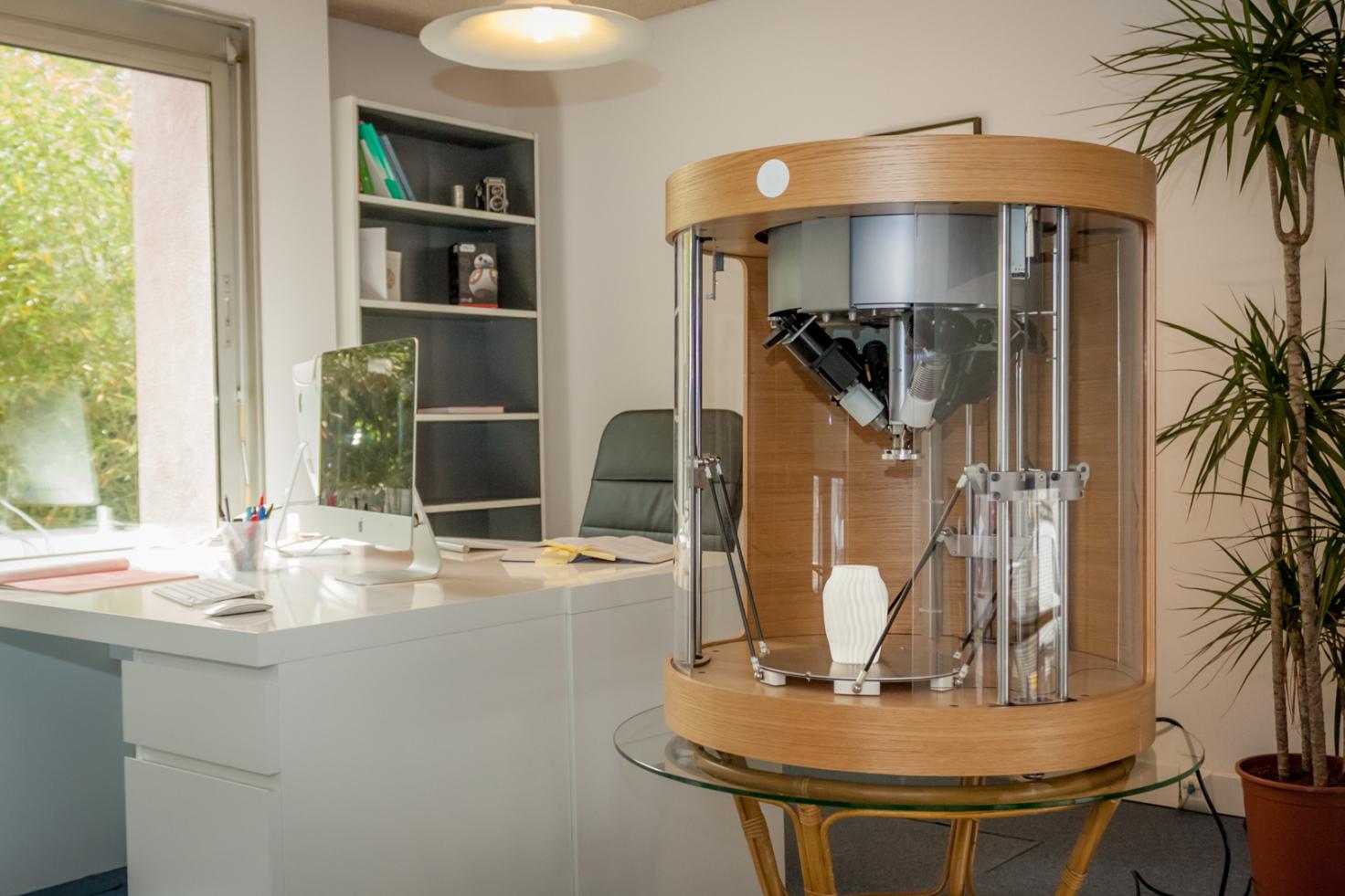
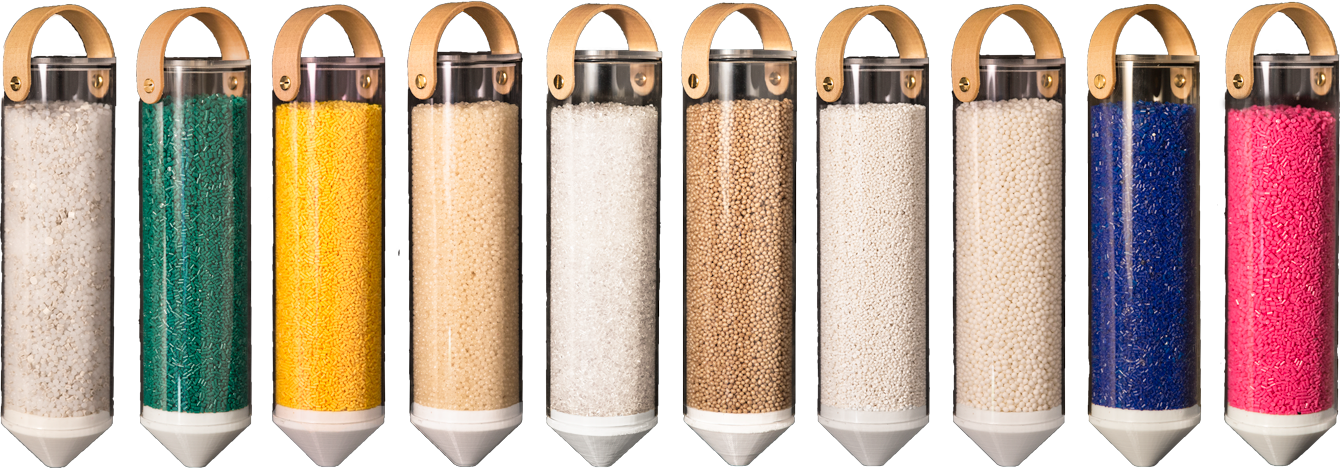
The 3D printer is loaded with bottles filled with pellets of raw materials that include thermoplastics, silicones, composites, and other types, all of which are engineered with industrial-grade quality. The max temperature the printer can reach is 350°C, making it compatible with a number of materials with flexible, strengthened, elastic, transparent, and colorful properties.
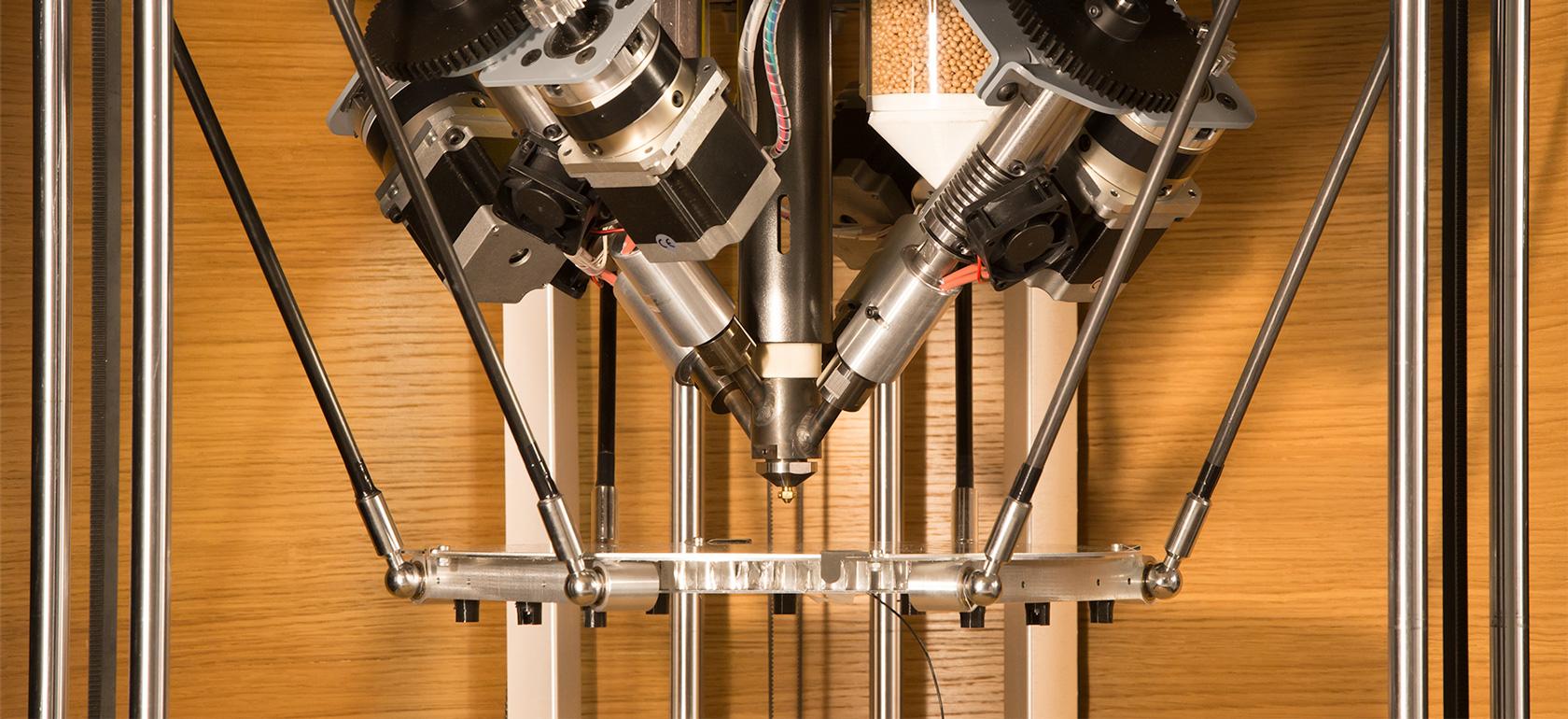
 The printer is also able to mend these materials together in order to create a gradient of properties and colors. The printer will come equipped with four different nozzle sizes, a heated aluminum build plate, and their built-in, all-encompassing Honeyprint software.
According to Pollen, the Pam 3D printer is able to reach a high quality resolution of up to 40 μ, and has a relatively large print volume of 30 x 30 cm. Pam is also quite the speedster, printing with multiple materials at speeds of up to 400 mm/s. It’s also Wi-Fi and Ethernet enabled, allowing users to control the printer through their web browser. In addition, the printer’s software stack is engineered within the 3D printer, enabling users to print without the need of a computer. The printer is by no means built for the consumer market, rather, Pollen is taking aim at companies and entrepreneurs looking to take their 3D printing capabilities to the next level.
 At the moment, the pre-order price for Pam is starting at €8,000 (approximately $9,000 USD) without delivery or VAT included. Although it seems like quite the investment, Pam is in fact being marketed as a professional-grade 3D printer. Also, Pollen plans on doubling the price of the 3D printer to €16,000 come 2017, so it seems that their first batch of 3D printers could in fact be a bargain for eager businesses. According to Pollen, Pam will essentially be able to create products like sunglasses (including the lenses) and translucent lamps in one shot, and will especially be useful for complex and functional prototyping, fashion, and many other applications.
Included with the limited edition offer, customers will also learn how to master Pam with the Quick Start pack, which will teach users how to use Honeyprint, controlling and utilizing the many features of Pam, and ensuring optimal maintenance of the printer as well. Pollen plans to start shipping out their unique delta-styled 3D printer in April 2017, giving them an adequate amount of time to build more hype for what could soon be a major game-changer in the professional 3D printing market. Discuss further in the Pam 3D Printer forum over at 3DPB.com.
Subscribe to Our Email Newsletter
Stay up-to-date on all the latest news from the 3D printing industry and receive information and offers from third party vendors.
Print Services
Upload your 3D Models and get them printed quickly and efficiently.













You May Also Like
Mosquito Dreams Part 3: Kelly Johnson & The Starfighters
Chair manufacturer Thonet pioneered bending wood, mass production, and composites. Then a strange wooden airplane takes to the skies and, against all expectations, does well. It takes on many roles and...
Mosquito Dreams Part 1: Thonet, A World History
As a child, I lived in Kenya for a while. When we went to Mombasa, wafting breezes, crunchy white powder that sounds like snow underfoot, beaches bordered by many unseen...
At This 3D Printed Petting Zoo, the Mistakes Are Part of the Fun
Pip the Rabbit has a glowing belly and ears that wiggle when you press his paw. Inchy the Caterpillar crawls when you clap. Plate the Armadillo can curl himself into...
When Data Becomes the Differentiator: Qualified Material Data is Changing the Future of Structural Additive Manufacturing
For years, additive manufacturing has promised engineers greater design freedom. The challenge wasn’t printing the part—it was proving the part belonged on an aircraft. Designing a lightweight bracket or consolidating...