Hexcel Explores 3D Printing Through Strategic Investment in Oxford Performance Materials

 Oxford Performance Materials, a Connecticut-based additive manufacturing company, has established a strong presence in the biomedical, aerospace, and industrial sectors, and in recent years they’ve made a tremendous impact on spinal surgery with their 3D printed SpineFab implants, as well as their entire OsteoFab system. A leader in materials science and development, OPM has been working with advanced polymers since their founding in 2000, and started incorporating 3D printing into their manufacturing capabilities ten years ago.
While OPM has gotten a lot of attention for their orthopedic implants lately, it’s the aerospace industry that is at the center of a strategic investment from fellow Connecticut company Hexcel Corporation. The advanced composites manufacturer specializes in lightweight structural materials including carbon fiber, which OPM has used as a component in their OXFAB technology. OXFAB ESD parts have been used in a variety of aerospace and satellite programs, but the two companies hope to work together to further leverage the technology to advance additive manufacturing in the aerospace industry.
“Aerospace adoption of reinforced manufactured parts using Hexcel carbon fiber is becoming a viable and meaningful design solution due to its performance and processing advantages,” said Nick Stanage, Hexcel Chairman, CEO and President. “With the adoption of these lightweight, high-performing materials expected to accelerate, this is an ideal opportunity for our two companies to work together enabling faster product development and adoption for our customers.”
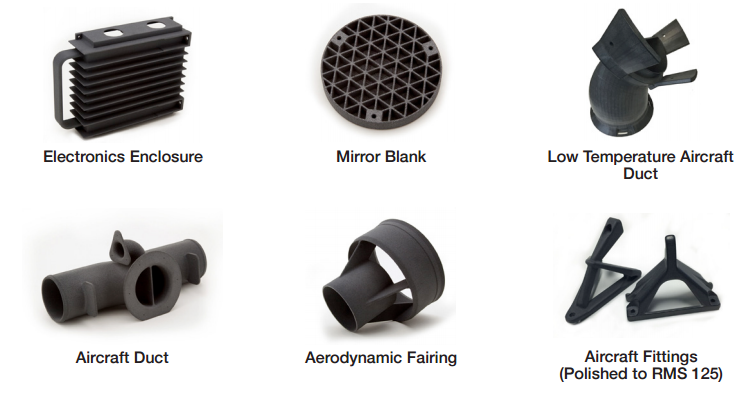
OPM OXPEKK parts
The backbone of OPM’s OXFAB technology is their proprietary OXPEKK (poly-ether-ketone-ketone) material, a high performance polymer capable of withstanding extreme temperatures and harsh chemicals. It hasn’t escaped either Oxford Performance Materials or Hexcel that they have a lot in common beyond carbon fiber – both are dedicated to the development of advanced materials technology to address needs in global transport, performance and energy efficiency, so a strategic partnership makes a lot of sense.
“Hexcel represents the gold standard in carbon fiber and composite material technologies, and our core target markets are extremely complementary,” said Scott DeFelice, Chairman and CEO of Oxford Performance Materials. “Hexcel’s investment in OPM will help enable us to further expand production capacity to meet rapidly growing market demand for our OXFAB® technology. In addition, this investment sets the stage for joint technology collaboration and business development efforts with Hexcel.”
 Hexcel hasn’t ventured into 3D printing yet, but they’ve been very interested in OPM’s high performance additive manufacturing (HPAM) technology, particularly its uses in the manufacture of carbon fiber-reinforced structures. Hexcel has been around for over 50 years, and they intend to remain on the “cutting edge” according to their website. Becoming more involved in 3D printing is a wise choice for any company that wants to stay on top of the market, so this partnership should be a beneficial one for both players. Discuss further over in the Hexcel Leveraging Carbon 3D Printing & OXFAB forum at 3DPB.com.
Subscribe to Our Email Newsletter
Stay up-to-date on all the latest news from the 3D printing industry and receive information and offers from third party vendors.
Print Services
Upload your 3D Models and get them printed quickly and efficiently.













You May Also Like
The Manufacturing Race Behind the Drone Revolution
We are in the middle of a major manufacturing shift focused on the production speed and payload capacity of uncrewed aerial systems (UAS), or drones. A recent Manufacturing Dive article...
ADDMAN to Buy Up to $10.8M in Nickel 718 Powder from 6K Additive Over 30 Months
After years of buildup, we’re finally starting to see what the US metal additive manufacturing (AM) market could look like at scale. To be sure, it’s still not quite there,...
Metal AM in a Multipolar World, Part 2: How PBF and DED Could Change by 2035
The first decades of PBF development were heavily shaped by machine capability: more power, more lasers, larger build volumes, better recoating, and improved process monitoring. These developments will continue, but...
Advanced Manufacturing at IMTS 2026: 3D Printing and AI and Drones, Oh My!
Last week’s International Manufacturing Technology Snow (IMTS) in Chicago welcomed over 90,000 attendees to the jungle that is McCormick Place. With over 1.17 million square feet of exhibit space, and...