3D Printing for Sustainable Economic Development in Africa

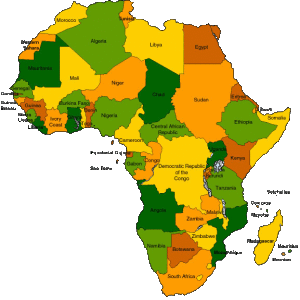
I’ve noticed a common refrain in today’s news cycle: in order to remain viable in the global economy, countries need to get behind 3D printing, and fast. Africa, which has been experiencing an encouraging amount of growth across the continent, hasn’t seen much of a reduction in poverty and unemployment, unfortunately. This is likely due to the stagnation of the manufacturing sector, while the service sector expands. China, which has long been the recipient of jobs outsourced from other countries looking to exploit its cheap labor, has, in recent years, benefited from rising wages and highly skilled manufacturing jobs of its own. This was expected to leave Africa as the new destination for outsourced, low-wage manufacturing jobs.
 However, fewer jobs are being outsourced these days, thanks in part to new digital manufacturing methods including 3D printing. The dramatic cost reduction that 3D printing provides means that there is less necessity to send jobs elsewhere, which is exciting for workers in developed countries who have much less to worry about in terms of losing their jobs. Developing countries, though, are left with sudden holes in their economies.
“The exploitation of cheap labour can no longer serve as the comparative advantage in the face of the relatively cheap, yet highly efficient technology that is radically overhauling the manufacturing sector around the globe,” says Hailemichael Teshome Demissie, PhD, senior research fellow and program head, Inclusive Bioeconomy of the African Centre for Technology Studies.
The only solution, Demissie contends, is for Africa to jump on the 3D printing bandwagon itself. So far, the continent has been slow to develop the technology, which leaves it in a position to fall further and further behind the rest of the world.
“President Obama’s pledge to turn America’s ‘Rust Belt’ into a ‘Tech Belt’ deploying 3D printing technology is instructive for Africa too,” Demissie adds. “The US government’s decision to open several 3D printing manufacturing hubs in a bid ‘to turn regions left behind by globalisation into global centres of high-tech jobs’ is not only a precedent to emulate, but also a serious warning if Africa chooses to ignore it.”

He suggests a series of steps that should be taken by Africa’s leaders to facilitate the adoption of the technology, including orchestrating the collaboration of funding agencies, academic institutions, governmental entities, industries and entrepreneurs to create an “innovation ecosystem” and establish regulations and funding strategies. 3D printing needs to be emphasized within school curriculum, and Africa’s research organizations should collaborate with both national and international programs to establish and maintain a strong foundation of digital manufacturing research. Startup and spinoff companies should be encouraged and supported, and overall, he says, African people should be made aware of the potential of the technology and its economic impact.
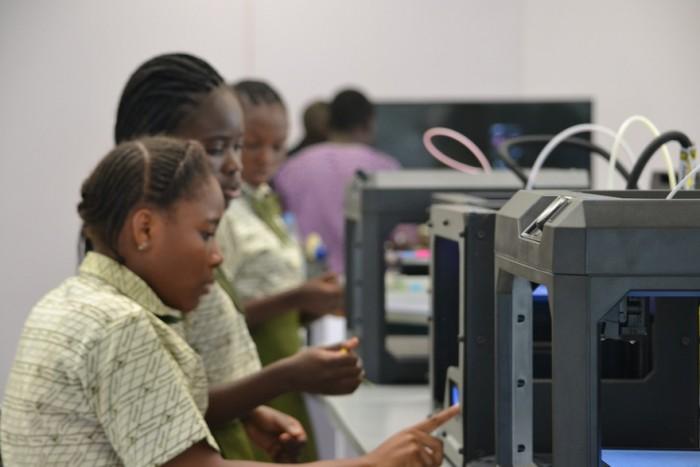
Image: Youth for Technology Foundation
There are reasons to feel encouraged that the continent is beginning to make an effort to adopt 3D printing technology. A Togolese inventor named Afate Gnikou proved that 3D printing need not be expensive when he built his own 3D printer from salvaged electronic waste for $100. 3D printed prosthetics have been lifesavers for some citizens, and researchers at the Vanderbilt-Zambia Network for Innovation in Global Health Technologies have utilized 3D printing to improve malaria testing. A program begun at the National University of Ireland, Galway is aiming to make the lives of African women easier by teaching them to 3D print their own labor-saving farm tools.
STEM education standards emphasize 3D printing, robotics and other emerging technologies. Youth For Technology, a nonprofit organization with offices in Nigeria and Kentucky, has made technology training in developing countries a priority for the last 15 years. In July of this year, they facilitated a 3D Printing Academy For Girls, which taught young girls in the Niger Delta about the basics of 3D printing technology. When trying to solidify the presence of a particular technology in a society’s future, it pays to get the youngest citizens excited about a technology early on. It may be a small step, but it’s an important step.
Is 3D printing the way towards further economic development in Africa? Let us know your thoughts in the African 3D Printing forum thread on 3DPB.com.
Subscribe to Our Email Newsletter
Stay up-to-date on all the latest news from the 3D printing industry and receive information and offers from third party vendors.
Print Services
Upload your 3D Models and get them printed quickly and efficiently.











You May Also Like
Formnext 2025: New Metal PBF 3D Printer, Serial Production Applications, & More
It’s Day 2 of Formnext 2025, where over 800 exhibitors from around the world have converged in Frankfurt for Europe’s premier additive manufacturing (AM) trade show. From exciting new printers...
3D Printed Interlocking Earthen Bricks Create Microclimates to Support Tree Growth
In some places, especially arid landscapes, tree saplings and crops need a little protection from the elements in order to grow. An interesting new project called TreeSoil was designed to...
Italy’s WASP Debuts CUBO HDP, Turning Shredded Plastic into Large-Scale Prints
Italian 3D printing company WASP has introduced its latest machine, the CUBO HDP, a large-scale pellet 3D printer built for industrial production and sustainability. The debut took place last week...
LibWork 3D Prints Residential Home in Japan with Soil & Crane WASP
Construction firm LibWork has 3D printed a home using WASP 3D printers and soil in Japan. The home is roughly 100 m² and was made using a Crane WASP printer....