3D Printed Interlocking Earthen Bricks Create Microclimates to Support Tree Growth


In some places, especially arid landscapes, tree saplings and crops need a little protection from the elements in order to grow. An interesting new project called TreeSoil was designed to create microclimates that support the early growth of young trees and plants. It’s an earthen shelter of interlocking bricks, made with robotic 3D printing, to help protect growing trees from evaporation, wind, and sun.
The biodegradable material system integrates architecture, plant biology, and material science to show how design can be used to actively help with ecological regeneration efforts. TreeSoil was developed in Israel, at the Technion Material Topology Research Lab (MTRL), with collaboration from the Tree Lab at the Weizmann Institute of Science.

The completed TreeSoil shelter stands within a reforestation site, merging earthen architecture, robotics, and ecology into a living system of care.
The idea was inspired by ancient agricultural practices, in which people shaped stone and soil into protective structures to protect growing trees in degraded environments. These structures create a microclimate, which is basically a small area that’s different from the climate in the surrounding region, and this microclimate is much better for early tree growth.
The project partners used computational design and robotic fabrication to reinterpret these ancient methods, and ultimately used soil to make a biodegradable, interlocking system for the protection of saplings.

A local soil-based mixture, composed of soil, clay, sand, fibers, and bio-based additives, is blended to achieve optimal properties for 3D printing.
The TreeSoil material system mixes local soil with clay, sand, and bio-based binders derived from organic fibers and cellulose. The team also used waste-derived nutrients, like biochar, in some prototypes, which served to improve the structural integrity and soil stability.
Then, the researchers test the mixture for erosion, mechanical, and rheological properties, to make sure that it’s not only compatible with the environment, but can also be successfully 3D printed.
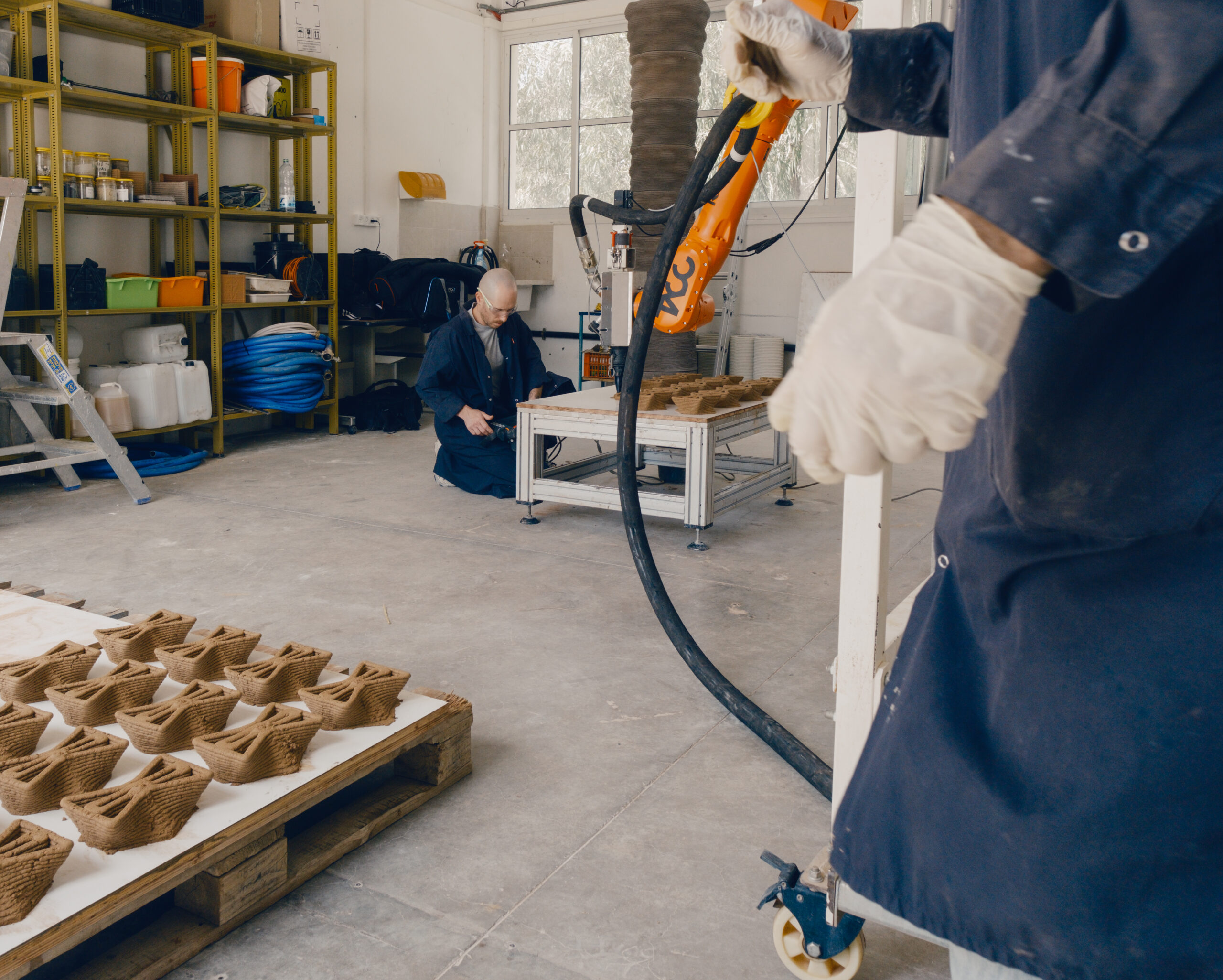

A KUKA robotic arm equipped with a WASP LDM extruder fabricates the first TreeSoil modules layer by layer from the prepared earthen mixture.
I don’t know about you, but anytime I hear about a company 3D printing with soil and other such natural materials, Italy’s WASP is the first name that pops into my head. The modular bricks for the TreeSoil structures are produced with large-scale robotic extrusion 3D printing: specifically a KUKA KR50 robot arm equipped with a WASP LDM XXXL extrusion system.
Once the bricks are printed, they are naturally dried, and then assembled around the sapling on-site, without the use of adhesives. The final protective structure is completely biodegradable, and will disintegrate gradually as the tree matures and gets bigger. As it breaks apart, nutrients are returned back to the soil in a truly circular process.
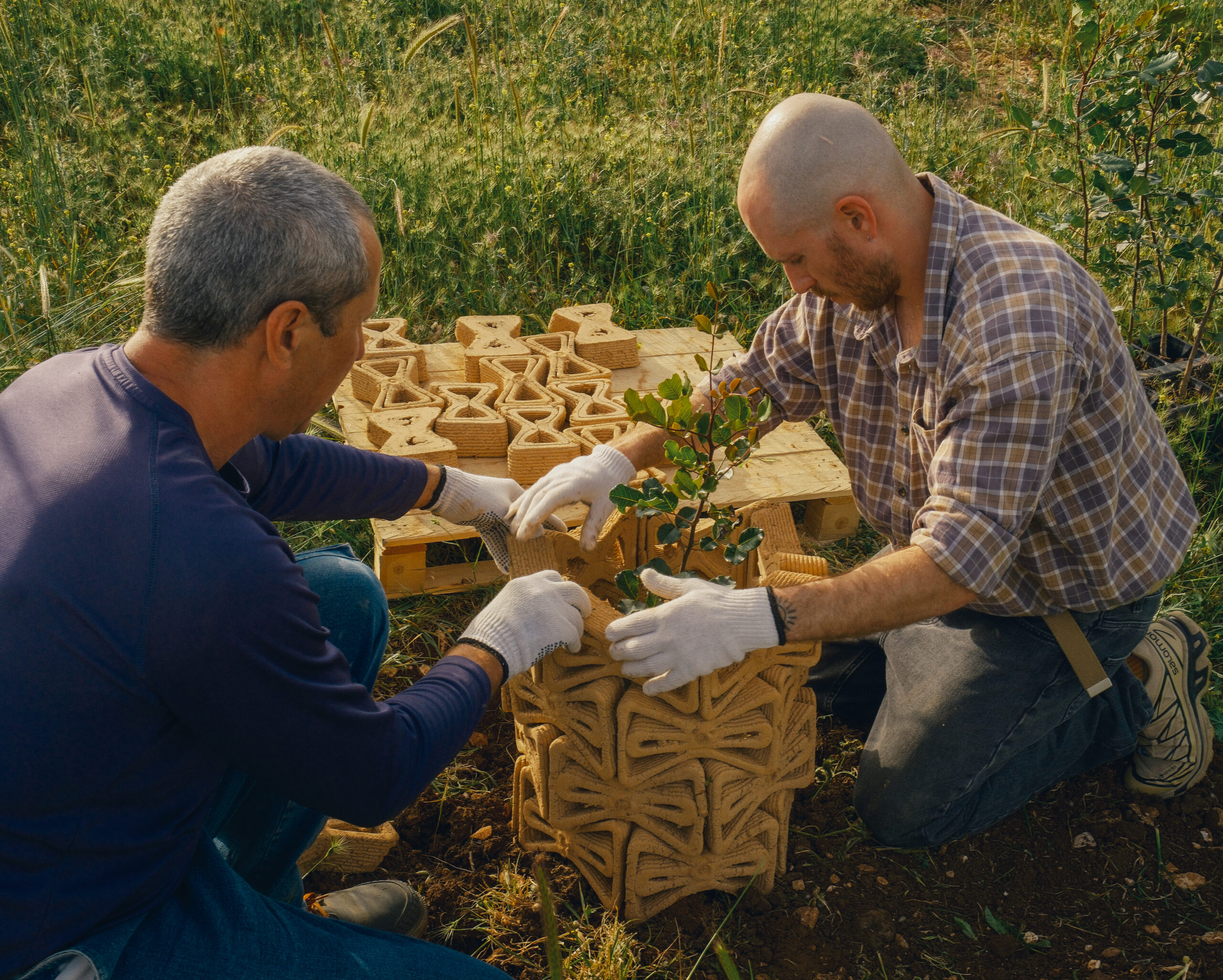
Researchers assemble the modular earthen units of TreeSoil around a young carob sapling, forming the base structure for the microclimate shelter.
In order to enhance survival rates of the saplings, each TreeSoil brick also takes local climate data into account, such as wind patterns, humidity, and solar radiation. The porous, interlocking geometry of the 3D printed soil bricks, in addition to making them structurally sound and easy to assemble, also enables better airflow and shading. The earthen material’s thermal mass also does its part during the tree’s growth process, helping to regulate moisture and temperature to support strong root establishment.
The project design highlights the relationship between trees and the land. The MTRL design team specifically chose the name TreeSoil to reflect what WASP explained in a press release was “the fundamental relationship between vegetation and the land it emerges from.” While we often think of architecture as permanent structures, these 3D printed earthen bricks show that it can indeed be adaptive and temporary, and even regenerative.
“It [TreeSoil] is a vessel of restoration, rooted within the landscape, weaving technology, soil, and trees into a new ecology of care,” WASP concluded.

Top view of the TreeSoil structure illustrating its internal cavity, where airflow, shading, and soil moisture create favorable growth conditions.
Images: Edo Asoulin
Subscribe to Our Email Newsletter
Stay up-to-date on all the latest news from the 3D printing industry and receive information and offers from third party vendors.
Print Services
Upload your 3D Models and get them printed quickly and efficiently.













You May Also Like
How the World’s Most Advanced Tech Companies Are Using 3D Printing
3D printing has been around for decades. For most of that time, it was a prototyping tool. Engineers used it to check if a design looked right before spending money...
The New Dental Lab: “Three Technicians Can Handle a Hundred Arches,” Says Digital Dentistry Expert Josh Jakson
Josh Jakson’s path into digital dentistry started long before he had a job title. He grew up around it. His father, a Polish immigrant, started the family’s dental laboratory in...
Why Beam Control Could Redefine the Future of EB-PBF
In Part 1, Ulf Lindhe examined how advances in beam control, point melting strategies, and process monitoring are changing the way engineers think about electron beam powder bed fusion (EB-PBF)....
Additive Manufacturing at a Crossroads
Additive manufacturing is at a crossroads. Simultaneously, we find ourselves between certain very different modalities, applications, and industries. Rather than being able to explore them all, companies will now have...