Surgeon Calls On Materialise Mimics Software to Create 3D Printed Patient-Specific Surgical Guides for a Complex Wrist Osteotomy


 Any type of surgery, from the simplest to the more complex, brings potential risks with it; any number of things can go wrong. That’s why Alistair Phillips, a Consultant Orthopaedic Surgeon specializing in the hand, wrist, and elbow who works at Spire Southampton Hospital and the Hampshire Hand Surgery Clinic, has a personal philosophy to treat his patients without surgery if at all possible. He only offers surgery as a medical solution if he honestly believes that it will improve a patient’s condition, with minimal risk involved. His goal is to keep patients in the hospital for as short a time as possible, which I’ve learned is often the goal of other physicians as well – the longer you stay in the hospital, the greater the risk of infection. 3D printing can often help with this goal, but not every surgeon goes straight to this technology as a first option.

Alistair Phillips
Phillips has a sub-specialist interest in using local anesthetics, rather than putting patients completely under, and has developed nearly painless injection techniques, due to his simple principle of treating patients as he himself would like to be treated.
“I also provide a full service for all other hand, wrist and elbow problems,” Phillips explained. “I work very closely with some excellent hand therapists and believe that, although surgery has its place, in hand problems particularly, therapy can be often as effective in treating some conditions. I will only operate if I feel it as close to a guarantee of success as I can make.”
All of this goes to show that if Phillips performs surgery, he’ll do whatever he can to make sure it goes smoothly. He receives a lot of referral cases for patients needing elbow surgery and trauma reconstruction, many times after having been in a car accident. A case that was recently referred to him was a young man with a distal radius wrist fracture. After Phillips performed surgery, a complication arose – the patient’s lunate fossa began to deteriorate, which caused intra-articular damage; the lunate bone is actually the most frequently dislocated carpal bone. This complication meant that the patient was in a lot of pain, and would need a second surgery. So Phillips called in the cavalry for a 3D approach to the impending wrist osteotomy.
![[Image: Mr. Alistair Phillips]](https://editorial.3dprint.com/wp-content/uploads/2017/02/Distal-radius-wrist-fracture-Xrays.png/)
[Image: Alistair Phillips]
- import JPEG, TIFF, DICOM, BMP, x-ray, or raw image data
- efficiently create accurate, patient-specific 3D models
- perform dedicated anatomical analysis
- virtually simulate surgery
- export 3D models for design, 3D analysis, FEA meshing, or 3D printing
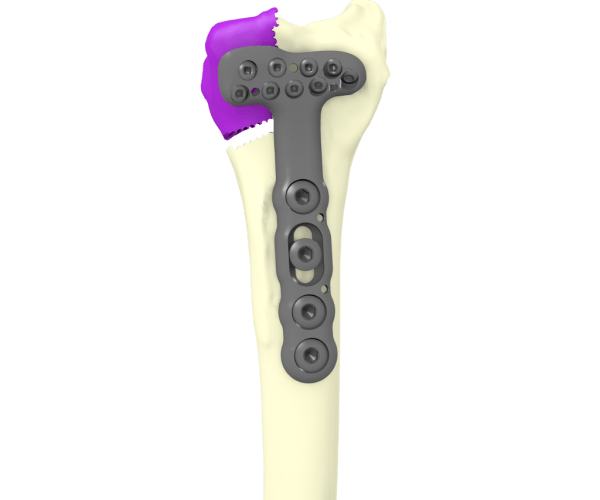
The specialized software has been used in human cases, such as the prediction of thyroplasty success for transgender women, and even in researching cases from the past, like dinosaurs and a 430,000-year-old murder mystery. In this case, once the wrist images had been segmented using the software, Materialise engineers used the 3D wrist reconstruction to plan out the optimal cuts for the wrist osteotomy, and then got to work designing the patient-specific surgical guides, so Phillips would know where exactly on the bone he needed to cut. The guides were then 3D printed and shipped to the Hampshire Hand Surgery Clinic.
-
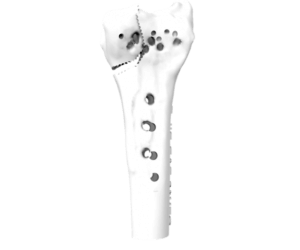
- Outcome model

-

- Osteotomy plan
-
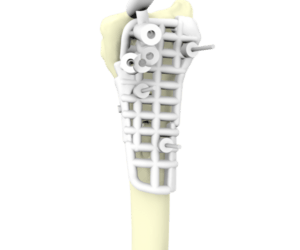
- Osteotomy guide, Hampshire Hand Surgery Clinic case

The wrist osteotomy in January went very smoothly, and the patient recovered well, with only minimal pain this time. Just a week after his surgery, Phillips was able to transfer the patient to a removable splint, and wrote in a blog post that although the patient wouldn’t be able to lift anything heavier than a pen for a while, everything seemed to be fine. You can take a look at how well the patient was able to move his wrist one week post-op in this short video:
Discuss in the Wrist Surgery forum at 3DPB.com. [Source: Materialise]
Podcast: Play in new window | Download
Subscribe to Our Email Newsletter
Stay up-to-date on all the latest news from the 3D printing industry and receive information and offers from third party vendors.
Print Services
Upload your 3D Models and get them printed quickly and efficiently.












You May Also Like
6K Energy Wins $1.9M Defense Grant to Advance U.S.-Made Battery Materials
The U.S. Defense Logistics Agency (DLA) has awarded 6K Energy a $1.9 million research and development grant to support the domestic production of advanced lithium-ion battery materials. The funding, issued...
New 3D Printed Hydrogen Cell Factory Just Switched On in Catalonia
The Catalonia Institute for Energy Research (IREC) has opened a pilot plant that 3D prints advanced ceramic devices for renewable hydrogen systems. It’s described as the first facility on the...
Sakuu to Auction Off Surplus Equipment in August — Company Says It’s Part of Normal Operations
Sakuu, a company known for developing additive manufacturing (AM) systems for battery production, is holding an online auction to sell a wide range of equipment. The auction will run from...
3D Printing News Briefs, May 21, 2025: Medical Training Models, Connectors, Makerspace, & More
We’re starting with research and medical in today’s 3D Printing News Briefs, as a research team from Caltech is using sound to 3D print deep inside living tissue, and rural...