
New 3D Printed Hydrogen Cell Factory Just Switched On in Catalonia

The Catalonia Institute for Energy Research (IREC) has opened a pilot plant that 3D prints advanced ceramic devices for renewable hydrogen systems. It’s described as the first facility on the planet that can manufacture solid oxide cells (SOC) this way, and the research center believes it could reshape how clean hydrogen technology is made, essentially by 3D printing the core ceramic parts that make hydrogen machines run.
A New Way to Build Hydrogen Tech
The new pilot line, called Merce Lab, uses 3D printing to create SOCs, the ceramic “engines” inside high-efficiency fuel cells and electrolysers; these are the machines that turn electricity into hydrogen and hydrogen back into electricity. Normally, SOCs are made through a long, multi-step process involving pressing, sintering, coating, and stacking layers by hand or with slow industrial tools. By 3D printing them instead, IREC can produce lighter, smaller, and more powerful cells in a fraction of the time and cost. That makes hydrogen systems cheaper to build, easier to scale, and far more attractive for clean-energy, transport, and storage applications. Basically, it’s a faster and smarter way to build the components that make renewable hydrogen possible.
Very few groups in the world can make SOCs at this level. Now, the IREC is one of them.
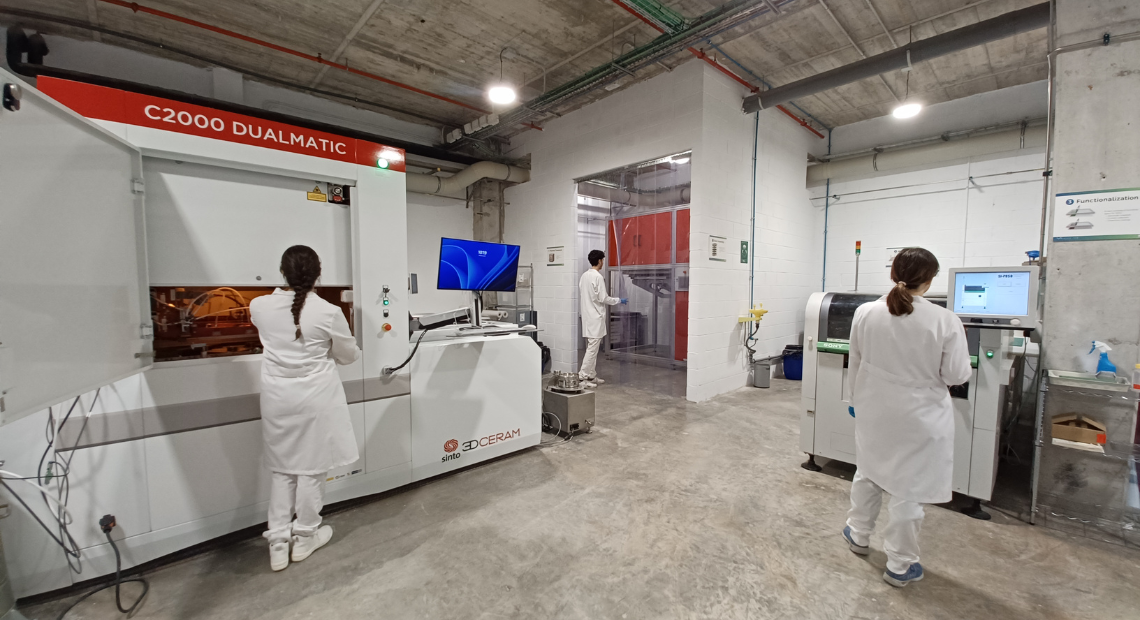
The Merce Lab. Image courtesy of the Catalonia Institute for Energy Research.
Solid oxide technology is already known for being very efficient. But when these ceramic parts are 3D printed instead of made the traditional way, engineers can create shapes and internal structures that weren’t possible before. That leads to better hydrogen production, stronger and higher-performance fuel cells, lighter and smaller systems for cars, trucks, ships, or even planes, and power material use without losing durability. And because Merce Lab is a pre-industrial pilot line, this isn’t just a research experiment; it’s in fact a process that can be scaled up for real manufacturing.
A European Push
Merce Lab was funded through the Tecnopropia Important Project of Common European Interest (IPCEI) program, supported by hydrogen technology company H2B2 and major European innovation funds. The facility is already working with industry partners such as the advanced ceramic 3D printing French firm 3Dceram, thin-film coatings specialist Nano4Energy, and Spanish companies AMES, Viver Clean Tech, and AESA.
What’s more, Merce Lab is bringing the technology closer to commercial use. IREC has even begun fabricating complete devices and plans to spin out a company called Oxhyd Energy to commercialize SOC fuel cells.
A Sneak Peek at the Future
Catalonia now has a pilot line capable of producing enough SOC devices each year to supply roughly 2 megawatts of power (for reference, a single modern onshore wind turbine produces around 3 MW). The cost target, which is roughly €800/kW, could help push renewable hydrogen below €4/kg, a major milestone for the sector. Today, European green hydrogen can range between €3.5 and €6 per kg under favorable conditions, but some estimates reached as high as €16 per kg in 2024. Meanwhile, in the U.S., production typically falls between $5 and $10/kg (€4.5 – €9/kg), while the lowest-cost region is the Middle East, where hydrogen is often estimated at €3 – €5/kg.
Even more important, the materials are designed to be free of cobalt, nickel, rare earths, and other critical materials. That gives Europe an easier path toward secure, sustainable hydrogen production.
If the early results are successful, Merce Lab could become a blueprint for how future hydrogen technology is designed, built, and scaled.
Subscribe to Our Email Newsletter
Stay up-to-date on all the latest news from the 3D printing industry and receive information and offers from third party vendors.
Print Services
Upload your 3D Models and get them printed quickly and efficiently.













You May Also Like
The Manufacturing Race Behind the Drone Revolution
We are in the middle of a major manufacturing shift focused on the production speed and payload capacity of uncrewed aerial systems (UAS), or drones. A recent Manufacturing Dive article...
ADDMAN to Buy Up to $10.8M in Nickel 718 Powder from 6K Additive Over 30 Months
After years of buildup, we’re finally starting to see what the US metal additive manufacturing (AM) market could look like at scale. To be sure, it’s still not quite there,...
Metal AM in a Multipolar World, Part 2: How PBF and DED Could Change by 2035
The first decades of PBF development were heavily shaped by machine capability: more power, more lasers, larger build volumes, better recoating, and improved process monitoring. These developments will continue, but...
Advanced Manufacturing at IMTS 2026: 3D Printing and AI and Drones, Oh My!
Last week’s International Manufacturing Technology Snow (IMTS) in Chicago welcomed over 90,000 attendees to the jungle that is McCormick Place. With over 1.17 million square feet of exhibit space, and...

























































