
Taking it to the Streets With Addibot: Mobile 3D Printers May Eliminate Pothole Issues Forever

 Potholes are just such a rude little surprise. Sending your morning coffee sloshing and your teeth gnashing on the fast track to work, they can also cause actual damage to your car–and take a nasty bite out of your wallet. It would seem that some of the world’s brightest minds would have set their sights on eliminating these gnarly little road hazards sooner.
Happily roving bots sound like the perfect answer for today though. And Robert Flitsch is making it his goal to put them to work, performing tasks that most humans probably really don’t want to do. It’s surprising how inconveniences we’ve dealt with nearly our entire lives may soon simply be eliminated due to innovations allowed by 3D printing–if Flitsch, a recent Harvard grad, gets his way. His machines, referred to as Addibots, should be out on the streets soon, once designs are finalized and sufficient funding procured.
The Addibot is, in its simplest form, a mobile 3D printer. The concept of indoor machines stuck in workshops pumping out components doesn’t do much for fixing our vast roadways–but releasing them from those constraints and putting machines like the Addibot out into the fresh air to clean up battered pavement opens up a whole new world of ideas for fabrication.
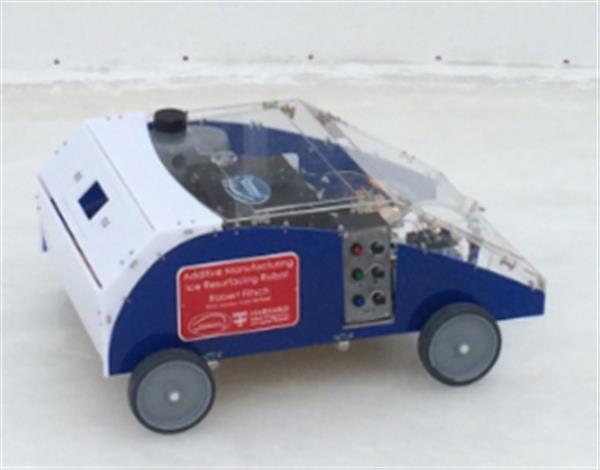
The Addibot working its magic on ice
The robot operates just like a traditional 3D printer, scaled down and made to weather the elements. Flitsch has designed it for dual controls, via remote operation or completely automated.
“One of the main limitations with 3D printers is you typically have it printing inside this box, and you can really only print objects of the size of the workspace you’re printing in,” says the 22-year-old Flitsch, a mechanical engineer who graduated from the Harvard John A. Paulson School of Engineering and Applied Sciences last May. “If you take additive manufacturing implements and make them mobile, you can print objects of arbitrary size.”
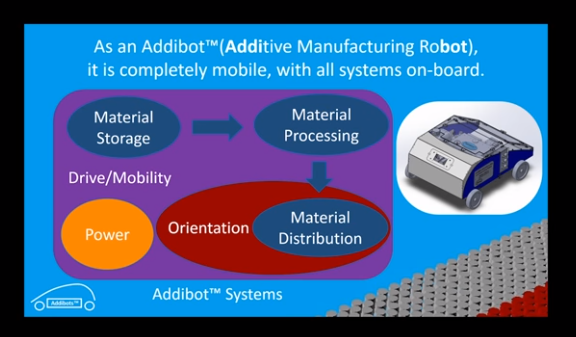
The mobile concept involves ‘all systems on board,’ with multiple nozzles which would be used to fill in and pave over potholes. Flitsch has tested this with some very interesting material: icy water. As a hockey player himself, he was inspired to try the Addibot on ice with his ‘Ice Resurfacing Addibot,’ allowing his pet bot to pour water into the slices and cuts made by players’ skates. The concept is brilliant in its simplicity, as the water would simply freeze, smoothing out the surface of the ice perfectly. And translating it to the road makes perfect sense.
 The goal with asphalt is in making sure the correct measurements are applied to fix potholes. With that in place, Flitsch says that repairs could be done at a consistent speed around a few miles per hour. Finding a way for the robot to manipulate tar accordingly is a stickier subject, and a work in progress. Other considerations come into play as well once you are taking your 3D printing outside, such as particles like dust causing interference. This can be dealt with due to a stronger undercarriage. Power is of course a main issue that has to be dealt with also.
“All the storage for material, all the chemical processing could be done on board the Addibot,” he says. “Tar materials, which have to be kept at a high temperature, can be done in a tank with a constant heat source added to it. Power sources could be various kinds, depending on the size of the robot.”

With one prototype already under his belt, Flitsch will require funding to keep working on R&D with different materials–and he sees that as having nearly unlimited potential.
“The only way that I see Addibots being limited is in whatever materials we can think up to use,” he says.
We think many will be behind this idea for not only fixing messy potholes and other infrastructure issues, but also in embracing the idea of taking away the indoor constraints from 3D printing and allowing for ‘making the world a makespace.’
Subscribe to Our Email Newsletter
Stay up-to-date on all the latest news from the 3D printing industry and receive information and offers from third party vendors.
Print Services
Upload your 3D Models and get them printed quickly and efficiently.













You May Also Like
Prusa Core One L+: A Worthy Upgrade?
Disclosure: The Core One L+ was provided to me by Prusa3d free of charge for the purpose of this review. I have not received any other compensation. All opinions expressed...
IFA 2026 Shows Where Multicolor 3D Printing Is Headed
Innovation For All (IFA) is best known for televisions, appliances, and consumer electronics. But this year’s show in Berlin also gave 3D printing companies plenty of room to show where...
PrusaSlicer 3.0 Review: A Major Slicer Overhaul
Prusa Research has implemented a major update to PrusaSlicer. The 3.0 version is not some tweak; it’s a big rewrite. From the get-go, the Alpha version I tested was light-years...
Prusa Upgrades Its Lineup with CORE One+ (Gen 2), CORE One L+, and XL+
Prusa Research has updated its high-end desktop 3D printer lineup. The company is offering new and improved versions of the machines it targets at industrial and power users, with the...
























































