European Space Agency Releases New 3D Images of Comet 67P

I remember the first time I saw a comet. People had been talking about the upcoming appearance of the comet Hale-Bopp for days; it was expected to be the brightest, most visible comet anyone had seen in years. Being a kid at the time, I had no idea what an actual comet would look like; I was expecting a massive fireball to go streaking across the sky. When I saw that it was actually just a small smudge of light among the stars, I was a bit disappointed. I now know, years later, that I had witnessed something amazing.
 Equally amazing is the fact that comets, those little smudges of light, can now be studied so closely that every crater, ridge, and bump on their surfaces can be not only seen, but rendered in 3D. Last year, we wrote about Rosetta, the European Space Agency’s (ESA) “comet chaser” which, in November 2014, made history when it became the first-ever spacecraft to orbit a comet’s nucleus and land a probe on its surface. Before the landing of the probe, Rosetta had been capturing incredibly detailed images of comet 67P/Churyumov-Gersimenko, which were then used to create a 3D model. The files were released to the public, allowing even casual space enthusiasts to print their own replicas of the comet.
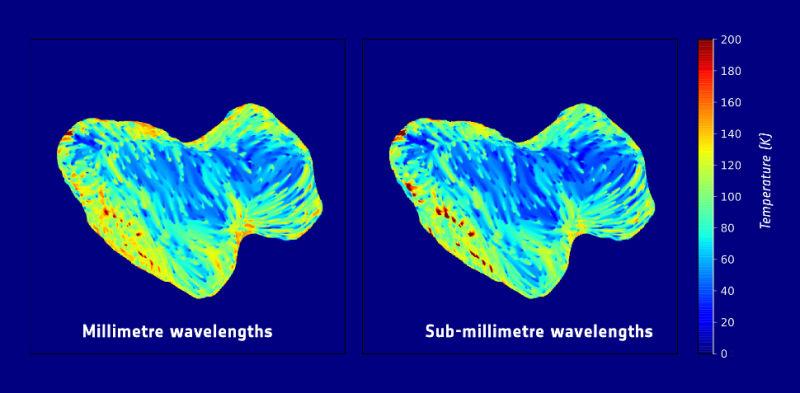
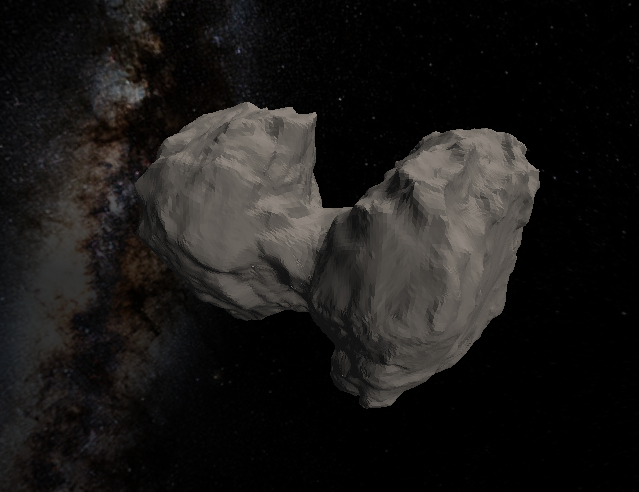 One year later, the ESA has released a new shape model of 67P, a more detailed representation that includes parts of the comet that were not previously visible. The model, which now includes the comet’s southern hemisphere, is based on images that Rosetta’s cameras took from May to August of 2015. On August 13, 67P reached perihelion, which is the point at which it passes closest to the sun in its 6.5-year orbit. At that time, the southern hemisphere, aka the comet’s “dark side,” became illuminated by the sun, allowing it to be not only photographed but scanned by the Microwave Instrument for Rosetta (MIRO).

The Rosetta orbiter was launched in 2004, and will end its mission next September in dramatic fashion, when it will crash into the comet. The crash landing is expected to reveal more detailed information than ever before, as the orbiter will continue to gather data as it descends towards 67P’s surface. Until then, you can print out the most accurate and detailed representation of 67P to date by accessing the files here. If you don’t have access to a 3D printer, you can still have fun with the comet by checking out this interactive 3D visualization tool, which lets you zoom in, see different angles, and look at the pictures taken by Rosetta from each point in its orbit. You can also see all of the images taken so far at the ESA’s Archive Image Browser.
When I saw my first comet, the only sort of celestial replicas I had were the glow in the dark stickers of comets, planets and stars that I had put all over my ceiling. I never imagined, at that time, that one day I would be able to hold an accurate representation of an actual comet in my hand. Have you downloaded these new models? Let us know in the 3D Printable Rosetta Comet forum thread on 3DPB.com.
Subscribe to Our Email Newsletter
Stay up-to-date on all the latest news from the 3D printing industry and receive information and offers from third party vendors.
Print Services
Upload your 3D Models and get them printed quickly and efficiently.











You May Also Like
U.S. Congress Holds Hearing on Cutting Healthcare Costs and Points to 3D Printing
A U.S. House subcommittee held a hearing this week on how technology can help lower the rising cost of healthcare for Americans. Lawmakers pointed to 3D printing as a key...
3D Printing News Briefs, December 13, 2025: 3D Imaging, Living Lung Cells, & More
We’re covering medical and dental news in this weekend’s 3D Printing News Briefs, starting with a new innovation at Boston Children’s Hospital that could become standard practice in orthopedics: 3D...
New 3D Printed Hydrogen Cell Factory Just Switched On in Catalonia
The Catalonia Institute for Energy Research (IREC) has opened a pilot plant that 3D prints advanced ceramic devices for renewable hydrogen systems. It’s described as the first facility on the...
Boston’s Additive Edge: Harvard’s MEDscience Takes High Schoolers Into the Future of Medicine
Forget chalkboards and worksheets. At Harvard Medical School’s MEDscienceTECH Program, students learn medicine by building, coding, and experimenting – whether it’s navigating a LEGO robot through a 3D printed spine,...