
Hike Medical Adds AI to AM to 3D Print Custom Orthotics

As companies like Backflip and 1000 Kelvin have demonstrated, artificial intelligence (AI) may be a key enabling technology for increasing the adoption of additive manufacturing (AM) at an exponential rate. For that reason, we’re only going to see more stories related to this element of the 3D printing software segment. Illinois-based Hike Medical applies AI to a unique application area that could have benefited more from machine learning a decade ago: insoles.
The potential of 3D printing in revolutionizing medical devices and consumer goods has often been discussed, yet few companies manage to achieve significant breakthroughs. Hike Medical, through its insoles.ai platform, is overcoming challenges in custom manufacturing and paving the way for broader adoption of 3D printing technology in the health and wellness sector. In a conversation with 3DPrint.com, Steven Chacko, Co-Founder and Chief Business Officer at Hike Medical, shared insights into the company’s operations, technological innovations, and how broader market trends are impacting their strategy.
“At the core of our business, we are a medical device manufacturer,” explained Chacko. “We create custom orthotics. Our platform allows users to scan their feet using a mobile application and receive a pair of custom insoles seven to ten days later. Before this, getting custom insoles required multiple doctor’s visits and referrals, making it a time-intensive and costly process.”
Hike Medical’s insoles.ai platform offers an AI-powered, web-based solution that eliminates the need for costly scanners or app downloads. Users can scan their feet in under five minutes with any camera-equipped device, from smartphones to tablets. The scans are analyzed by AI to produce precise 3D foot models, enabling the fabrication of custom-fit insoles tailored to each individual’s biomechanics.
Hike Medical has streamlined this process by partnering with employers and clinics to provide an end-to-end workflow for custom orthotic ordering, delivery, and evaluation. Leveraging artificial intelligence, the company automates much of the data entry previously handled manually. Chacko highlighted the company’s partnerships with major organizations such as Intel and OSF Healthcare, emphasizing the scalability of their solution.
“Two years ago, people said we couldn’t make 3D printing work for custom orthotics using FDM printers. Yet, we recently achieved FDA and PDAC approval for our diabetic inserts,” Chacko noted. Hike Medical’s use of Bambu Lab, via a partnership with reseller Dynamism, and Artillery Sidewinder printers has enabled efficient production at scale, a feat many believed was impossible in such a regulated industry.
This achievement reflects larger trends in AM industry. Recent data from AM Research indicates that while hardware sales in 3D printing have stagnated, material consumption has grown steadily. The ongoing softness in hardware adoption contrasts sharply with the increasing utilization of existing machines. Hike Medical’s focus on maximizing printer utilization aligns with this market trend, showcasing how companies can extract value from existing technology.
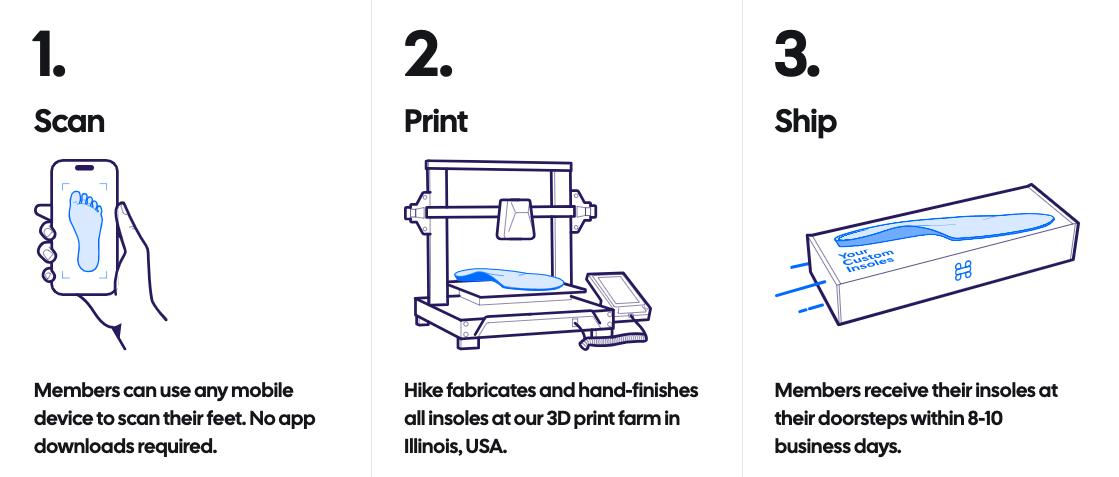
Hike Medical’s operations include a seamless three-step workflow: scanning, printing, and shipping. After scanning, the data is sent to their 3D print farm in Illinois, where insoles are precision-crafted and hand-finished. Orders are delivered to members within 8–10 days, ensuring a quick turnaround without compromising quality.
However, the journey hasn’t been without challenges. As Steven Chacko shared, the company initially relied on Artillery printers, which required significant modifications and maintenance to keep operational. “Moving to Bambu Lab printers has made the process much smoother. These systems are faster, more reliable, and better supported by the manufacturer,” he explained. This technological shift highlights a broader maturation of 3D printing hardware, making it more accessible for small and medium-sized enterprises.
Hike Medical’s journey also reflects lessons learned from previous 3D printing ventures in the insole market. Companies like SOLS and HP’s FitStation struggled to scale their solutions and ultimately exited the market. Chacko attributed part of Hike Medical’s success to focusing on operational excellence and end-to-end integration. “We’re not just offering a fragmented scanner or production unit. Our solution guarantees specific turnarounds and integrates seamlessly into our clients’ workflows.”
This accessibility is powered by Hike Medical’s AI-driven scanner, which uses deep learning to reconstruct foot models from monocular video—a feature that doesn’t require the LiDAR technology found in high-end smartphones. “If your device has a camera, you can scan,” Chacko noted, emphasizing the platform’s potential to democratize access to custom orthotics globally.

The company’s current production capabilities are impressive. With over 120 printers, Hike Medical produces up to several thousands of insole pairs per month. Most customers opt on Hike performing production rather than printing files themselves locally. This centralized model ensures quality control, a critical factor in the medical device industry. “That said, we’re happy to provide STL files for clinics that are equipped to handle the manufacturing,” Chacko added.
Hike’s growth will likely continue, thanks in large part to the movement to bring manufacturing back to domestic markets. Supply chain vulnerabilities exposed during the pandemic have accelerated reshoring efforts across industries, as detailed in the White House’s 2021–2024 Quadrennial Supply Chain Review.
According to the report, the Federal Reserve Bank of New York staff’s Global Supply Chain Pressure Index was shown to correlate supply chain disruptions with goods inflation and underscored the importance of localized manufacturing strategies like those employed by Hike Medical. Elevated supply chain pressures lead to significant inflationary impacts, which can disrupt industries reliant on global supply chains.
By maintaining domestic production and leveraging AI-driven workflows, Hike Medical avoids the cost volatility and delays associated with international supply chain challenges, ensuring consistent product delivery and pricing stability for its custom insoles even during periods of heightened global supply chain pressures. The significance of this strategy will only increase as Hike moves beyond insoles.
Looking forward, Hike Medical is exploring other verticals within the medical device space. “Long-term, we want to launch comprehensive solutions for products like cranial orthotics and AFOs,” Chacko shared. By leveraging the same AI-driven workflows, the company aims to expand its impact while maintaining its focus on operational excellence.
At the same time, as the adoption of both AI and AM increase, we’ll see the paired technologies used in a broader range of industries for the same application. This form of supply chain insurance will help mediate global disruptions. 10 years or so on and we see 3D printed insoles reborn not just as a case for mass customization, but for domestic production as well.
Subscribe to Our Email Newsletter
Stay up-to-date on all the latest news from the 3D printing industry and receive information and offers from third party vendors.
Print Services
Upload your 3D Models and get them printed quickly and efficiently.













You May Also Like
The Money Behind AM: What to Watch at AM Investment Strategies 2026
For years, simply being a 3D printing company could attract attention from investors. New machines, new materials, faster speeds, and the promise of mass production were often enough to get...
AmeraLabs Offers New Dental 3D Printing Resins
Lithuania-based AmeraLabs is putting new dental 3D printing resins on the market. Its new Made in Europe resins will include one material for impression trays, one for surgical guides, and...
3D Printing News Briefs, June 10, 2026: Grand Opening, Photoresins, Footwear, & More
We’re starting with some exciting news in today’s 3D Printing News Briefs: Stratasys just celebrated the opening of its new North American headquarters in Minnesota. Moving on, Nanoscribe is scaling...
3D Printing News Briefs, April 22, 2026: DINOs, Post-Processing, AM for Aerostructures, & More
We’ll start with event news in today’s 3D Printing News Briefs, as AMUG presented its DINO Award to six members at this year’s conference, and Axtra3D celebrated its five-year anniversary...























































