Young Girl Breathes Easier with Help from 3D Printed Trachea

As we have written about in numerous articles, one of 3D printing’s most important applications is in healthcare. New, life-saving treatments are being developed every day, some of the most impressive being advances in prosthetics and surgical techniques. The impact of these innovations is rarely more evident than when a story comes to light about a child whose life is saved or improved by 3D printing. Accidents and illnesses that, as little as a few years ago, would have derailed a child’s life are now being reduced to bumps in the road.
 Six-year-old Katie Parke, of Northern Ireland, has a condition known as pulmonary alveolar proteinosis, or PAP. The disease causes grainy deposits made of protein and phospolipid, a fat-like substance, in the alveoli, or air sacs, of the lungs. The buildup inhibits the lungs’ ability to absorb oxygen, leading to breathing difficulties. The disease is treatable, but the treatment isn’t pleasant – the most common treatment is called whole lung lavage and involves, in short, washing the lungs with a saline solution. The procedure is a delicate one, requiring one lung to be ventilated while the other is cleaned. Because of the differing sizes in tracheas, particularly in children, doctors often are forced to try different sizes and combinations of tubes, wasting valuable time during the operation.
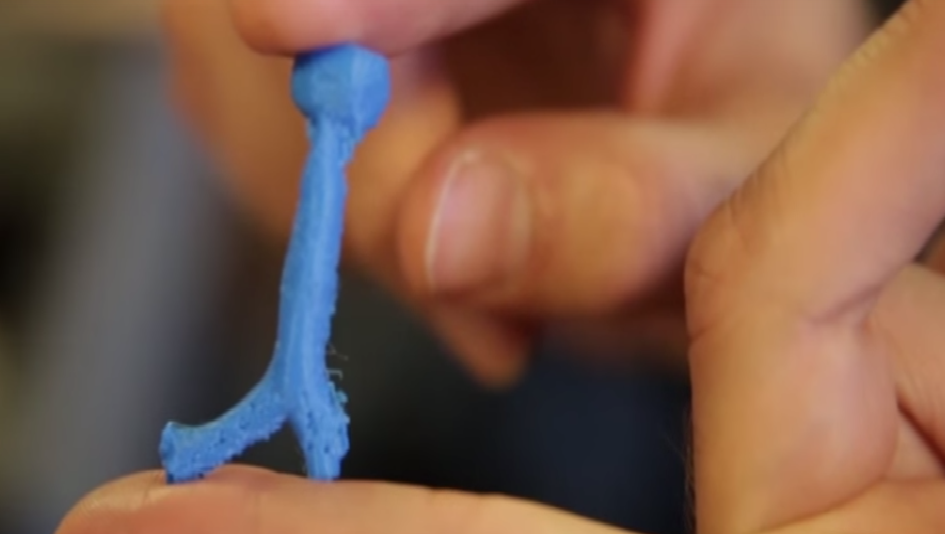
Doctors at London’s Great Ormond Street Hospital came up with a solution to make Katie Parke’s surgery safer: they took a CT scan of her and used it to print a 3D rubber model of her trachea. They were then able to use the model to select the properly sized tools needed for Katie’s surgery before she even arrived in the operating room. With the 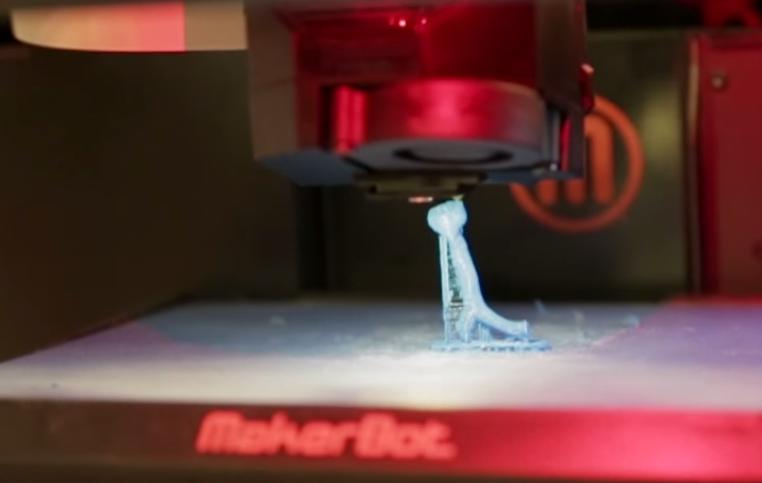 advance preparation, Katie needed to spend much less time under anesthesia and on a ventilator.
Because Katie will need treatments for the rest of her life, and because she is a growing child, she will need a new model printed each time to accommodate the changes in her body’s size and shape. Fortunately, the print is inexpensive and can be done in a matter of hours.
“Each time a child comes in to have their procedure they will have grown and so require different equipment to be used for their treatment,” says physician Colin Wallis. “A model that is tailor-made to the child each time they have treatment means that the right sized tubes can be identified prior to surgery and a child can potentially be under anaesthetic for a shorter period of time.”
Take a look at this video of a model trachea being printed on a MakerBot:
https://youtu.be/LzPYcwE6NxE
“We can look at a 3D reconstruction on a computer, but this takes it into a whole new dimension,” Dr. Owen Arthurs, the radiologist who organized the study, told BBC News. “Being able to hold it in your hand makes the procedure much easier and safer.”
 The hospital, which is notable for its previous research in 3D printing, is hoping to adapt the procedure to print other organs to assist in other risky surgeries. They also intend to print a collection of models for training purposes, allowing doctors to practice various surgeries before they operate on humans.
“This work demonstrates that it is possible to create precise anatomical models of complex organs cheaply and in a very short space of time from standard CT scans and a 3D printer,” said Dr. Arthurs. “In the future, 3D printing could feasibly be adapted to scan and create many more organs in the body making a larger number of surgical procedures safer, quickly and easier.”
What are your thoughts on another incredible Trachea implant? Discuss in the 3D Printed Trachea forum thread on 3DPB.com.
Subscribe to Our Email Newsletter
Stay up-to-date on all the latest news from the 3D printing industry and receive information and offers from third party vendors.
Print Services
Upload your 3D Models and get them printed quickly and efficiently.













You May Also Like
3DPOD 316: Beehive’s Gordie Follin on 3D Printed Engines and More
Gordie Folin had deep experience in engineering at Pratt & Whitney, GE, and GE Aviation before becoming the Chief Product Officer at Beehive Industries. Among his achievements, he served as the...
3DPOD 315: Dirk Simon, from BASF to Farsoon to FKM, and now Square New Business
Dirk Simon had already spent years in the chemicals industry before joining and pioneering BASF‘s 3D printing effort. We get to hear how that firm looked at 3D printing and...
Printing Money Episode 42: Q2 2026 Public Markets 3D Printing Earnings Analysis with Troy Jensen, Cantor
Welcome to Printing Money Episode 42. Troy Jensen (Managing Director, Cantor) returns, joining Danny Piper (Managing Partner, NewCap) to review Q2 2026 publicly traded 3DP/AM company earnings reports. Troy’s quarterly...
3DPOD 314: Debinding, Sintering, and Metal Binder Jetting with Stefan Joens, Elnik Systems and DSH Technologies
Stefan Joens of Elnik Systems sells ovens. Their debind and sintering equipment powers a lot of high-volume binder jet and MIM production. We learn about Elnik and its origins. But...