Canadian Artist Guillaume Lachapelle Creates Haunting, 3D Printed Dioramas

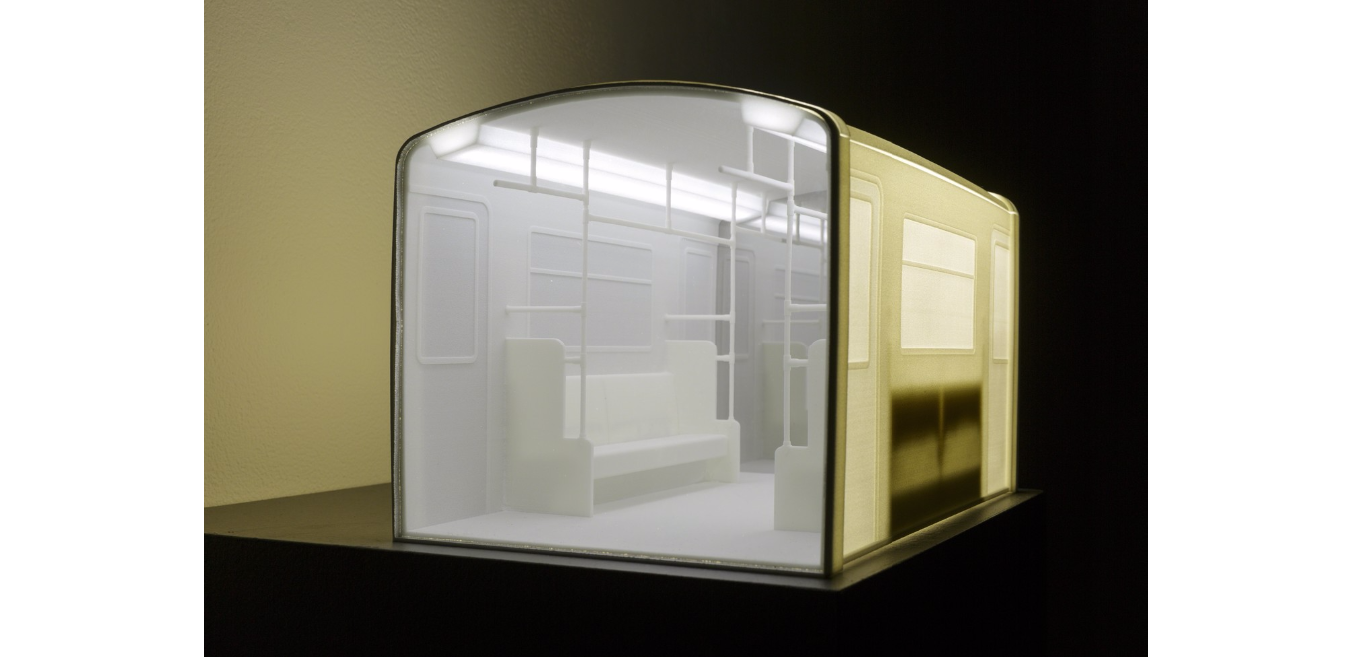
Metro, 2013
There’s something so compelling and, conversely, off-putting and potentially even anxiety-provoking about the 3D printed dioramas of Montréal-based artist Guillaume Lachapelle. This sculptor–who is clearly inspired by architecture and the human impulse to organize and standardize space, particularly communal space–creates meticulous models reminiscent of the miniature stage sets produced in intricate detail. Lachapelle’s sets, however, are sterile versions of those often elaborate maquettes. Rather than suggesting that, in the context of one of the small-scale worlds that action will erupt momentarily, the Québec artist’s sets are devoid of human presence, monochromatic and in a sense scrubbed clean of life.

Nuit étoilée, 2012
The models, some of which are no larger than about 6″ x 6” x 12”, largely represent interior spaces arranged in grid-like fashion. Relying on feints of mathematical perspective, including utilizing mirrors in many instances, the sculptor creates the illusion of diminution into seemingly infinite space, most ironically within the confines of the small diorama.
One piece, titled Nuit étoilée (Starry Night, 2012), of the three representing exterior spaces, recreates an ubiquitous parking lot lit by four-armed streetlights, the poles of the lamps and the lines painted onto the tarmac stretch out and diminish into the distance as though the lot is endless. Another piece, Rêve collectif (Collective Dream, 2014), again relies on an orderly grid and diminution to invoke the homogeneity of suburban life as expressed in the seemingly limitlessness of a landscape filled with identical houses.
Lachapelle turned to the banality of interiors like train cars and office spaces with Metro (2013) and Vie secrète (Secret Life, 2014), respectively. With mirrors and, with the ease of reproducing veristic details that 3D design facilitates, the sculptor again creates the illusion of endlessness and even tedium at the same time that the virtuosity of these works in their protective cases lends an air of magic to the mundane, whether the factory-produced seats and poles of the subway car or the pipes and duct work of an other, subterranean world actually do hint at secrets perhaps never to be revealed.
In a 2010 interview with Montréal newspaper La Presse, Lachapelle explained that, prior to the advent of 3D printing, he used traditional methods and materials for creating and manufacturing his sculptures. Now, he creates the models (presumably after producing a series of conventional, 2D sketches) using SketchUp and then 3D prints them in nylon and other materials (although nylon seems to be a favored medium).
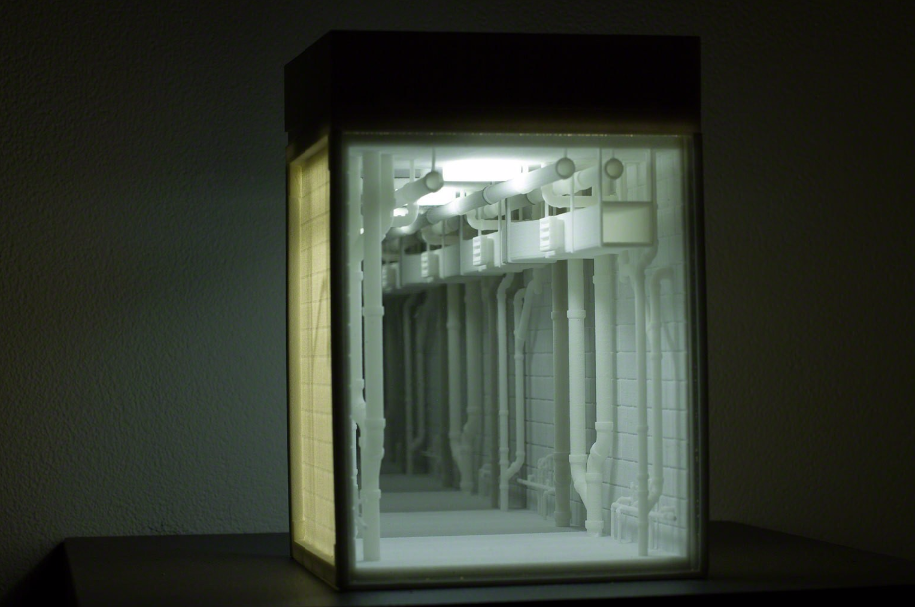
Vie secrète, 2014
This past summer, Lachapelle exhibited his work at Art Mûr, a Montréal gallery. The show, which he titled Visions, presented a sort of retrospective of his oeuvre with older works produced using more traditional techniques and more recent ones that were largely produced via 3D printing. Notably, it is difficult to discern which works originate from his pre-3D printing period and which do not.
This indistinguishability is certainly, among other things, a testament to the capacity of 3D printing not to usurp or render obsolete traditional methods of artistic production but, rather, to augment them and, in the case of Lachapelle’s work, to facilitate the kind of uncanny verisimilitude that makes his work so compelling and unsettling at once.
Discuss these incredible creations in the 3D Printed Dioramas forum thread over at 3DPB.com.
Subscribe to Our Email Newsletter
Stay up-to-date on all the latest news from the 3D printing industry and receive information and offers from third party vendors.
Print Services
Upload your 3D Models and get them printed quickly and efficiently.













You May Also Like
Stratasys Showcases 3D Printed Automotive Applications & New Printer at IMTS 2026
Just ahead of last week’s International Manufacturing Technology Show (IMTS) in Chicago, Stratasys launched the F870, a new large-format, production-grade FDM 3D printing platform designed to drive industrial manufacturing at...
3D Printing Financials: $28M in China, U.S. Deals and a Metal AM Comeback
Money continues to go into additive manufacturing (AM). From a $30 million raise for a Chinese metal 3D printing company to new funding for naval AM and a European company...
Stratasys Wins $27.6M in Patent Case Against Bambu Lab; Bambu Challenges Verdict
Update, September 21, 2026: This article has been updated with a statement from Bambu Lab responding to the verdict, along with additional information about the company’s ongoing patent challenges against...
AMAsia Pulse: AM Investment Picks Up Across Asia-Pacific
The first half of September brought fresh investment and expansion activity across Asia-Pacific’s additive manufacturing sector. China’s Xinjinghe secured funding for an aerospace AM hub, South Korea’s Lincsolution outlined plans...