Malaysian Woman Freed From Headaches By 3D Printed Facial Implant

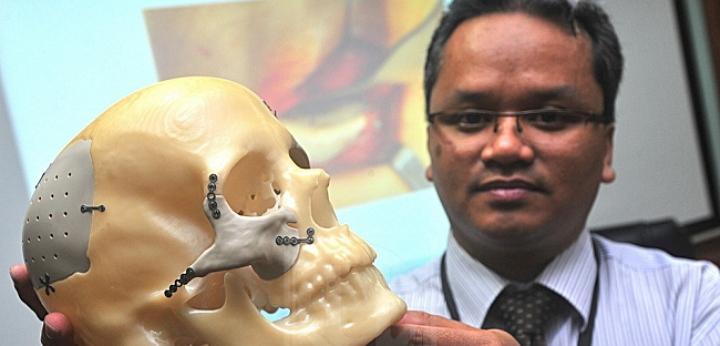
Dr Mohd Nazimi Abd Jabar
Medical applications are one of the most active arenas for innovation in 3D printing advancement, and doctors and technical specialists have now corrected the damage caused by serious facial injuries with 3D printed facial implants.
At the Universiti Kebangsaan Malaysia, Oral and Maxillofacial Surgical expert Dr Mohd Nazimi Abd Jabar has recently used a 3D printed facial implant to correct the damage caused to a female patient involved in a car accident. As part of his collaboration with Materialise Malaysia, Nazimi used the method, what the team says is the first in Malaysia, to implant a 3D printed structure to repair the woman’s facial fractures. The process used 3D planning software – and a custom-made 3D printed titanium device – to reconstruct the skull around the patient’s left eye. It not only resulted in cosmetic improvements, but helped alleviate pain she experienced and the occurrence of excruciating headaches.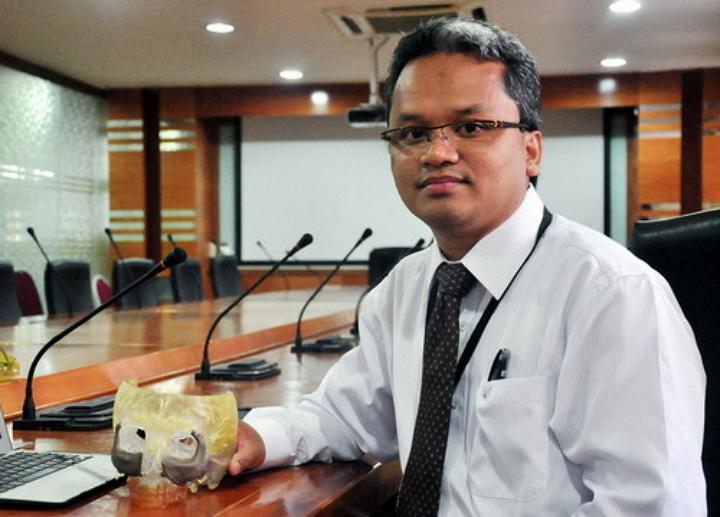
“On a simple X-Ray, you only get a limited amount of information, which is not sufficient to have an accurate analysis of the patient’s pathology and visualize the extent of tumorous growth or damage to a patient’s bone,” Nazimi says. “With 3D, you can get a better understanding of a patient’s unique anatomy and the relationship between bone, soft tissue, and other internal structures.”
Working in cooperation with the engineers, the doctor and his team virtually visualized the patient’s facial structure in 3D using the patient’s MRI and CT data. The surgery was planned and the implant was designed and manufactured to fit the exact dimensions of the patient’s face.
The method meant a 3D printed implant was accurate enough to provide both excellent support around the patient’s eye socket, but it also resulted in an implant which mimics the properties of real bone. Nazimi says that unlike traditional facial implants, 3D printed facial implants are more porous and lighter weight, but they also result in structures of optimal strength and comfort for a patient.
“It can facilitate natural bone growth. It is designed to deal with temperature changes and is impact resistant,” Nazimi says. “Since the device was designed specifically for the patient, it was easy for me to implant, saving time in the operating theater in addition to achieve better results. As a surgeon, knowing the exact dimensions for an incision and exact locations of damage increases the quality of surgical outcomes. This 3D planning and printing technology provides just that by helping surgeons like me visualize and predict outcomes.”
Certainly we will be seeing this technology used much more in the years ahead as 3D printing continues to work its way into the medical arena. Are you aware of any other situations where 3D design and printing have been used to help patient’s recover from injuries? Let us know in the Malaysian Facial Implant forum thread on 3DPB.com.
Subscribe to Our Email Newsletter
Stay up-to-date on all the latest news from the 3D printing industry and receive information and offers from third party vendors.
Print Services
Upload your 3D Models and get them printed quickly and efficiently.













You May Also Like
Creality K3 Opens for Pre-Order at $849, Advancing Multi-Color 3D Printing
Creality has officially opened pre-orders for the Creality K3, its latest flagship K Series 3D printer, starting at $849 in the United States. Recognized as an IFA Innovation Awards 2026...
Beyond the Printer: HP and DyeMansion Tackle the Future of Prosthetics
Making a custom orthotic or prosthetic device involves much more than producing the final part. Patients need to be measured, devices must be designed to fit their bodies, and finished...
3D Printing News Briefs, October 14, 2026: Bolus, Aerospace Tooling, Water Filter, & More
In today’s 3D Printing News Briefs, we’re starting with medical news, as Myrava has received FDA 510(k) clearance for its 3D printed bolus. Moving on to aerospace and metals, AML3D...
Can India’s AM Push Help Make it a Viable Supplement to China?
Diversifying manufacturing supply chains to locales outside of China has nothing to do with actually cultivating “substitutes” to the Chinese economy. The real stakes are these: China is an irreplaceable...