German Designer 3D Prints an Amazing Optical Illusion That Will Drive You Insane!

The idea that 3D printing can open up avenues that previously have not been available via other art forms, is something that makes this technology so incredibly appealing for artists and visionaries throughout the world.
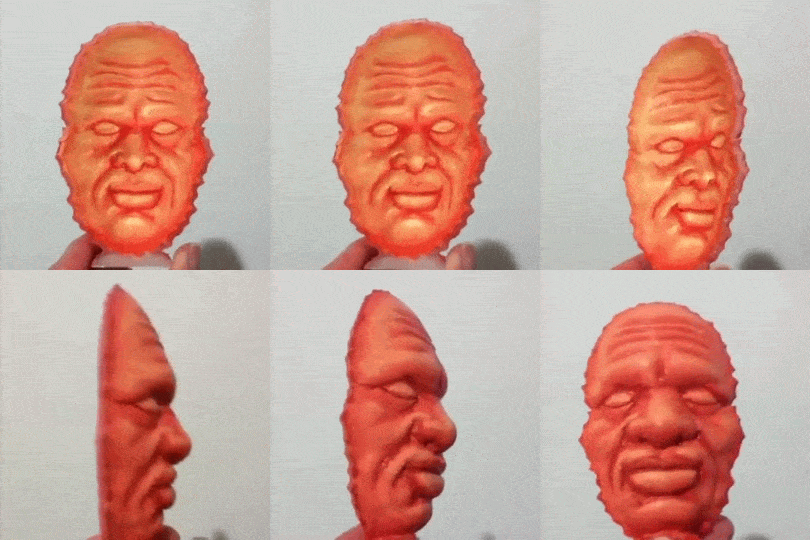 For one German man, named David Hagemann, 3D printing has really allowed him to unleash many really unique creations on a global level. Just last week, we reported on a 3D printed palm tree fruit holder that he created, and last month we did a story on his 3D printed ‘Linklings‘. Hagemann is constantly trying to come up with new ideas that separate his creations from the mundane.
One of his latest design ideas came about after he saw how a simple black and blue dress became an overnight internet sensation, simply because no one could agree on what color it was. Surely you have seen this overly publicized dress.
“I just thought about what kind of illusion could be easy to 3D print and I then came up with an inverted face idea which is also known as the hollow mask effect,” Hagemann tells 3DPrint.com. “I did something with inverted eyes before which happened more by accident since a lot of my early prints were shells and I made the eyes separate.”
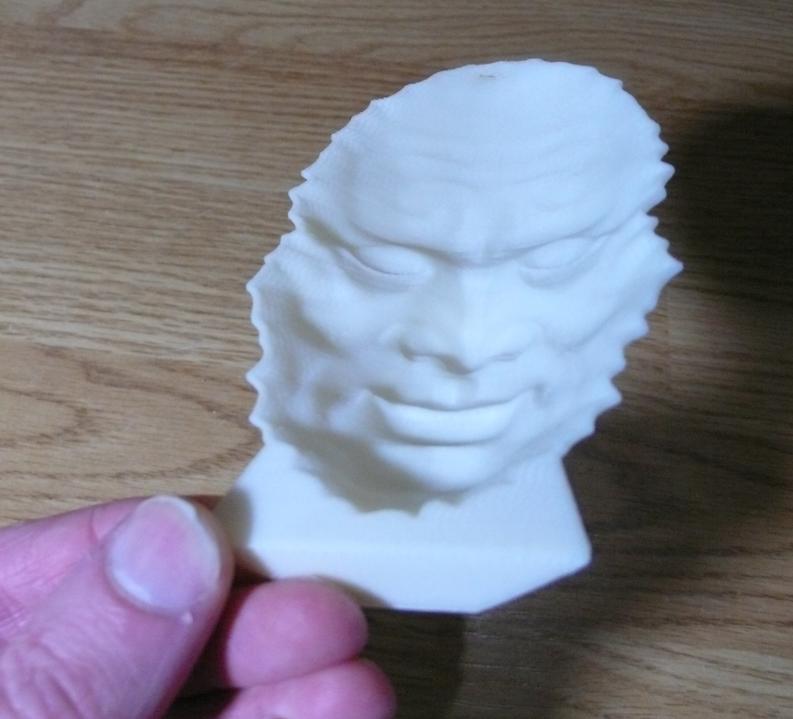 So Hagemann set out to create an entire face that can be viewed from both sides, yet provide the appearance that the facial features are protruding outward toward the viewer. While one side of the print is inverted, both sides appear to be sticking out. The task of creating this design and then 3D printing it, certainly wasn’t easy.
When Hagemann printed his first version, he noticed that ‘shadow casting’ was a huge problem. The steep hole, which acts as the inverted nose on the face, was casting a large shadow which in turn made the entire illusion fail.
“I ended up smoothing steep facial features, which was mainly the nose, and squashing the whole face to be more flat,” Hagemann tells us. “This way it hardly [has any] overlapping when viewing it and it only very little shadow casting inside. I printed a very thin version in natural ABS which came out surprisingly well.”
Hagemann also discovered that his illusion worked really well when light shines through it from the back side. While the illusion is mostly one that stems from psychological conditioning, the design itself also plays a huge role in making it happen.
“The effect does not really require a light shining on it from the bottom, since most people have the viewing of positive faces engraved so much into their brain that they will see a negative face always as a positive face,” Hagemann explains to us.
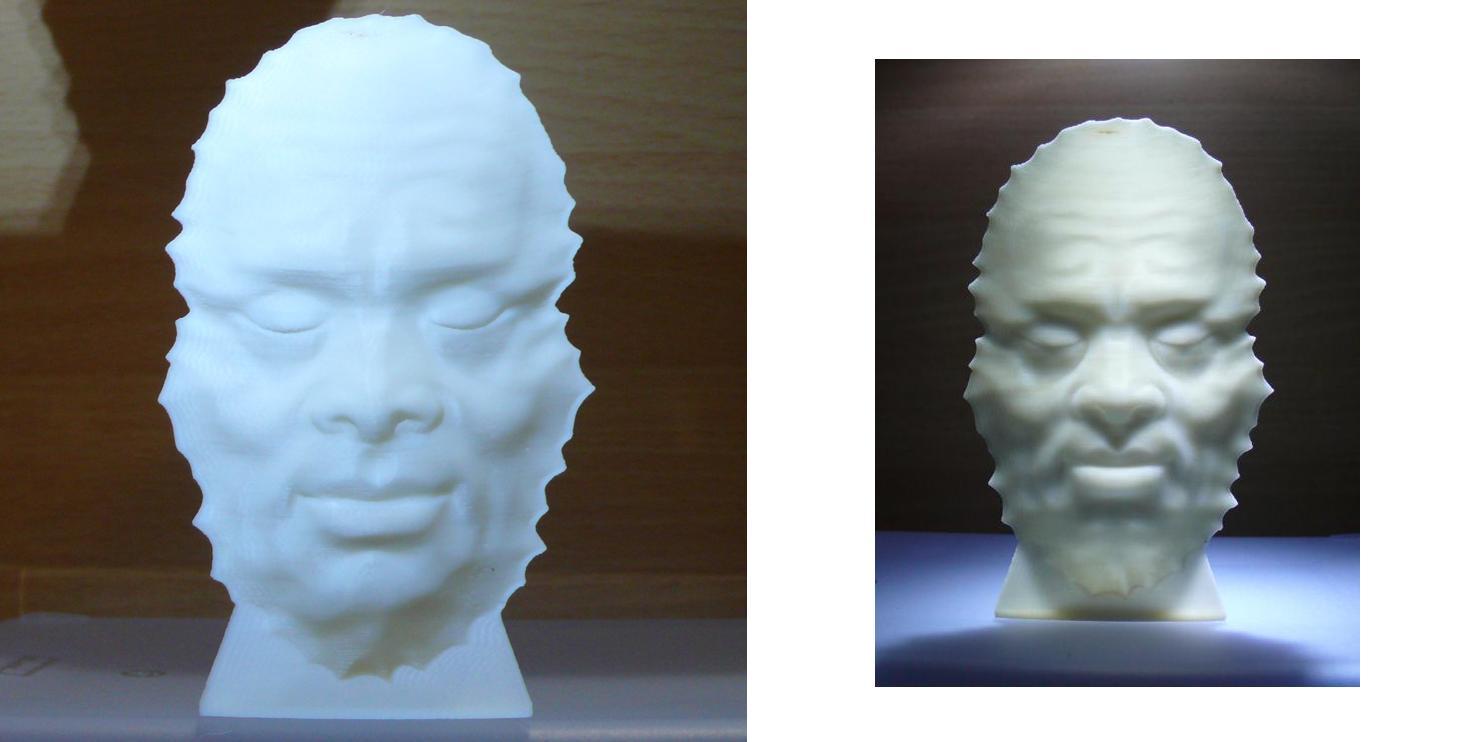
The majority of people will see a ‘positive’ face when viewing Hagemann’s 3D printed creation, although not everyone will. In particular Schizophrenia sufferers will not be fooled by this illusion. Others also have the ability to depict the fact that they are viewing an inverted object, but very few do. This is because of the way our brains are built.
“Our top-down processing holds memories, like stock models,” explained Danai Dima of Hannover Medical University, in Germany, co-author of a study in NeuroImage. “All the models in our head have a face coming out, so whenever we see a face, of course if has to come out.”
So, what do you see? Do you see a positive or negative face? Discuss in the 3D printed optical illusion forum thread on 3DPB.com. Check out the video of the mask below, as well as the Sketchfab illustration.
Subscribe to Our Email Newsletter
Stay up-to-date on all the latest news from the 3D printing industry and receive information and offers from third party vendors.
Print Services
Upload your 3D Models and get them printed quickly and efficiently.











You May Also Like
U.S. Congress Holds Hearing on Cutting Healthcare Costs and Points to 3D Printing
A U.S. House subcommittee held a hearing this week on how technology can help lower the rising cost of healthcare for Americans. Lawmakers pointed to 3D printing as a key...
3D Printing News Briefs, December 13, 2025: 3D Imaging, Living Lung Cells, & More
We’re covering medical and dental news in this weekend’s 3D Printing News Briefs, starting with a new innovation at Boston Children’s Hospital that could become standard practice in orthopedics: 3D...
New 3D Printed Hydrogen Cell Factory Just Switched On in Catalonia
The Catalonia Institute for Energy Research (IREC) has opened a pilot plant that 3D prints advanced ceramic devices for renewable hydrogen systems. It’s described as the first facility on the...
Boston’s Additive Edge: Harvard’s MEDscience Takes High Schoolers Into the Future of Medicine
Forget chalkboards and worksheets. At Harvard Medical School’s MEDscienceTECH Program, students learn medicine by building, coding, and experimenting – whether it’s navigating a LEGO robot through a 3D printed spine,...