Nivalon Creates a Custom, Metal-Free Spinal Implant Using XJet 3D Printing


Nivalon Medical Technologies says it has successfully produced a fully patient-specific spinal implant that preserves motion and contains no metal, using AI-based design and ceramic 3D printing.
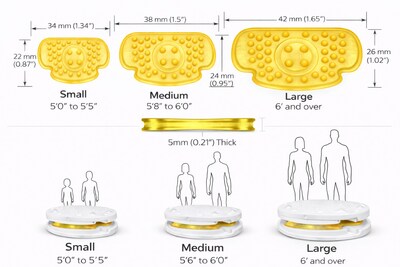
The implant is designed directly from a patient’s CT data and combines bone-like ceramic endplates with a flexible core that allows natural movement. Unlike conventional spinal implants, which are made from metal alloys and produced in fixed sizes, Nivalon’s design is tailored to each patient’s anatomy and how their spine actually moves.
According to the company, the implant uses a zirconia-toughened alumina (ZTA) ceramic structure that behaves more like bone than metal. By eliminating metal, the design avoids issues commonly associated with metallic implants, such as corrosion, ion release, stiffness mismatch, and imaging artifacts during MRI or CT scans.
Nivalon says this is the first fully ceramic, patient-specific spinal implant system it has taken into production. While ceramic and polymer-based spinal implants have been studied for years, the company says its work stands out by combining custom design, load-bearing ceramic parts, and motion preservation in a single implant.
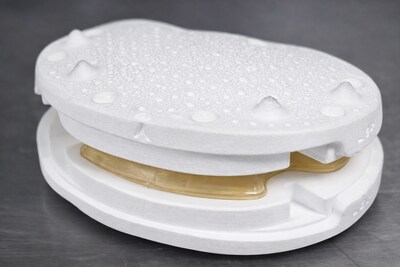
Patient-specific, 3D printed ceramic spinal implant.
Preclinical Testing and Validation
The implant platform has undergone independent preclinical testing at the University of South Florida (USF) and the University of Connecticut Institute of Materials Science (UConn IMS).
At USF, the company’s proprietary EvoFlex implants were evaluated on the Dynamic Investigation of Spine Characteristics (DISC) simulator under six degrees of freedom motion. Nivalon reports that the implants “demonstrated stiffness and motion profiles closely resembling those of the native human spine, supporting the claim of true motion preservation rather than simple mechanical articulation.”
Mechanical testing at UConn IMS showed compressive load performance of 14.6 kN, equal to roughly 1,490 kg (3,280 lbs) of force. Shear testing showed the implant remained stable and behaved predictably under stress.
UConn researchers also tested the implant in simulated body fluid and analyzed its surface. The company says the ceramic showed bone-like behavior and the ability to integrate with surrounding bone (osseointegration) in a predictable way.
The company also tested its digital planning system using cadaver studies. In a complex, multi-level spinal reconstruction, the software accurately aligned the spine and restored proper balance.
Ceramic 3D Printing in Youngstown
Manufacturing of the implant was carried out in collaboration with the Youngstown Business Incubator, using XJet’s NanoParticle Jetting technology to produce load-bearing ceramic components.
According to Nivalon, microscopic analysis showed the ceramic could be produced consistently for medical use, supporting scalable manufacturing.
The project is deeply personal for Nivalon’s co-founder and CEO, Todd Hodrinsky, who plans to be among the first recipients of the implant when first-in-human procedures begin in 2026.
“I realized the problem wasn’t the surgeons — it was the implants,” said Hodrinsky. “We were trying to treat a living biological structure with industrial metal hardware that was never designed to behave like bone or properly follow natural spinal motion. We knew we could engineer something fundamentally better.”
What began as a collaboration between Hodrinsky and co-founder Marcel Janse has grown into a broader effort to rethink spinal implants around patient-specific design and biological compatibility, rather than standardized metal components.
“This is more than a technical achievement — it’s personal,” said Hodrinsky and Janse. “The endplates for my own spine are now complete. This is the difference between living with chronic complications and restoring a normal, active life.”
Nivalon says the project marks a transition from research to clinical manufacturing. The company holds two issued U.S. patents and has six pending, and is preparing for NIH Phase II SBIR funding, FDA PMA clinical trials, and first-in-human procedures in 2026.
Nivalon is not presenting the implant as a finished commercial product. Instead, the company says this milestone shows that patient-specific, metal-free spinal implants can be designed, made, and tested using 3D printing, opening the door to new approaches in spine surgery. The impact will depend on clinical results and regulatory approval, but the project shows ceramic 3D printing moving from research into real medical use.
Images courtesy of Nivalon Medical Device
Subscribe to Our Email Newsletter
Stay up-to-date on all the latest news from the 3D printing industry and receive information and offers from third party vendors.
Print Services
Upload your 3D Models and get them printed quickly and efficiently.













You May Also Like
Metal 3D Printers for the Desktop Are Finally Starting to Feel Like Desktop Products
FDM 3D printing is becoming increasingly accessible, yet metal 3D printers designed for everyday desktop use remain rare on an ordinary workbench. The real challenge is not making a metal...
What 3D2GO Says About 3D Printing’s Growth in Southeast Asia
The Philippines offers an interesting case study in how 3D printing can develop in Southeast Asia, and Manila-based 3D2GO helps illustrate it. 3D printing in Southeast Asia doesn’t have to...
The Frankenservice Part 2: Have Your Cake and Eat it Too
This series of articles delves into a thought experiment. What if we let go of using a few machines very optimally, but instead use lots of different machines to meet...
Silencer Market Set to Test Metal Additive’s Readiness for Production Prime Time With Enormous Market Expansion
Throughout the history of additive manufacturing (AM) technologies, there are only a couple of really interesting case studies in which we see a market significantly disrupted and revolutionized by AM....