Sean Hall 3D Prints a DIY HoloLens Setup


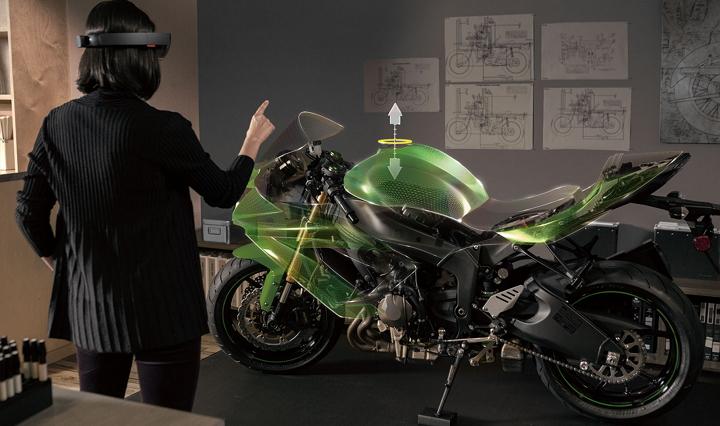 Microsoft has hinted at the imminent release of a piece of hardware they call the HoloLens, and the software giant says it “goes beyond augmented reality and virtual reality by enabling you to interact with three-dimensional holograms blended with your real world.”
That’s some mighty big talk.
Microsoft says HoloLens is not simply a heads-up display, it’s a promise of high-definition holograms and the ability to interact with three-dimensional holograms in the real world. They say the system will deliver, with no cords, no phones, no wires, and no tethers, via a lightweight and adjustable headset, holograms, and built-in “spatial sound” capability distributed throughout a room. We covered the announcement back in January.
Of course, that kind of vision has sent DIY engineers into paroxysms of joy and spurred a number of efforts to develop hardware for the system.

Sean Hall
Sean Hall has built an end run around Microsoft with this 3D printed prototype, a pair of VR goggles which use Pepper’s Ghost illusion to create a hologram.
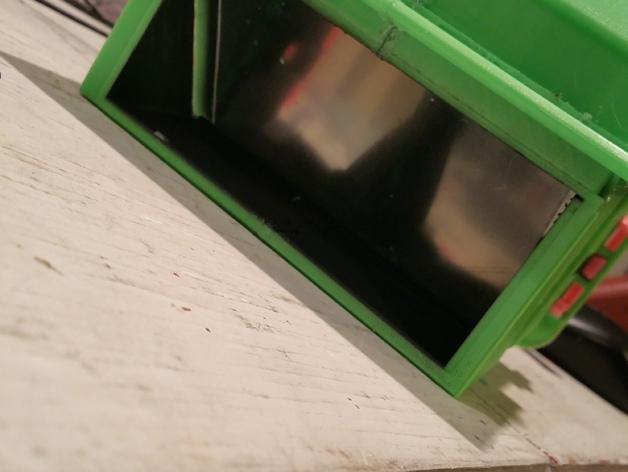
Hall 3D printed an enclosure like others before it, but with a twist. Hall’s device mounts a smartphone above the 3D printed goggles, and then uses a mirror and a piece of transparent plexiglass to locate and display the image.
Hall, a VR game programmer and software engineer in Marietta, GA, took on developing his hardware after deciding to start work on building HoloLens apps.
His DIY HoloLens device cost him just $10 in materials, and he says it projects any mobile phone image to an enlarged version 16″ from the eye.
“I plan to add a Leap Motion, depth sensor, and/or tracking to be able to interact with virtual objects,” Hall says. “A friend found a product called one-way mirror film. It is usually used on windows in the home to let light in but still provide privacy. I ordered some to try on the piece of plexiglass. Hopefully, the silvering will not only make the image brighter, but also allow me to remove the film from the back side – which blurs the outside world slightly – although given how rough around the edges this whole thing is, may be hiding some focus issues for various distances, and be for the better in the end.”
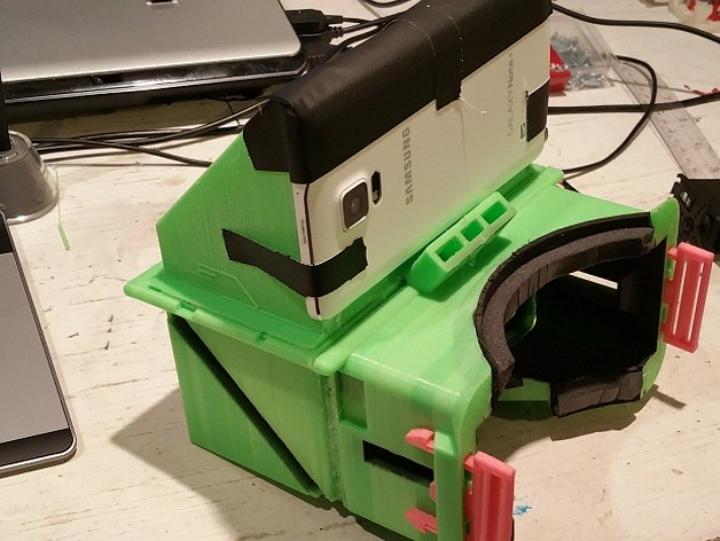 To make the device, Hall says he used PLA and his Printrbot Simple Metal to print his design made in Simplify3D.
“I’m still new to this, so I haven’t had a chance to experiment with ABS, but I don’t see why it wouldn’t work,” Hall says of the material selection. “The parachute-style buckles probably prefer PLA’s flexibility over ABS, but the rest should be fine. I may try out semi-rigid Ninjaflex next.”
You can find the files to print out your own version on Thingiverse.
What do you think about Sean Hall’s “DIY HoloLens” setup? Can you see any potential uses for his design? Let us know in the 3D Printed HoloLens forum thread on 3DPB.com. Check out the video below to see the DIY setup in action (and try not to get that soundtrack stuck in your head!) to get an idea of the headset.
Subscribe to Our Email Newsletter
Stay up-to-date on all the latest news from the 3D printing industry and receive information and offers from third party vendors.
Print Services
Upload your 3D Models and get them printed quickly and efficiently.













You May Also Like
3D Printing Markets Totaled $4.35 Billion in Q1 2026, AM Research Report Shows
According to the latest data from Additive Manufacturing Research (AM Research or AMR), the 3D printing markets totaled $4.35 billion in the first quarter of 2026. The leading industry analyst...
The Next Phase of EB-PBF Will Be Defined by Beam Control
The bar for metal additive manufacturing has moved. Early on, the question was often simple: Can the machine print the material and produce a dense part? That still matters, but...
UAS Additive Strategies Shows How Fast Drone Manufacturing Is Changing
The recent UAS Additive Strategies online event, hosted by 3DPrint.com and Additive Manufacturing Research (AM Research), brought together leaders from across the additive manufacturing (AM) and drone industries to discuss...
The Drone Industry is Showing Where 3D Printing Delivers Real Value, AM Research Report Finds
The rapid rise of drones is creating one of the biggest opportunities for additive manufacturing (AM). Whether they’re used on battlefields, inspecting bridges or crops, or delivering supplies, drones need...