Expand Your NUC’s Capabilities with Intel’s 3D Printable Lids


 If you are a fan of smaller-scale computing, then you probably already know about the Intel NUC (Next Unit of Computing). It’s a customizable micro-sized (4.53″ x 4.37″ x 1.92″) PC that comes with a bare bones set up of mother board, CPU, and casing. You provide everything else — like the memory, power cord, and mSATA SSD. It can be used for home theatre and basic office needs, and it has appeal for those who like the sleek small size that generates much power while simultaneously leaving a smaller footprint. It is so small that it fits into your hand, yet for that size, it can fulfill a wide range of your personal or business needs. Now Intel has made files available to 3D print your own NUC lids, further expanding the machine’s capabilities and applications.
First introduced in 2012, the NUC has developed into a powerful platform. Fans of the NUC laud its simplicity of design and its multi-functional capabilities for college 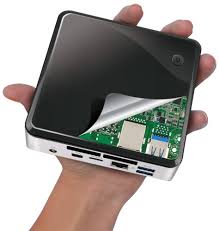 campus computer labs, digital signage, and retail kiosks — to give just a few examples. It also supplies a surprisingly easy way to use basic office programs and surf the web for those who don’t have a complex range of computer needs. The NUC comes as a kit with a wide range of options, and the most expensive kit to date is just over the $400 mark, with the NUC board available for as little as $99.
Since the NUC is available as a kit, it has also been described as a more powerful (and expensive) Raspberry Pi. The Raspberry Pi is an inexpensive computer the size of a credit card that can plug into a TV or computer monitor. It can be used for all of the basic computer functions (play video, surf web, make word documents) and it has also facilitated many digital maker projects as well. The Intel NUC shares the same functionality as the Raspberry Pi, but more so, and Intel encourages people to expand the NUC’s functionality by maximizing its capabilities through access.
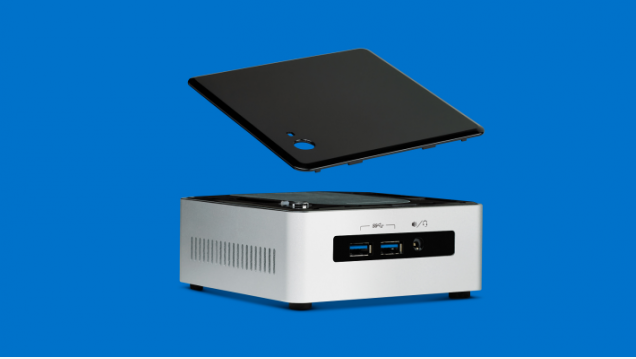
Because the latest Intel NUC kits have some open internal headers, the right lid will allow you to access their power. Intel has provided mechanical drawings for users to customize their own NUC lids, or it encourages the use of third parties for lid replacements. The company’s website states that a new lid will expand the NUC’sfunctions like “wireless charging near field communications, or 4G/LTE.” Customization allows users to emblazon their own company or institutional logo onto the machine, while supporting expanded functionality as well.
Since customization is the essence of 3D printing technology, it’s fitting that Intel has encouraged 3D printed replaceable NUC lids. In fact, Intel now provides downloadable files for you to 3D print your own NUC lids for easier access to the machine’s various possibilities. An example of this is to print a lid that expands connectivity. The company website explains that “if the NUC doesn’t come with the all the I/O you want, you can add more with an expansion lid containing USB 2.0, VGA, RS232C COM, SDXC card reader, or other ports.”
So, if you have a NUC and have been itching to take it to the next level, however you define it, Intel couldn’t have made this easier to do. Simply download and customize the replaceable lid files, and see exactly what this little machine is capable of doing.
Is the Intel NUC part of your computing arsenal? If so, how would you (or have you) customize its lid with the newly available 3D files? Let us know in the Intel NUC forum thread over at 3DPB.com.
Subscribe to Our Email Newsletter
Stay up-to-date on all the latest news from the 3D printing industry and receive information and offers from third party vendors.
Print Services
Upload your 3D Models and get them printed quickly and efficiently.













You May Also Like
Conexeu Sciences Wishes to Make a Regenerative Breast Matrix Solution (and sell shares)
Conexeu Sciences wants to commercialize a regenerative breast matrix solution. For years, Australian firm BellaSeno and Lattice Medical have been working on similar solutions. In 2018, Lattice came out with...
3D Printing News Briefs, August 23, 2025: Facial Implants, Tibial Fractures, Lamps, & More
It’s all about medical in this weekend’s 3D Printing News Briefs. BellaSeno established a clinical advisory board. MedCad is donating 3D printed facial implants to war-injured Ukrainians, and researchers in...
BellaSeno’s 3D Printed Breast Implants Keep Shape with 87% Fat Volume, Avoids Silicone Risks
At a medical conference in Austin this week, a new kind of breast implant took center stage. It is not made from silicone but from a 3D printed, fully resorbable...
BellaSeno Completes Two Clinical Trials on 3D Printed Resorbable Breast Implants
German firm BellaSeno, which is focused on 3D-printed resorbable breast implants for both augmentation and lumpectomy, has completed two clinical trials for resorbable breast implants. These trials represent the first-ever...