Why the AM Industry Should Pay Attention to Schneider Electric’s $22.6B PTC Acquisition

By late 2024, there was already enough signaling of the additive manufacturing (AM) industry opportunity in the data center infrastructure market for AM Research to write a report on the topic, which was published in February 2025. Since then, AM use cases in data centers have steadily increased, reinforcing that it’s a topic the industry has to pay attention to.
One of the companies covered in the AM Research report is Schneider Electric, the French energy technology giant. While Schneider may not be one of the companies that regularly pops up in conversations about AM, the multinational is a longtime AM user and a big proponent of smart manufacturing processes.
Along those lines, Schneider’s recent major acquisition of PTC, the Boston-based industrial hardware firm, has significant implications for the AM industry. Schneider’s all-cash, $22.6 billion acquisition, expected to close in Q3 next year, values PTC at more than 40 percent above its last closing price before the transaction’s announcement.
According to company leadership, Schneider views the price as well worth it because data center equipment demand has become integral to its business model. In that context, US demand is primary to Schneider’s strategy, driving the company to expand investment in its domestic US manufacturing capacity, a topic highlighted in the AM Research data centers report.
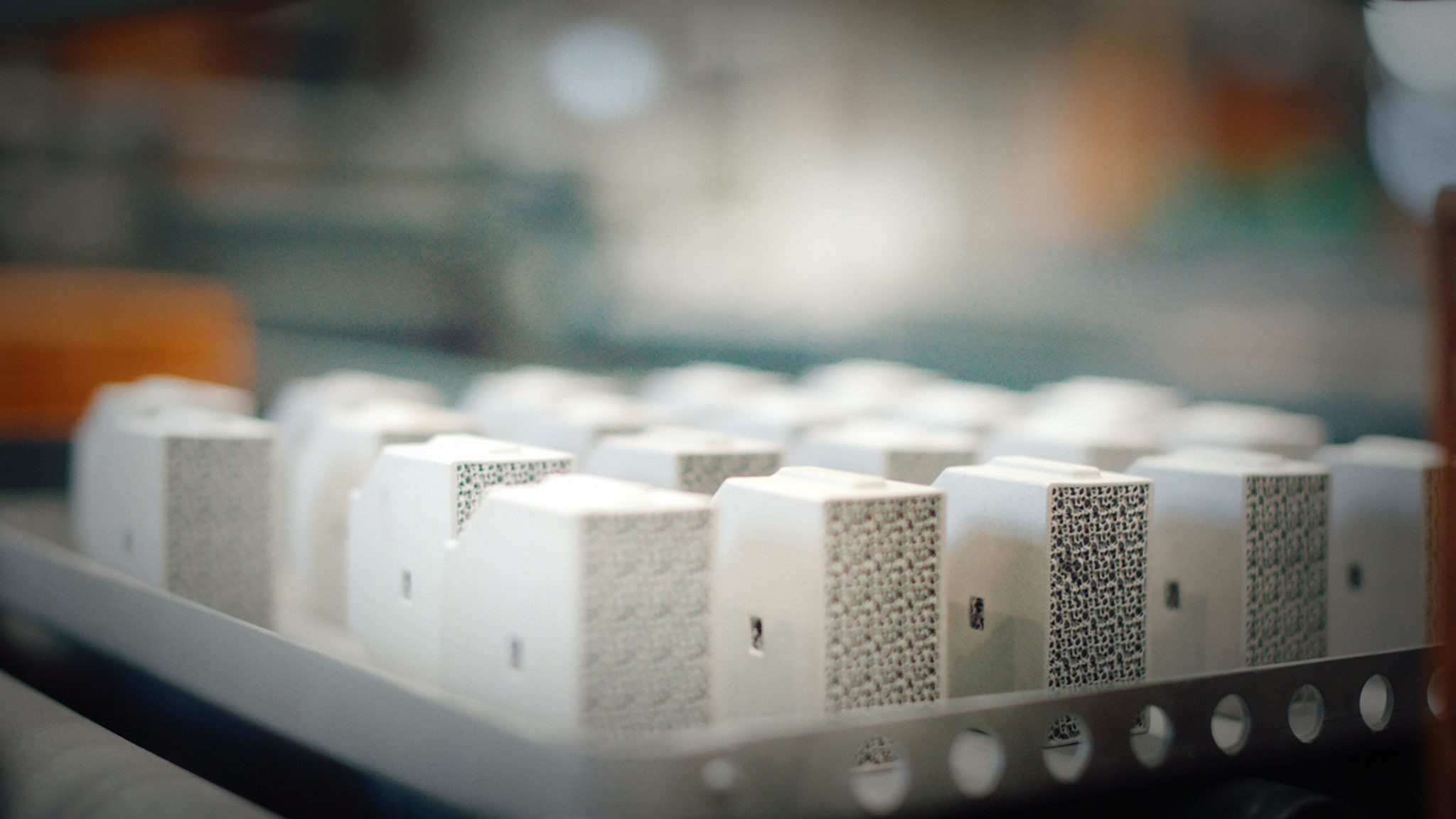
Filter printed on HP’s Metal Jet system. Image courtesy of Schneider Electric.
While PTC offers a broad variety of enterprise management products, Schneider may be most interested in the company’s Windchill Product Lifecycle Management (PLM) software. PLM is PTC’s biggest revenue driver, and earlier this year, the US Army named Windchill “as its primary product data and lifecycle management platform”, which obviously has relevance at a time when the Army is ramping up its AM adoption for applications including drones and ground vehicle systems. PTC excels at providing capabilities related to managing the digital thread across large enterprises (a topic Vanesa Listek recently discussed in a post sponsored by America Makes).
In addition to helping data center operators secure 3D printed components, like this metal filter for a circuit breaker that Schneider made in collaboration with HP and GKN, Schneider is also likely interested in helping US manufacturers ready their own networking capacity in anticipation of an acceleration of the reshoring process. This is a subject I’ve written about occasionally, but it seems to be one that manufacturers are starting to pay more attention to as demand for US-based manufacturing finally seems to be picking up. The need for more electric power capacity is increasingly seen as a major barrier to US manufacturing output growth.
With that in mind, there appears to be a coherent, multilayered rationale behind the acquisition, which is the largest in Schneider’s history. Schneider adds to its ability to manufacture products for the data center market, while at the same time adding to its ability to deliver data products to manufacturers.
This aligns with what I recently wrote in my post about the signaling of rising demand for AM solutions to the global grid resilience problem. AI, growing electricity demand, the reorganization of manufacturing supply chains: these are in no way separate considerations; they’re all components within the enormously complex challenge involved in a general recalibration of the relationship between the virtual and real economies.
In that case, it couldn’t be more appropriate that this macroeconomic theme has been manifested in a microeconomic story about a hardware giant acquiring a software giant. And if Schneider successfully assimilates PTC’s operations, US AM companies should find it much easier to tap into demand for data center hardware and a broader range of grid applications.
Featured image courtesy of PTC
Subscribe to Our Email Newsletter
Stay up-to-date on all the latest news from the 3D printing industry and receive information and offers from third party vendors.
Print Services
Upload your 3D Models and get them printed quickly and efficiently.













You May Also Like
South Korea’s Lincsolution Lands Hanwha Defense Deal as Hanwha Invests Billions in US
I recently wrote about how the South Korean additive manufacturing (AM) firm Lincsolution is building an aerospace and defense hub, part of the company’s construction of “the largest AM facility in...
Bambu Lab and SUSAN FANG 3D Print for London Fashion Week
At London Fashion Week, some of the more unusual pieces on the runway came from 3D printers. Chinese fashion designer SUSAN FANG presented her Spring/Summer 2027 Air-Illusion collection at the...
Why Cross-Border 3D Printing Is Closing the Speed Gap with Local Manufacturing
The fastest 3D printing supplier in your shortlist may no longer be the one closest to your office. That sounds unlikely to many engineers. For years, overseas 3D printing carried...
Arridex Expands 3D Printing Network to Ghana
Nigeria-based Arridex has deep experience in oil and gas additive manufacturing. Previously known as RusselSmith, the firm has in-house metal and polymer additive technology. The company is making 3D printed...