ETH Zurich Uses Bacteria to 3D Print Facade Elements


ETH Zurich has used bacteria to build facade elements. The living bacteria effectively bind sand together by forming calcium carbonate through the precipitation of calcite crystals. The work was carried out by Karen Antorveza Paez of ETH’s Department of Architecture. The process, known as microbiologically induced calcite precipitation (MICP, also called biocementation), has previously been used in self-healing concrete and to reduce soil erosion. The bacteria involved, Sporosarcina pasteurii, could also be used in applications such as crop control and eco-friendly construction. Paez’s approach could offer environmental benefits, since it may require significantly less energy and produce far less CO2 than conventional construction methods.
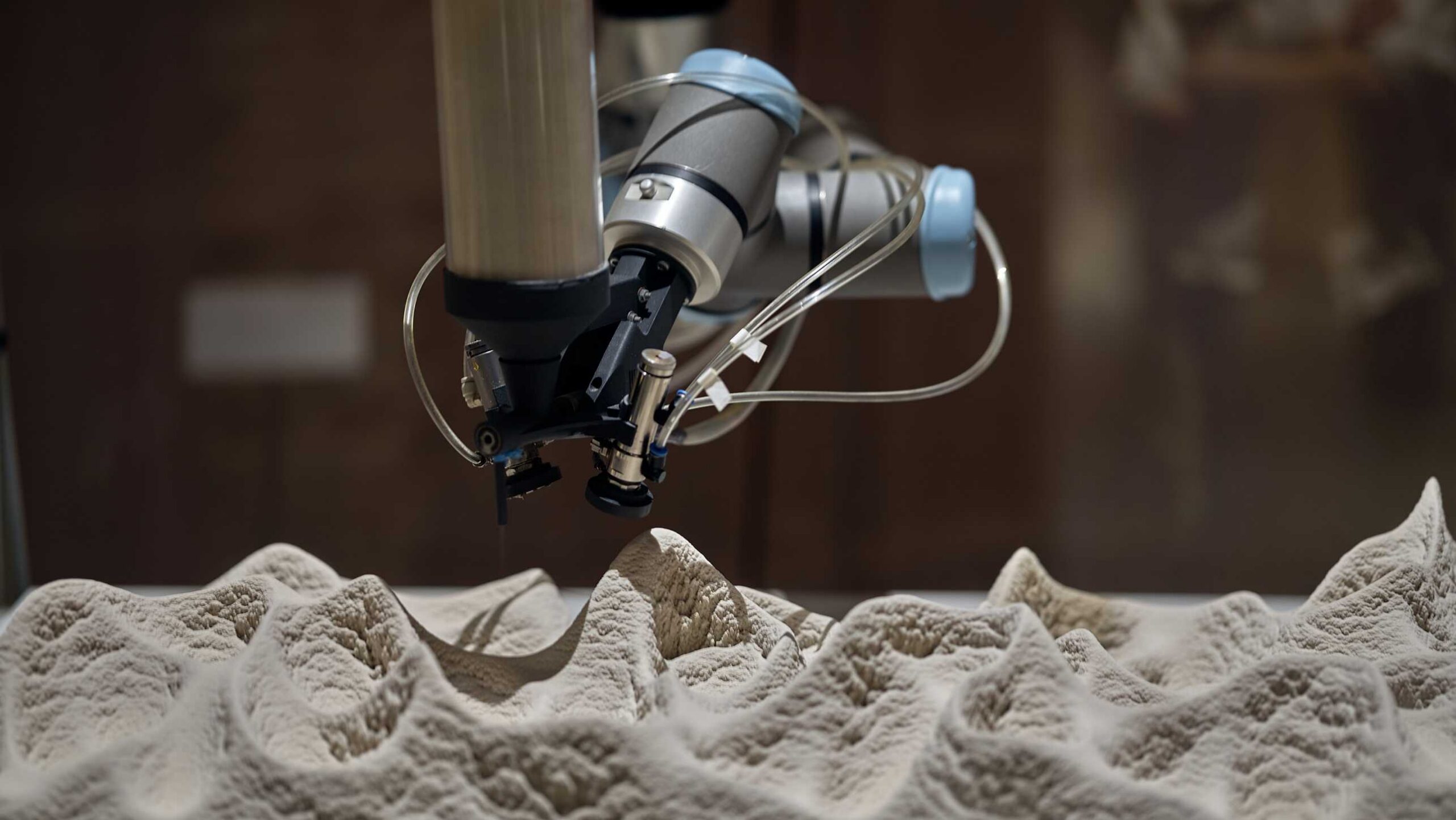
A robotic system applies material to create biocement structures as part of ETH Zurich’s research into bacteria-based construction. Image courtesy of ETH Zurich/Gerhard Bliedung.
Paez states that “We’re using bacteria to produce a sort of mineral glue. What was missing were manufacturing processes whereby these biological processes can be controlled as required and used to make architectural elements.”
In this case, biocement 3D printing uses a shear-thinning alginate and xanthan-based hydrogel ink doped with bacteria. This is printed into a form and put in a urea and calcium chloride bath. Calcium crosslinks the alginate, and ionic bonds stabilize the shape. The bacteria then feed on the urea, precipitating out the calcium carbonate. There should be some ammonium waste, but this is a very exciting process because all the ingredients are super cheap and abundant. Essentially, they’re creating limestone or oyster shells from bacteria. Then the crystals lock into place, and the object is set. It then dries, and the bacteria become inactive. These two distinct steps — alginate formation and crystal locking — should leave a stable material behind. What’s more, it shouldn’t be a danger to the environment and could be reused.

ETH Zurich’s robotic biocementation exhibit at the 2025 Venice Architecture Biennale. Image courtesy of ETH Zurich/Matteo Losurdo.
The whole process takes up to five days, but much of that is essentially marinating.
Paez thinks that, “It’s a bit like baking a cake. You’ve got the dough, which is still very malleable and delicate. Only the oven can turn it into something solid.”
Additionally, Paez and her team are exploring robotic spraying, where bacteria, sand, urea, and calcium chloride are sprayed layer by layer. The team showcased this at the 2025 Biennale Architettura in Venice for six months. This automated approach could be a promising path toward bacteria-3D printed buildings. Some things will have to be fixed, of course, like safely capturing the ammonia so it isn’t absorbed into the soil. Calcium chloride is also a respiratory irritant, so you probably will want to do this in a central factory or enclosure of some sort while wearing PPE. Happily, the team is looking to mitigate any environmental risks.
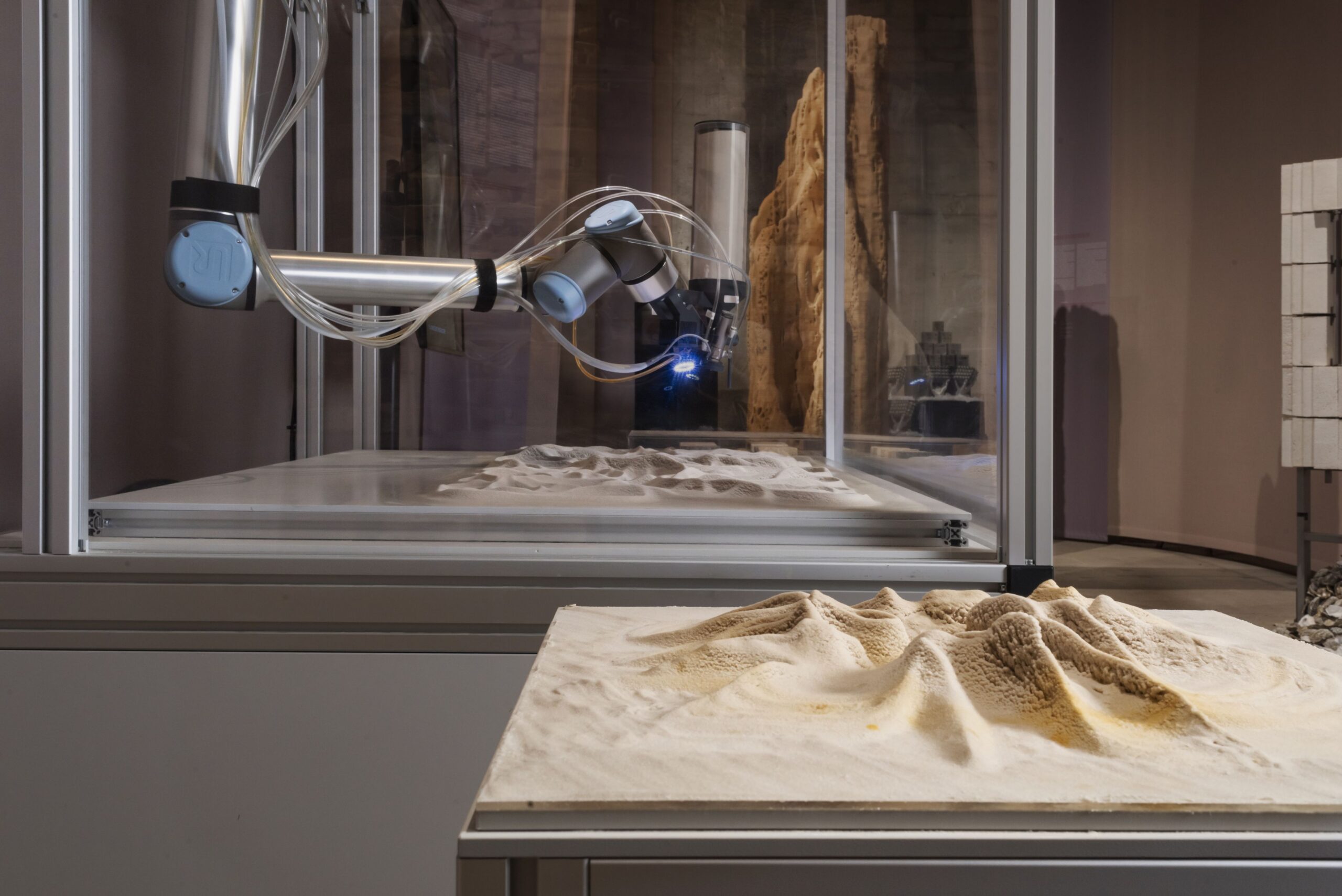
A robotic spraying system used to create biocement structures with bacteria. Image courtesy of ETH Zurich/Matteo Losurdo.
Paez considers that “The printing is geared more towards architectural elements, while the spray process is more designed for surfaces.”
For the spray process, mechanical properties, bonding, and deposition remain challenges. Paez also states that while facades and the like are doable, actually getting the binder, aggregate, proportions, and recipe right may take a very long time. You can find this research in 3D biocement printing: scaling up living mineral structure, robotic biocementation spraying: a bioinspired fabrication method for architectural surfaces, and design workflow for porous 3D printed biocement geometries.
In situ SEM imagery of Bacteria building structures.
I love this so much. This is a completely new way of making structures, but at the same time it’s analogous to some of the oldest ways of making. Things like coral and stalactites are very similar. Bacteria already manufacture so much for us, from insulin to antibiotics, vaccines, bioplastics such as PHA, yogurt, and kimchi. This could be a super-sustainable process that produces certain architectural elements that are recyclable and use little energy. If the team can find a way to turn excess ammonia into fertilizer on site, or perhaps use the nylon rope trick invented by Stephanie Kwolek, who invented Kevlar, you could make PA66 or something else useful with the excess ammonia. We don’t yet know whether this process is feasible for construction or what the costs would be. But if you’re an artist, designer, municipality, or science museum that wishes to showcase a world radically different from our own, then this may be just the ticket. Bacteria already build so much for us; why not buildings?
Subscribe to Our Email Newsletter
Stay up-to-date on all the latest news from the 3D printing industry and receive information and offers from third party vendors.
Print Services
Upload your 3D Models and get them printed quickly and efficiently.












You May Also Like
50,000 Orders and Counting: EPlus3D & Chinese AM Services Provider Are Scaling Liquid Cooling Solutions for AI Servers
An under-appreciated story driving the additive manufacturing (AM) industry this year has been the divergence between what’s driving the market in China and what’s driving it everywhere else. Let’s start...
Additive Manufacturing Has a Major Growth Opportunity; Trust Will Decide Who Captures It
After years of overpromising, the next phase of AM growth will be won by companies that consistently deliver what they say. When I entered additive manufacturing in 2014, after 15...
Seven Trends Reveal What’s Next for 3D Printing at TCT Shenzhen 2026
TCT Shenzhen 2026 opened on October 14 in Hall 15 of the Shenzhen World Exhibition & Convention Center in Bao’an, and ran through October 16. The event brought together equipment...
AM Investment Strategies 2026 Sets the Stage for AMS 2027
AM Investment Strategies 2026 Nov. 5 · 12 p.m. ET · Free online event RESERVE YOUR SPOT ↗ A one-hour online discussion featuring some of the biggest names in 3D...