
Bambu Lab Is Building More Than 3D Printers. Now Comes the S1 Scanner

Bambu Lab is moving into 3D scanning. The company has teased its upcoming Bambu Lab S1, its first 3D scanner, marking another step in its expansion beyond desktop 3D printers. The device is set to launch in November 2026, although Bambu Lab has yet to reveal its technical specifications, pricing, and full list of features.
After expanding into laser cutting with the launch of its H2D 3D printer in March 2025, Bambu Lab is now entering another part of the digital manufacturing process. The move brings the company closer to its goal of offering a broader range of tools for personal manufacturing, rather than focusing on 3D printing alone.
Behind this expansion is a bigger goal of building what Bambu Lab calls a “personal manufacturing hub,” making professional-grade tools more accessible to individual creators, designers, and small businesses. And 3D scanning could become an important part of that approach. While a 3D printer turns a digital design into a physical object, a scanner does the reverse, creating a digital model of a real-world object. Bringing both technologies into its product lineup could open new possibilities for users who want to reproduce, modify, or customize physical objects.
According to Bambu Lab, potential applications include scanning vehicles to design custom wraps, capturing collectible figures for replication or restoration, preserving cultural artifacts for virtual and augmented reality, and scanning the human body to create customized clothing, footwear, or assistive devices. More broadly, 3D scanning is also used in reverse engineering, product development, and the creation of replacement parts, although it is still unclear which other applications the S1 will support.
The company also believes there is room to improve the scanning experience. In its announcement, Bambu Lab pointed to “unreliable wireless connections” and “steep learning curves” as obstacles that have made 3D scanning difficult for some users. It says the S1 is being developed with a focus on engineering performance and ease of use.
Actually, these challenges are not entirely new. Industry reviews and research have also highlighted the practice, preparation, and technical knowledge sometimes needed to produce good 3D scans, suggesting there is still room to make the technology easier to use. A 2025 study on 3D hand scanning found that even a short training session could improve scanning reliability, while technical training resources also highlight how lighting, surface conditions, and preparation can affect scan quality.
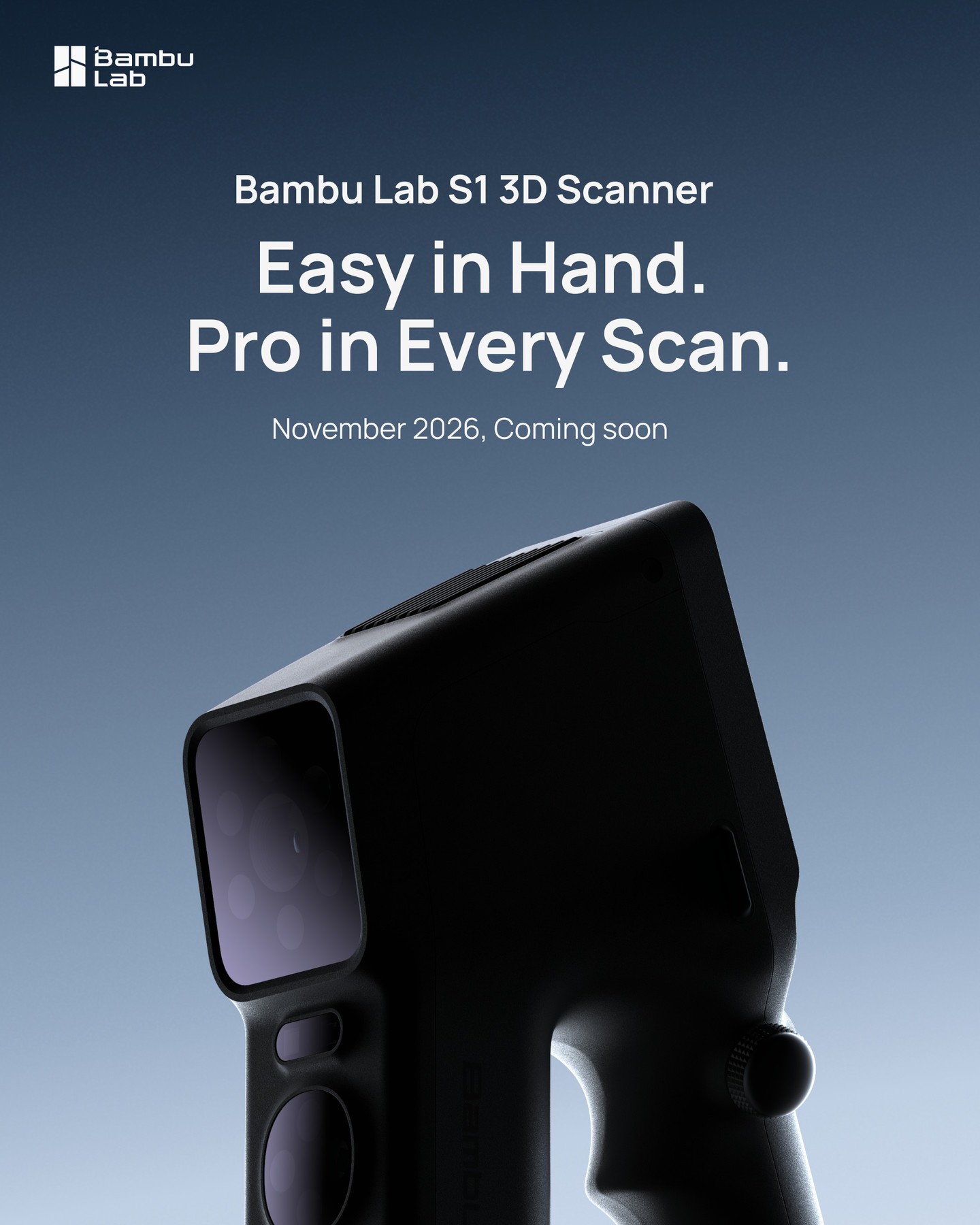
Bambu Lab S1 3D Scanner. Image courtesy of Bambu Lab.
Ahead of its official launch in November, Bambu Lab has announced the S1 as one of the prizes in Make for Good, an accessibility design contest organized by the company through its MakerWorld platform. Launched in September, the competition brings together seven accessibility organizations and invites creators worldwide to develop practical assistive devices based on 24 design briefs. Submissions close on November 15, with winners expected to be announced in December.
One example involves a pickleball paddle holder for people with weakened hand and arm muscles. U.S. nonprofit MakeGood provided a 3D scan of an evaluator’s hand so participants could design around a real person’s needs. Creators, including TBLew Designs and Duck, used that reference and received feedback to improve their prototypes.
“Seeing so many designers use their skill to help others is what the 3D printing community is all about,” said Noam Platt, founder and president of MakeGood. “The creativity and problem solving on display is just great! I especially love that anyone can download and try prototypes. This open community design process is revolutionary and an amazing way to develop assistive devices.”
Winning designs will be added to open libraries and distributed through volunteer networks that already deliver devices in more than 70 countries.
The contest is also a good example of where 3D scanning could make a difference. When designing assistive devices, being able to scan someone’s hand or another part of their body can help create something that fits their specific needs.
For Bambu Lab, the S1 is another step beyond 3D printing and into a wider range of manufacturing tools. The company has already expanded into laser cutting, and now it’s adding scanning to the mix. There is plenty of potential, especially for users who want to combine scanning and printing.
Subscribe to Our Email Newsletter
Stay up-to-date on all the latest news from the 3D printing industry and receive information and offers from third party vendors.
Print Services
Upload your 3D Models and get them printed quickly and efficiently.













You May Also Like
3D Printing News Briefs, October 10, 2026: Drones, WAAM, Ceramics, & More
We have a packed 3D Printing News Briefs for you this weekend! First, America Makes celebrated the recent National Manufacturing Day with 3D printed drones, and then it’s on to...
3D Printing News Briefs, October 1, 2026: Defense, Enclosures, & More
In today’s 3D Printing News Briefs, we’re starting with defense news, first from Massivit and then from AML3D. Then we’ll move on to U.S. manufacturing of a new large-format LPBF...
3D Printing News Briefs, September 24, 2026: Metallic Alloys, Nanobone, Alternative Meat, & More
In this week’s 3D Printing News Briefs, we’ll discuss some materials news: a reference material for standardizing photopolymer manufacturing, metallic alloys that help reduce energy loss in electric motors, a...
3D Printing News Briefs, September 19, 2026: Process Validation, Orthotics, Energy Storage, & More
In this weekend’s 3D Printing News Briefs, Eplus3D and Young-Will Aerospace are working on LPBF process validation for a nickel-copper alloy. Meltio released a U.S.-made version of its Meltio Robot...

























































