
3D Printing News Briefs, October 14, 2026: Bolus, Aerospace Tooling, Water Filter, & More

In today’s 3D Printing News Briefs, we’re starting with medical news, as Myrava has received FDA 510(k) clearance for its 3D printed bolus. Moving on to aerospace and metals, AML3D is working on a manufacturing tooling project, while Mears Machine Corporation has purchased a Velo3D Sapphire XC system that will be dedicated to printing copper-nickel (CuNi). Finally, Canadian researchers developed a low-cost 3D printed filter that removes a lot of microplastics from water.
Myrava Gets FDA 510(k) Clearance for Patient-Specific 3D Printed Bolus
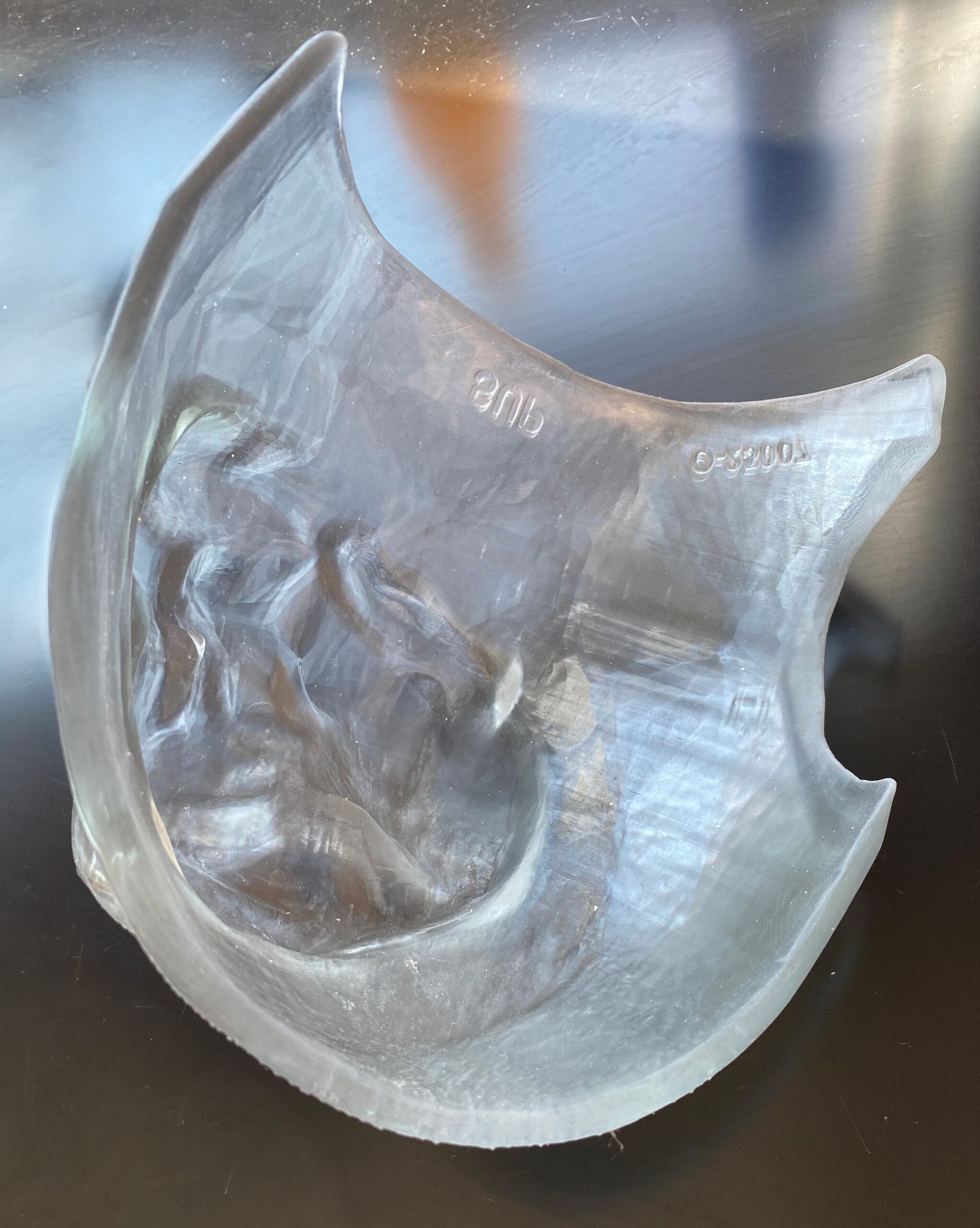
Myrava patient-specific 3D printed bolus
Myrava LLC, formerly known as Ricoh 3D for Healthcare, recently announced an exciting advancement in personalized radiation therapy. The company received FDA 510(k) clearance for its new 3D printed patient-specific bolus device, which helps to optimize the accuracy and control of radiation dosing. Many radiation oncology teams use wet cloths, gelatin sheets, or other makeshift bolus options, but these typically haven’t been optimized for a specific patient or their treatment plan. Myrava’s 3D printed bolus is placed right on a patient’s skin, to help physicians better control the dose of radiation the patient gets during treatment. Each one is 3D printed directly, instead of cast from a mold, and specifically fabricated to match the radiation therapist’s design for individual patients, their anatomy, and their treatment plan. The flexible, translucent material used to print each bolus is supposed to help ensure increased comfort and accurate positioning, and if properly maintained, it can be safely reused for the same patient throughout their treatment cycle.
“FDA 510(k) clearance of our patient-specific bolus marks a significant step forward in our mission to empower clinicians with customized tools to help advance treatment precision and patient comfort. By leveraging our expertise in advanced manufacturing and healthcare innovation, we are helping radiation therapy teams deliver reliable and reproducible outcomes,” explained Gary Turner, CEO and Co-Founder at Myrava. “The Myrava Bolus can be manufactured at co-located point-of-care facilities offering additional benefits, such as closer contact to the clinicians for iterative design and faster turnaround times.”
AML3D Joins Global Aerospace Prime in Manufacturing Tooling Project
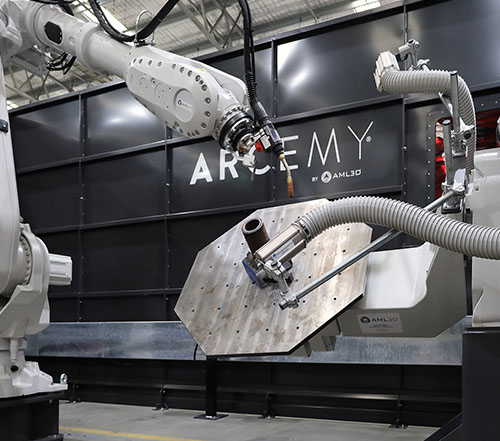
Large scale ARCEMY metal 3D printer. Image courtesy of AML3D.
Aussie company AML3D is joining industry and research partners, including an unnamed global aerospace prime, in a three-year advanced aerospace manufacturing R&D project. The goal is to further develop and mature AML3D’s wire arc additive manufacturing (WAM) technology to a point in which it’s suitable for qualified aerospace tooling production. The project participants will be providing roughly A$3.89 million to run the R&D project over the three-year term, with AML3D’s contribution expected to be about A$530,000 (A$130,000 in cash and A$400,000 in staff and other in-kind contributions). The aerospace prime is an aviation contractor that manages design, development, and manufacturing of large-scale aerospace systems, such as aircraft, but AML3D believes it’s not necessary to share its identity, as that is not information “that a reasonable person would expect to have a material effect on the price or value of AML3D’s securities.” AML3D also doesn’t expect to generate any revenue from this project, but its success will position it as a possible aerospace tooling production supplier, which could lead to new revenue opportunities.
“This $3.89 million R&D project, with an aerospace prime, will build on AML3D’s track record demonstrating WAM© technology can support the Aerospace sector. We have already achieved the AS9100D Aerospace Quality Management accreditation, the highest global quality standard for manufacturers supplying flight-ready structures. This new R&D project moves AML3D into a formal qualification pathway for WAM© to be deployed for Aerospace tooling applications,” said AML3D CEO Sean Ebert.
“Tooling lead times of up to 24 months present a significant challenge across aerospace manufacturing. A successful conclusion to this R&D project has the potential to position AML3D as a solution to these Aerospace supply chain constraints. It is expected AML3D’s WAM© technology will be shown to dramatically reduce Aerospace tooling component manufacturing lead times compared to traditional manufacturing techniques.”
Mears Machine Orders Sixth Velo3D Sapphire XC for CuNi Production

Velo3D announced that precision machining and metal AM company Mears Machine Corporation has ordered its sixth Velo3D Sapphire XC system, which will be dedicated specifically to printing copper-nickel (CuNi). Mears’ current production fleet of Sapphire XC systems is supporting customer programs for materials including CP1 aluminum, Inconel 718, and Haynes 282, and now it can add CuNi, which has historically been cast. It’s a 70-30 copper-nickel alloy that resists corrosion in seawater, and maintains consistent mechanical and thermal properties across a wide temperature range, which makes it a good choice for applications in seawater cooling, heat exchangers, shipbuilding, and condensers. Plus, by using a common production platform, Mears is able to build on existing machine infrastructure, workforce capability, and operating experience. All the printers run on Velo3D’s Flow print preparation software and Assure quality reporting, and standardized process controls and software-driven calibration keep output consistent on all machines.
“Following a period of market, product and technical analysis, our move into copper-nickel additive manufacturing is a strategic decision. We are building a vertically integrated Cu-Ni supply chain solution for the industry, with the ability to take a customer from additive design support through additive manufacturing, machining and final inspection—all within one facility. That changes the customer experience significantly by reducing handoffs, shortening the manufacturing chain and giving customers a single accountable partner from concept through finished hardware. For the markets we are targeting, our existing medium-to-large format machining capability is also very well matched to the size and geometry of the components’ our customers need,” said James Lloyd, Mears Machine Corporation CEO.
“Some customers are already treating laser powder bed fusion Cu-Ni components as interchangeable with traditionally cast hardware for selected applications. That creates an important opportunity to provide tooling-free replacements for legacy components, particularly where castings are difficult to source, tooling is no longer available, or volumes do not justify traditional foundry investment. At the same time, additive manufacturing gives engineers far greater freedom to develop next-generation heat-transfer and fluid-management hardware, including more integrated geometries, optimized internal flow paths and designs that would be difficult or impossible to manufacture conventionally.”
Researchers Develop Low-Cost 3D Printed Water Filter
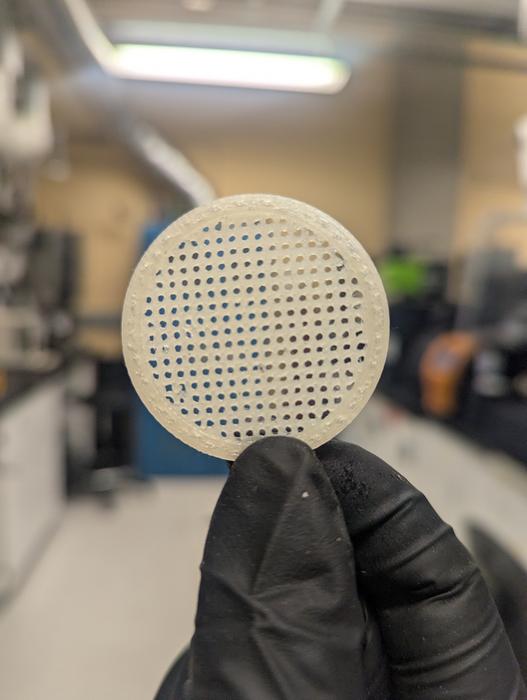
A low-cost, customizable 3D-printed filter developed by University of Waterloo researchers that removes up to 90 per cent of microplastics from water (University of Waterloo).
Microplastics are plastic fragments, smaller than 5 mm, that are being found more and more in drinking water around the world. If they’re ingested, they can enter human blood and tissue, and research suggests that these tiny pieces of plastic could be linked to serious health problems, like heart attacks and cancer. A team of University of Waterloo engineers developed a customizable, low-cost, 3D printed filter that can supposedly remove up to 90% of microplastics from water. They developed an easily customizable filtration column of stacked, 3D printed disk filters made from a biodegradable material, first designing filters to maximize their contact with water flowing through, and then adding a water-soluble polymer that washes away post-print, which leaves behind micro- and nanoscale pores. Finally, the team added a pressure-sensitive adhesive that increases capture of microplastics, without blocking the pores. The filter was easily able to capture larger microplastics, but particles smaller than 10 mm are still a challenge, which is what the team will tackle next.
“We explored using between eight and 20 filters stacked together. With 20 filters, we removed 90 per cent of microplastics, a marked improvement over current filtering technologies,” said Dr. Tizazu Mekonnen, a chemical engineering professor at Waterloo.
You can learn more about their work in their published paper.
Subscribe to Our Email Newsletter
Stay up-to-date on all the latest news from the 3D printing industry and receive information and offers from third party vendors.
Print Services
Upload your 3D Models and get them printed quickly and efficiently.













You May Also Like
3D Printing Services Near $2.5B as AM Market Shifts Beyond Hardware
The additive manufacturing market may be growing again, but one of the more interesting numbers behind that recovery has little to do with selling 3D printers. AM services generated nearly...
The Money Behind AM: What to Watch at AM Investment Strategies 2026
For years, simply being a 3D printing company could attract attention from investors. New machines, new materials, faster speeds, and the promise of mass production were often enough to get...
Ski Lift Foundations Made With 3D Printing in Hemavan, Sweden
While most of the 3D printed construction hype has been around houses, we’re more bullish on infrastructure. By 3D printing in hard-to-reach areas, remote structures can bring infrastructure to new...
3DCP Group 3D Prints Student Housing in Denmark
Denmark’s 3DCP Group has built 36 3D printed student apartments as part of its Skovsporet project in Holstebro. Designed by SAGA Space Architects and MS+, the project is a single-story,...

























































