The Science Lab You Can 3D Print

Researchers at Sweden’s Umeå University have shown how desktop 3D printers can be used to make lab equipment, giving scientists a cheaper way to build tools for their research. The work focuses on equipment used to study bacteria and other tiny organisms, including devices that use lasers to find and move bacteria.
The research, carried out by Daniel Nilsson at the university’s Department of Physics, shows how consumer-grade 3D printers can help scientists design and manufacture equipment for their own experiments. Rather than relying entirely on commercial instruments, laboratories could build tools that meet their specific needs and modify them as their research develops.
Scientific instruments used to study microorganisms often need to be extremely precise. They can also be expensive and take time to manufacture, which can be a problem for smaller labs with limited budgets. This isn’t the first time researchers have turned to 3D printing for a cheaper option. In 2024, 3DPrint.com covered how the Custom Lab Institute was using 3D printing to make more affordable lab equipment. Nilsson’s work takes a similar approach, using desktop 3D printers and open-source electronics to build tools for biological research.
“We have developed a set of instruments that can be manufactured directly in the laboratory by anyone. We hope this will make biological research less expensive and more accessible to a larger number of researchers,” Nilsson noted.
Building Tools for Bacterial Research
One part of the research focuses on making tools to study bacteria. These include devices that use lasers to find and move harmful bacteria, as well as equipment to grow and measure biofilms.
Biofilms form when bacteria stick together on surfaces. They can be difficult to remove and cause problems in places like hospitals and food factories, where keeping things clean is especially important.
Scientists usually need special equipment to study how biofilms grow and behave. Nilsson’s research shows how they can make some of these tools themselves using 3D printers, instead of buying expensive lab equipment.
One of the biggest benefits is that scientists can make tools that fit their needs. They can design equipment for a specific experiment and change it whenever necessary. This is useful because different experiments often require different tools. 3D printing could also help researchers test new ideas faster. Instead of ordering a custom part and waiting for it to arrive, they could print it in their own lab and make changes as needed. Of course, the idea isn’t to replace all traditional lab equipment, but to give scientists a cheaper and more flexible way to get the tools they need, when they need them.
“These methods enable a more collaborative and needs-driven approach to development within the research community,” Nilsson said.
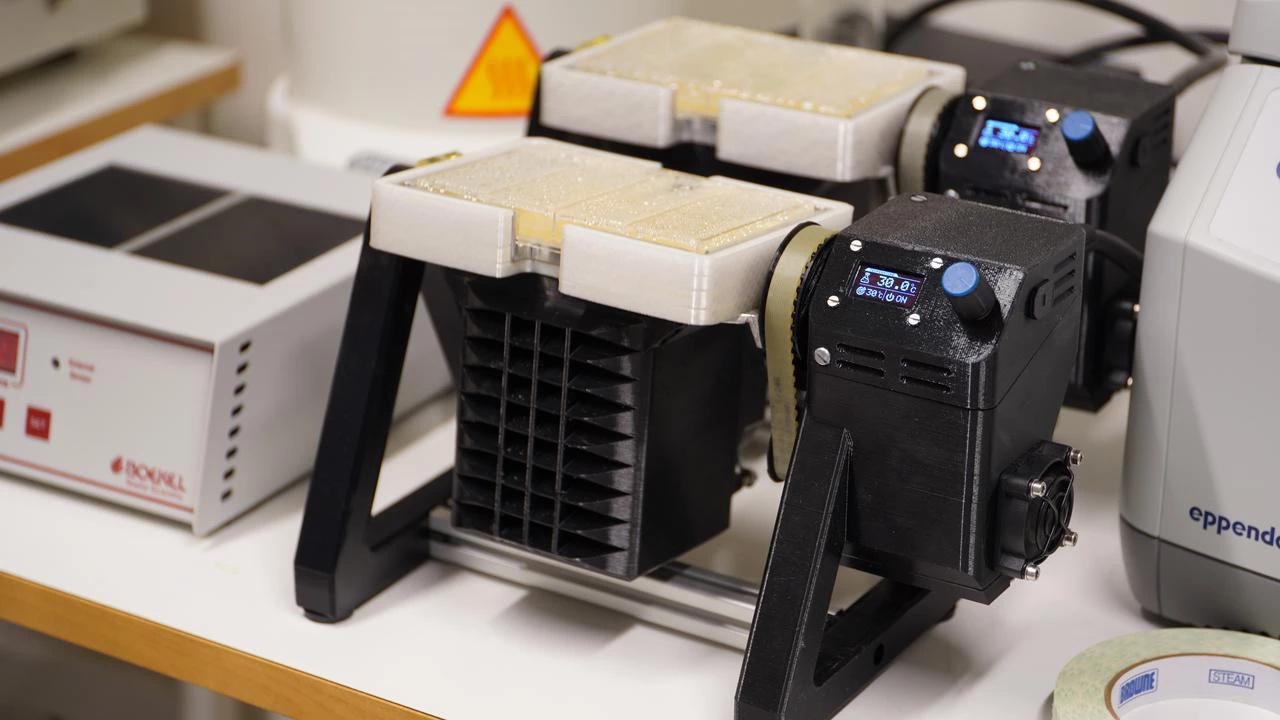
3D-printed research instruments can be tailored to specific laboratory requirements. Image courtesy of Daniel Nilsson.
Making Laboratory Equipment More Accessible
The work is presented in Nilsson’s thesis, Democratizing Biophysical Instrumentation: Development of Open-Source Tools Using Additive Manufacturing. Alongside the research instruments, the thesis includes a practical guide explaining how scientists and other users can design 3D printed tools and combine them with open-source electronics.
Of course, making lab equipment takes more than just printing plastic parts. Many tools also need electronics to run, collect data, or take measurements. By combining 3D printed parts with affordable electronics, researchers can build equipment that actually works in the lab.
Other researchers have taken a similar approach. Back in 2017, scientists developed a low-cost lab system called FlyPi, using 3D printed parts, simple electronics, and a small computer.
Another benefit is that scientists don’t have to start from scratch every time. They can take a design they’ve already made, change a few things, and use it for a different experiment. This saves time and helps them get more out of the tools they already have.
“The same methods can be used both for advanced research instruments and for everyday technological solutions in the laboratory,” Nilsson went on.
For Nilsson, the idea is to make it easier for scientists to build the equipment they need without spending so much money on commercial tools. His research shows that even regular desktop 3D printers can be used to make lab equipment, including tools for studying bacteria.
Scientists can also change their designs to fit different experiments, rather than having to buy new equipment each time. Nilsson hopes this will make research cheaper and give more scientists the chance to develop their own tools.
Subscribe to Our Email Newsletter
Stay up-to-date on all the latest news from the 3D printing industry and receive information and offers from third party vendors.
Print Services
Upload your 3D Models and get them printed quickly and efficiently.













You May Also Like
The Manufacturing Race Behind the Drone Revolution
We are in the middle of a major manufacturing shift focused on the production speed and payload capacity of uncrewed aerial systems (UAS), or drones. A recent Manufacturing Dive article...
ADDMAN to Buy Up to $10.8M in Nickel 718 Powder from 6K Additive Over 30 Months
After years of buildup, we’re finally starting to see what the US metal additive manufacturing (AM) market could look like at scale. To be sure, it’s still not quite there,...
Metal AM in a Multipolar World, Part 2: How PBF and DED Could Change by 2035
The first decades of PBF development were heavily shaped by machine capability: more power, more lasers, larger build volumes, better recoating, and improved process monitoring. These developments will continue, but...
Advanced Manufacturing at IMTS 2026: 3D Printing and AI and Drones, Oh My!
Last week’s International Manufacturing Technology Snow (IMTS) in Chicago welcomed over 90,000 attendees to the jungle that is McCormick Place. With over 1.17 million square feet of exhibit space, and...