Additive Economics 101, Part 1: Betwixt Rolex and Ryanair


Let’s look at what matters when we make things that matter. What considerations are there, what is important, what affects cost? Look at the levers in laser powder bed fusion, sintering, and MJF, to see what can make or break a 3D printing business. The point is to give you an idea of the major cost drivers, and the levers affecting process outcomes and constraints.
We’re going to begin with Cathy’s Brace Yourself. Cathy wants to start a brace manufacturing company. As a solopreneur, she has $350,000 to invest, plans to rent a relatively inexpensive location, and wants to do all the production herself in her own community. Now, there’s one basic assumption that is going to kill her business, but she can change it; it’s not too late. Cathy thinks that she won’t work weekends. But we’ll get to saving Cathy’s business later.
Now the examples and numbers below are mostly realistic. The idea is to get you to delve a bit deeper into the cost drivers of additive, and the things to pay attention to when designing and producing LPBF parts made with SLS or MJF. The model used here is mostly solid, but as we can see, in a few instances it will have some rather crazy results. But that’s not the point. The point is to get you to understand what matters. Once this becomes clearer, you can really make a decision as to which machine is right for you and what you need.
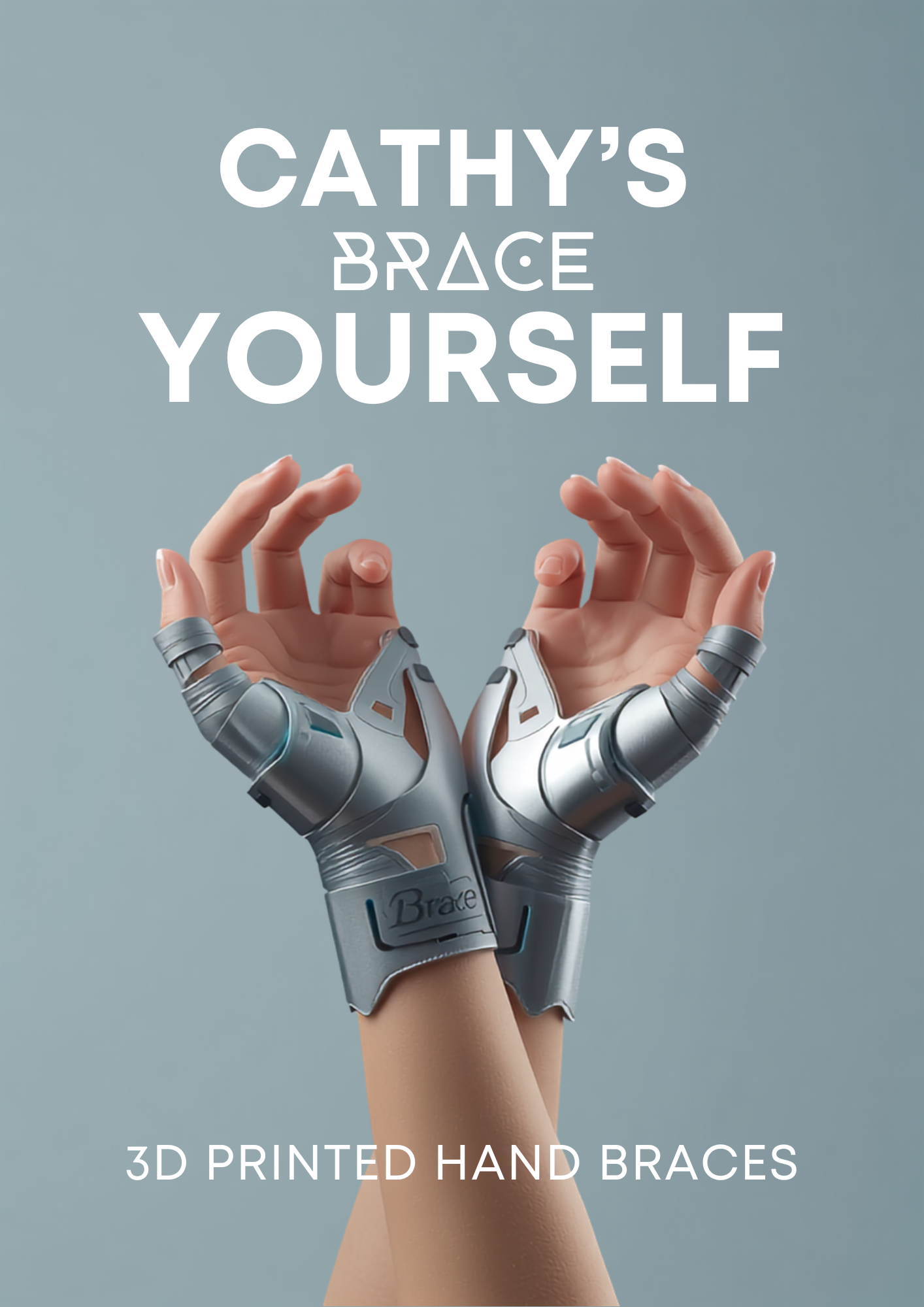
Cathy is looking at either buying one Formlabs X1 with all its auxiliary equipment, or three HP 1200 MJF printers. She’s not sure yet if she wants flexibility, or a bigger printer to make bigger things as well. She buys a DyeMansion VX1 for $33,000 to make nice, smooth parts; a great Rosle shot peening machine second-hand somewhere; a nice sieve; and the world’s most expensive vacuum cleaner. She’s rocking Fusion 360 and an illegally downloaded copy of Rhino.
The Devil is in the Details
So let’s say we want to make a kind of extended hand brace, which weighs around 150 grams. We could do this object on either machine, the Formlabs X1 or the HP 1200. If we had a full arm brace, we couldn’t make it on the 1200, and would only have the X1. Now, the 150 grams is arbitrary, but it’s important that mass counts. This is powder that we eat. In every part, there is powder that we lose, which ends up on our clothes, a soapy layer on our hands, or in the vacuum cleaner. Our powder degrades in the machine. We can recycle it, but we will end up throwing away powder. If we reduce the complexity of parts or the chance that they’ll break, then the outcome will be vastly different. If a part has an occlusion with trapped powder, and I struggle each time to get it out, this is going to accumulate in powder and time wasted. If I make something delicate, I’ll break more of them. If I need a mating surface, then this may deform during cooling and not work, meaning I’d have to scrap many more parts than if I didn’t need that in my design. If I have flat things, I’m going to have a horrible time. I’d never want to start an LPBF business with a lot of flat things in it. If I have a lot of mass in my object or in my build, then my cooling times will be longer. If I have a solid object and a thin one, and these two make up my project, then I may get a lot of warping and failed parts because of the difference between them. If I make something just a teeny tiny bit smaller, I may be able to make 30% more of that thing to build. It’s not about how many things you can fit in the printer. It’s about how many things come out well all of the time. So slightly better packing may lead to longer cooling or more shrinkage.
Now, these things differ in importance if I’m making a jig, a medical implant, or a tea cozy. Deformations and warp are more likely with some features, designs, or types of objects. Thermal distortion during cooling is real, as are clumsy hands. We could maybe have a cool living hinge; this will fail, however, at an undetermined time. So maybe adding a fastener is easier. We could have a cool snap fit, but maybe the cleaning cost and the extra failed parts will make it uneconomical. You may not be able to win in the design stage, but you definitely will be able to lose here. For 3D printing to work, it’s better that you have no other choice. If it can be made another way, then for the love of God, make it another way. There’s this thing called design for additive manufacturing, or DfAM; it’s like the CrossFit of 3D printing, as in these people won’t shut up about it. And I’m loath to admit it, but it really matters. Getting it right in design saves money. Now, you should also be concerned with costs at this stage: yield, shifts, the actual hours you need to do stuff and be places. Small changes in your design can have huge impacts on profitability. Fitting one more in a build or having one more in a 100 complete QA really matters. So design for additive, but engineer for profitability.
Idle Printers are the Devil’s Playthings
If Cathy would want custom braces, she’s going to give herself 20% more work and make her business 10 times more complex. With custom, a brace in the wrong box will undermine a core client belief, may result in two clients having to return and exchange their products, or maybe even result in two reprints. With custom, a big fat comfy safety factor may be a mirage because the design is a moving target. With custom, any returns or warranties will need a reprint of the item and a redesign. If you want to do a custom business, then I’d advise you first to sell that same product in limited sizes. Getting to the market faster with a simpler product will give you the time and money needed to experiment, change your value proposition, change designs, change your audience, change how you market things. Find out if people want braces, and meet their needs. Then in a later stage, offer more sizes to make more comfortable braces. Then offer models others don’t, to meet new needs. Then go into specific braces for tennis, swimming, padel, etc. Only then would I suggest you add a more expensive custom version to your lineup. This is a good idea because you are not taking on as much manufacturing complexity from the get-go. Additionally, it’s a good idea because it lets your business have the time to find its customers and develop a value proposition well. Custom braces get in the way of you developing a good value proposition and brand. What kind of braces? For whom? At what price point? What differentiates you? If you spend all your time making something in isolation from the market, then you have no time left to adjust it to reality. But if you assume that your entire game is custom braces, then you’ll be complacent about getting your product-market fit right because, psychologically, you think that your braces will fit everyone perfectly.
My main income-generating unit is the printer. It should be moving always, since even if it’s moving it’s probably not printing, but rather recoating. The printer should not be idle. The build should be out immediately. Optimizing cooling, build extractions, powder reclaim, designs, nesting, and work will help. But if the printer is idle, the process economics won’t fly at all. Nesting is super important, because the more we can put in, the more we can effectively print, and the more money we make. A 3D printer can make a certain amount of money per minute, and optimizing this minute is key. Now the other important part of this is “effectively print.” It’s only when a part is accepted by the customer, paid for by the customer (as in you have the money, not just that they ordered it), is in a box, has passed quality checks, has been shipped and received, has cooled, has been printed, and has been ordered that you have effectively made that thing and sold it. A click on a website isn’t a sale; a payment isn’t a sale; it’s once that cycle has completed.
The Smell of Victory
With 3D printing, the best business cases occur when we have a constant flow of powder in and out of the machine. If the machine has high utilization, is always printing, and makes parts that pass muster, then the business should be good. The key thing is that ideally your customers will be in an unending stream. So we want to think like Ryanair. Let’s fill the asset, keep the asset moving, and have an unending stream of customers keeping my asset at cost, producing for me. Once you have this stream and a good utilization, the economics of 3D printing businesses fall into place. If you have variations in orders, times of ebb and flow, quiet months, interrupted shifts due to illness, lots of failed builds, and fickle customers, then you’re probably going to fail. But if Bob orders $5,000 worth of parts from you every month and never has any complaints, you’re on your way to a good business. It’s about filling the plane, always. And if we always fill the plane completely on every trip, we will have an excellent business. So Cathy should look at demand. Cathy should definitely not just focus on braces. There’s a limit to how many prototypes are useful for her to make and test every day. Can she do contract work on the side? Will there be more braces when people go skiing in the winter? Or will demand drop off sharply when the local university closes for the summer? Can she, even at terrible margins, find something to fill that machine? Because the beauty of this is that once we have the fixed costs out, once we pay for ourselves, we’re rooting for gold in that powder cake. Any tchotchke is pure profit after we cover everything. This means that we can heavily discount the last 10% or first 10% of any build. And we should heavily discount recurring revenue. If Cathy knows she has to build this Friday anyway, she can give that one waffling customer an 80% discount. The economics of this mean that she can win the customer at almost any cost. The machine is depreciating in front of your eyes. Fill it. Are you asleep? Your 3D printer better not be. But if we have to build anyway and we’re able to stuff just one more thing in that printer, that’s gold dust right there. That’s not the smell of toasty polyamide; that’s the smell of victory. Can we cram in another build somehow? Beautiful, we just made rent. Now, can it get better? Yes, if our customers in effect pre-finance us, if they give us a float by paying in advance, even if it’s a few days in advance, everything gets better still.
What Would Rolex Do?
Now, if we get too greedy and stuff too much in, parts will fail, tolerances will slip, people will be unhappy. So there is a balance. Ask yourself: what would Ryanair do? Also ask yourself: what would Rolex do? How to better utilize our asset, how to better ensure that the quality of the product is increased? We don’t want to be too Ryanair here—faster turnaround? Awesome, but paying to go to the toilet? Too far. Skimping on safety? Not efficient. I trust Ryanair because they fly one plane even though I don’t trust that plane. I also trust them not to crash because it would be so expensive for them to crash. On the other hand, there are limits; cheapness can make people unhappy and turn them away. That’s where our Rolex side of the coin comes in.
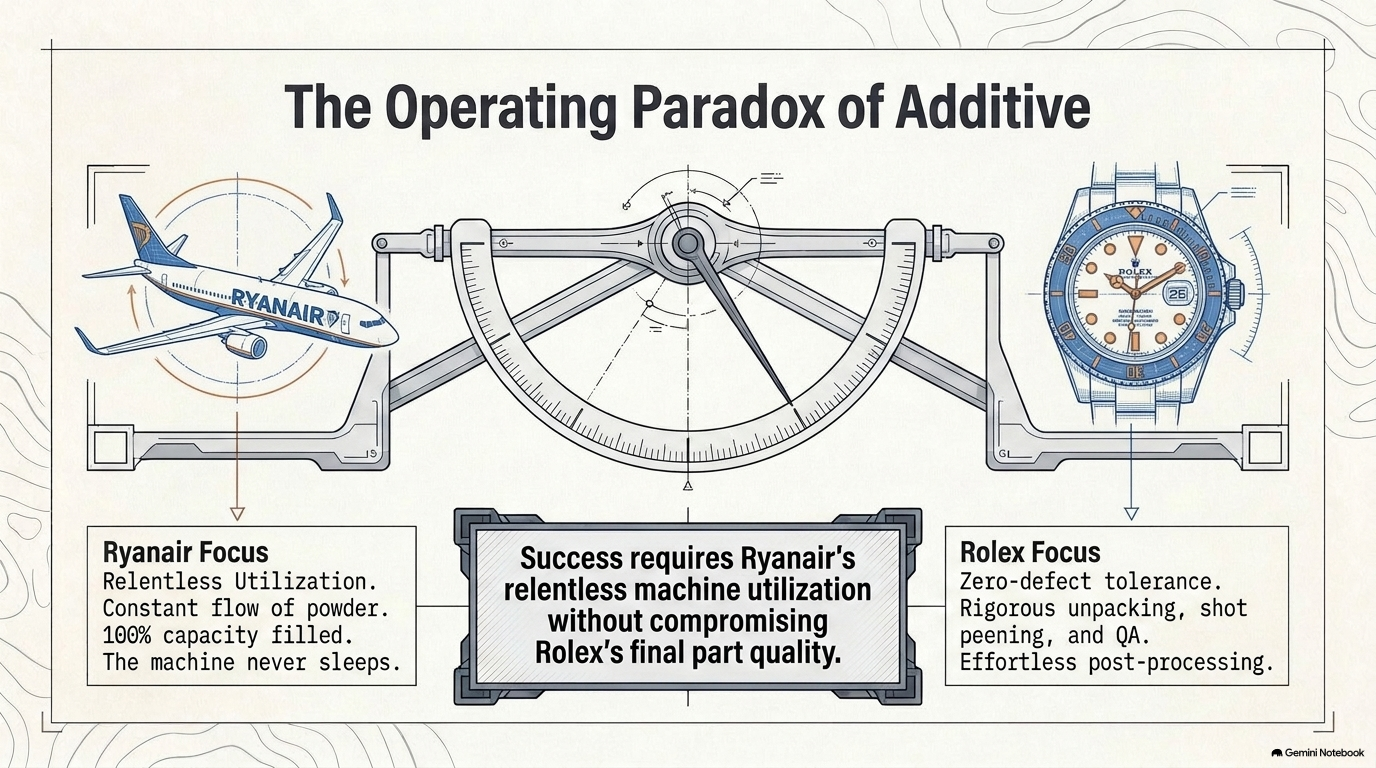
Now we’d love to just press a button and have parts pop out. But we need unpacking, shot peening, vapor smoothing, maybe dyeing. So choosing two colors in your object or two materials has a big impact. Offering different colors and finishes does as well. You must be allergic to complexity and driven to effortlessness. You should be able to cut and dice all your steps into easily digestible parts to optimize them very particularly. But, at the same time we should look at the overall flow and operation to see if we can do radical changes. Yes, printing is important, but sieving is super important too. How can we optimize batch sizes? Can we skip a step? Can we reduce handling? Can we make a compact station where someone can clean, check, and pack a part without moving around too much? The UPS man comes at 16:15 every day, what does that mean for me?
Generally speaking, this is an overview of a lot of the things you should be considering when developing a 3D printed product or when considering production. But we’ll look a bit deeper into some numbers for the next installment of Additive Economics.
Subscribe to Our Email Newsletter
Stay up-to-date on all the latest news from the 3D printing industry and receive information and offers from third party vendors.
Print Services
Upload your 3D Models and get them printed quickly and efficiently.













You May Also Like
Phillips Federal Participates in Marine Corps Exercise
Phillips Federal will participate in a Marine Corps exercise that will use several additive manufacturing technologies. The 1st Maintenance Battalion, 1st Marine Logistics Group, I Marine Expeditionary Force (IMEF), will...
Ceramics 3D Printing at Ceramitec 2026
Ceramitec is a key event for the ceramics industry. Held in the lovely city of Munich, it is the leading global event for the ceramics community. With around 13,000 participants...
AM Forum Berlin 2026: Tough Love From BMW’s Timo
We’re once again in the lovely city of Berlin, at the absolutely immense Estrel Center. The congress center, a musical and theater venue, towers over the easternmost reaches of the...
Printing Money Episode 35: Notable VC and M&A Deals, with Arno Held and Alex Kingsbury
Welcome to Printing Money Episode 35 and let us be the last to wish you a happy new year. For this episode Danny is joined by Arno Held (Managing Partner,...