3D Printing News Briefs, July 16, 2026: Russell Indexes, Car Customization, & More

We’ve got a lot to cover in today’s 3D Printing News Briefs, from business and additive manufacturing (AM) in Europe to automotive 3D printing, and generative design. Read on for all the details!
Velo3D Added as Member to Russell 3000 Index & Russell Microcap Index

Metal AM firm Velo3D announced that it’s been added to the membership of the broad-market Russell 3000® Index and the Russell Microcap® Index. This was effective when the U.S. market opened on June 29th, as part of the first 2026 Russell indexes reconstitution. These indexes are designed to reflect the shifting U.S. equity market, often used by investment bankers and institutional investors as benchmarks for active investment strategies. The reconstitution process is important to maintaining accurate representation. The June reconstitution captures up to the 4,000 largest U.S. stocks as of April 30th, 2026, and ranks them by total market capitalization. Companies are re-evaluated to determine where they stand along the investment styles spectrum, and the breakpoints between large, mid, and small cap are redefined, in order to make sure that any market changes that happened in the preceding period are captured. Membership is mainly decided by market-capitalization rankings and style attributes, and as a member, Velo3D is automatically included in the large-cap Russell 1000® Index or small-cap Russell 2000® Index, in addition to the appropriate growth and value style indexes.
“Being added to the Russell 3000 and Russell Microcap indexes is an important milestone for Velo3D. We have made meaningful strides in transforming the company, advancing our technology leadership, and creating value for shareholders. Inclusion in these widely followed indexes broadens our exposure to the investment community,” said Arun Jeldi, CEO of Velo3D.
CECIMO Formally Spins Out AM-Europe Into Dedicated Platform

For decades, CECIMO, the European Association of Manufacturing Technologies, has been working with policymakers, industry, and key stakeholders to promote additive as a strategic technology for the European industrial base. Last year, CECIMO and nine national associations formed AM-Europe, an initiative representing over 700 companies across Europe to give the AM sector a single, strong voice at the EU level. Now, AM-Europe has been formally launched as a dedicated European platform for AM, representing the evolution of CECIMO’s additive activities into a broader, more inclusive, more visible European initiative. The platform will work to continue advancing the vision it set out in last year’s Manifesto for a Competitive European Additive Manufacturing Sector: setting up the continent as a global AM powerhouse, and building an ecosystem that can develop and deploy AM over industrial sectors. AM-Europe operates within CECIMO’s governance framework, and is now opening participation to a wider range of AM stakeholders, including research organizations, competence centers, and national associations. It will be a common platform for representation and coordination, ensuring that the voice of AM in Europe is reflected in policy discussions.
“From an industrial perspective, additive manufacturing has become a strategic technology for Europe’s competitiveness, resilience and capacity to innovate. Through AM-Europe, we want to create a stronger and more coordinated European platform that brings together the AM ecosystem, supports closer dialogue with policymakers, and helps ensure that companies have the right framework conditions to develop, invest and scale,” said Virgilio García, Chairman of AM-Europe. “Europe has the expertise and industrial base to lead in additive manufacturing, let’s work together within AM-Europe to make this happen.”
Ferrita Achieves 50% Time & Cost Savings for Custom Mercedes-Benz with Meltio

Ferrita Sweden AB develops and manufactures advanced technical solutions, working on things like vibration, thermal insulation, and exhaust gas purification. Swedish car culture values unique project cars, so Ferrita can be super creative with exhaust design. A great example is the 2003 Mercedes-Benz SLR McLaren a customer brought in, which Ferrita customized using Meltio’s wire laser metal deposition (wire-LMD) technology. There were plenty of engineering constraints that led Ferrita to AM. Aftermarket fabrication shops operate under strict deadlines, so they only had the car for a week. It’s expensive to produce specialized automotive components using traditional methods, and they needed four symmetrical tailpipes with a specific shape that matched the existing lines of the vehicle. Ferrita didn’t have the time, nor the money, to achieve this kind of symmetry without special tooling. It’s also very hard to achieve optimal flow with conventional manufacturing, and Ferrita also needed to replace the car’s 20 kg muffler to save weight and get rid of excess heat.
Meltio helped Ferrita repair the pieces, which helped “automate the welding and repair process.” First, Ferrita scanned the bottom plate and created a digital concept model to get a better idea of the space with which they had to work. Then, they printed a rapid plastic prototype to ensure that the design matched the lines of the supercharged V8 car. To print the final parts, a Meltio Robot Cell was used; this features an ABB robot and a laser head with nine beams to melt MIG wire. They used 316 stainless steel to print the tailpipes, and the system was programmed to run at 10 millimeters a second, with a gas flow of 15 liters per minute, to achieve fine detail resolution. By using the efficient wire-LMD process, Ferrita achieved 50% time and cost reduction, noting that it only took 4-5 hours to print the tailpipes and €2000 as opposed to €4000. Finally, the new 3D printed exhaust system replaced the heavy original muffler, which saved about 20 kg of weight.
Researchers Use Topology Optimization to Generate More Buildable Structures
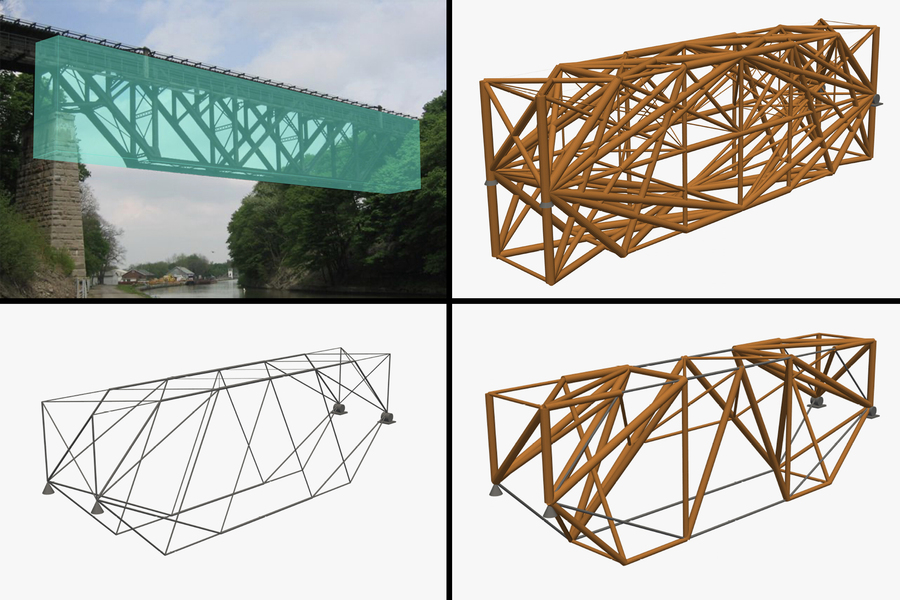
On top left is the Lockport truss bridge passing over the Erie Canal near Buffalo, New York. Researchers mimicked this structure, highlighted in teal blue, and created multiple timber-only designs (top right), steel-only designs (bottom left), and timber-steel designs (bottom right). Image: Courtesy of the researchers
Global production of construction materials accounted for over 7% of total carbon emissions in 2022, but were they all necessary? A team of researchers from MIT developed a framework to make topology optimization designs more buildable, with less material. Topology optimization is mostly used by researchers to reduce the amount of material used in a given space, but in real-life engineering scenarios, the resulting structures can’t be easily built on time or within the budget. The team’s framework enables users to limit the complexity of algorithmically generated structures by applying constraints, like how many components meet at each point in the design. The key: a class of equations called mixed integer algorithms, which help make binary decisions about things like materials and connections. To test their approach, the team designed wood, steel, and multimaterial truss structures that support loads in bridges and buildings, and compared them to structures designed with conventional topology optimization. They found that the carbon emissions associated with the materials majorly changed when they applied different constraints. They concede that their approach is “more computationally intensive,” but believe most civil engineering firms could handle it.
“It’s computationally a little tougher to solve, but there’s a lot of tools coming out nowadays that make these problems a lot more feasible. This approach has been avoided by industry in the past, but now we think it’s a practical way to solve problems dealing with variable constraints,” said first author and civil and environmental engineering PhD student Zane Schemmer.
“As a structural engineer by training, I was never taught how to design for low-carbon. To tackle a problem as big as climate change, addressing the built environment is a great place to start. One of the most tangible things we can do is work at the layer of construction, at the design stage, because that’s a fundamental step that we can control. There’s a lot of decisions we make early on that lead us to use extra material we don’t need.”
Subscribe to Our Email Newsletter
Stay up-to-date on all the latest news from the 3D printing industry and receive information and offers from third party vendors.
Print Services
Upload your 3D Models and get them printed quickly and efficiently.













You May Also Like
The Money Behind AM: What to Watch at AM Investment Strategies 2026
For years, simply being a 3D printing company could attract attention from investors. New machines, new materials, faster speeds, and the promise of mass production were often enough to get...
AmeraLabs Offers New Dental 3D Printing Resins
Lithuania-based AmeraLabs is putting new dental 3D printing resins on the market. Its new Made in Europe resins will include one material for impression trays, one for surgical guides, and...
3D Printing News Briefs, June 10, 2026: Grand Opening, Photoresins, Footwear, & More
We’re starting with some exciting news in today’s 3D Printing News Briefs: Stratasys just celebrated the opening of its new North American headquarters in Minnesota. Moving on, Nanoscribe is scaling...
3D Printing News Briefs, April 22, 2026: DINOs, Post-Processing, AM for Aerostructures, & More
We’ll start with event news in today’s 3D Printing News Briefs, as AMUG presented its DINO Award to six members at this year’s conference, and Axtra3D celebrated its five-year anniversary...