Phillips Corporation Rebrands Additive Hybrid Division, Now Called Phillips Advanced Manufacturing

Phillips Corporation announced that it will rebrand its Additive Hybrid division to become Phillips Advanced Manufacturing. The focus will now be on advanced manufacturing in the broadest sense. Brian Kristaponis will run the division of the company, focusing on, “hybrid, standalone additive, and deployable manufacturing systems.”
This seems like it could be a very sensible move for the firm. Many companies only focus on one additive technology, or just polymer or metal. But, by looking at possible hybrid manufacturing, manufacturing cells, and different 3D printing solutions, the company can deliver on the right solution in a more holistic way. Rather than just try to pigeonhole everything into LPBF or make Material Extrusion fit, it can talk with authority about possible different solutions. This is a very mature way of looking at things. This will, in my opinion, build up more longstanding relationships with partners.
Brian Kristaponis, the newly anointed President of Phillips Advanced Manufacturing Solutions, said,
“This rebrand reflects a fundamental shift in how manufacturing is evolving. Our customers are increasingly focused on how technologies come together to improve flexibility, resilience, and speed. Phillips Advanced Manufacturing Solutions positions us to lead in that environment, bringing together a broad ecosystem of technologies, partners, and expertise to deliver integrated manufacturing solutions while continuing to support the critical equipment that powers production.”
More people are also looking for deployable cells that offer, for example, DED, scanning, and machining in one unit, in order to speed up part production, reduce conveyancing, and reap efficiencies. We know that an awful lot of turbine blades are made in this way. Especially if space is at a premium, or you want as little handling as possible, these solutions make a lot of sense.
The unit will look at additive and subtractive cells, large-format additive, expeditionary manufacturing, consulting on such issues as applications engineering, and 3D printers themselves. Again, by integrating solutions with application development, Phillips can speed up customer development, sell faster, and have them integrate faster. As we keep saying, 3D printing lacks systems integrators. By acting like a systems integrator, the firm can accelerate and de-risk additive adoption for customers.
John Harrison, the President of Phillips Global Additive, said,
“Advanced manufacturing is reshaping how products are designed, built, and sustained across nearly every industry, Our customers look beyond individual machines. They want trusted partners who can help them evaluate technologies, integrate complete solutions, and support them long after installation. Phillips Advanced Manufacturing Solutions represents that broader mission. Brian has been instrumental in building this organization, strengthening strategic partnerships, and helping customers successfully implement advanced manufacturing technologies. His leadership has positioned this division for continued growth, and I am excited to see him lead its next chapter as President.”
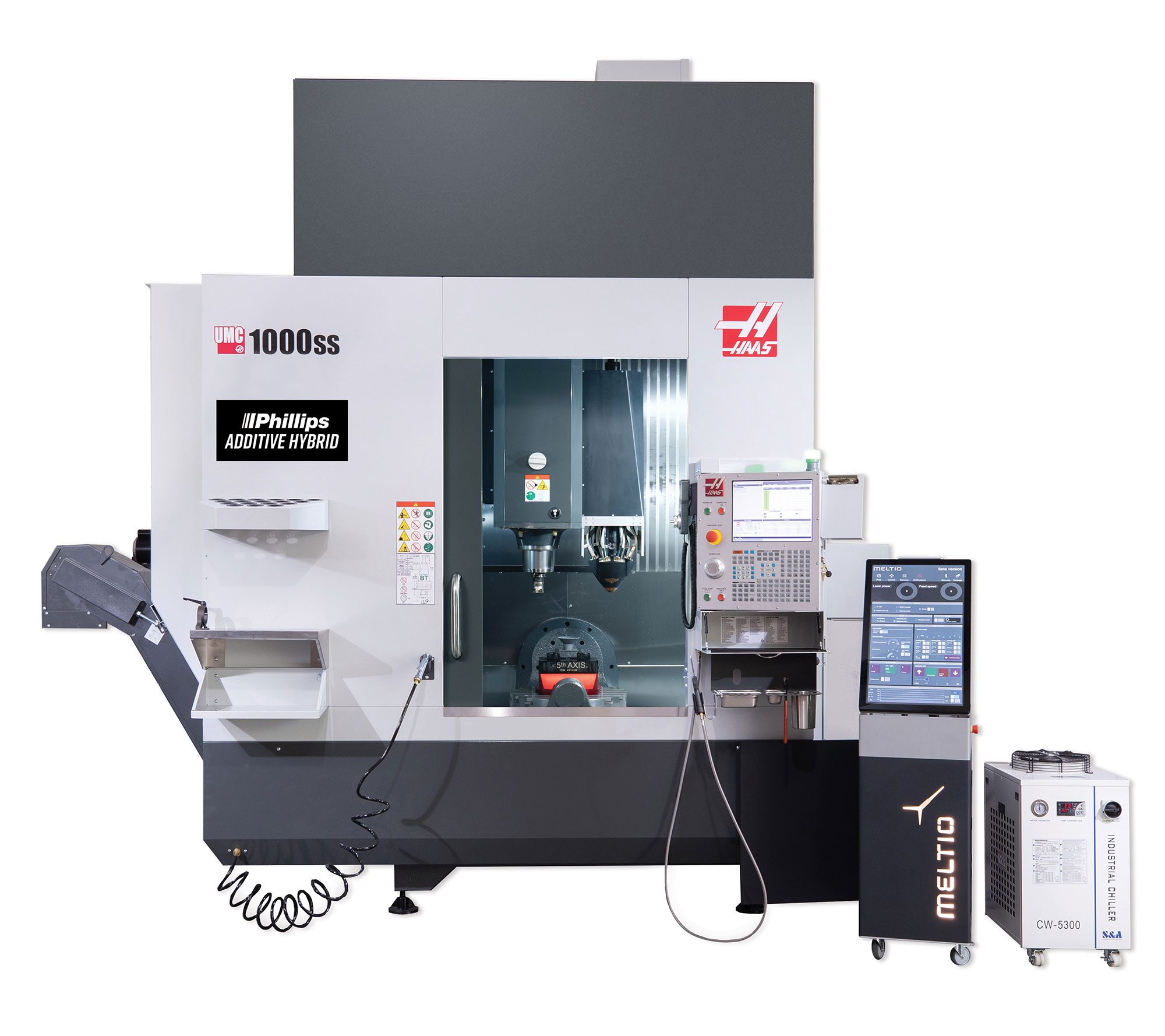
The company now offers Meltio’s W-LMD, wire arc additive from Fronius, DED with powder and wire from Korean firm InssTek, and WAAM from bridge builders MX3D. This is a particularly strong DED offering, allowing them to make large-scale structures with MX3D, complete robotic cell-based wire manufacturing with Meltio, and do powder mixing for applications like armor with Insstek, while also having a super accessible unit for forward-deployed-ish DED with Fronius.
If I got this right, the rest of the firm will offer Markforged, EOS, Solukon, and the existing solutions. So it’s kind of a split between the people who will things stuff in Pittsburgh, and those who will spent their time at rather smallish interesting airports going camping. Recently, the unit got a contract for containerized Haas and Meltio units with the Naval Surface Warfare Center Carderock Division (NSWCCD) Additive Manufacturing Project Office, so that dovetails well with this approach.
Kristaponis said,
“The conversation around advanced manufacturing has changed, Organizations are no longer asking whether these technologies are viable; they’re asking how to successfully implement them to improve productivity, strengthen supply chains, and manufacture closer to the point of need. Our role extends well beyond delivering equipment. We help customers evaluate applications, integrate technologies into production environments, train their workforce, and provide ongoing support to ensure long-term success.”
This again seems like the right path forward. I think that more resellers and consultancies should operate like Phillips. By being a solution-focused, one-stop-shop with an offering across price points, the company can really advise clients while speeding up adoption. De-risking is the key element to engendering and accelerating additive adoption. The challenges on paper may be budget or isotropy and the like, but in reality, it’s trust and risk. And yes, there’s risk to a plane falling out of the sky of course, but so few people pay attention to risk at the company, risk to careers, budgets, and business units. By making it easier to offset risks, know the risks, and overcome institutional resistance, we can make it less risky to be the point man for additive in a firm. Understanding this and helping companies go faster will lead to success for you and your client, and I think that is what Phillips is doing here.
Subscribe to Our Email Newsletter
Stay up-to-date on all the latest news from the 3D printing industry and receive information and offers from third party vendors.
Print Services
Upload your 3D Models and get them printed quickly and efficiently.













You May Also Like
The Manufacturing Race Behind the Drone Revolution
We are in the middle of a major manufacturing shift focused on the production speed and payload capacity of uncrewed aerial systems (UAS), or drones. A recent Manufacturing Dive article...
ADDMAN to Buy Up to $10.8M in Nickel 718 Powder from 6K Additive Over 30 Months
After years of buildup, we’re finally starting to see what the US metal additive manufacturing (AM) market could look like at scale. To be sure, it’s still not quite there,...
Metal AM in a Multipolar World, Part 2: How PBF and DED Could Change by 2035
The first decades of PBF development were heavily shaped by machine capability: more power, more lasers, larger build volumes, better recoating, and improved process monitoring. These developments will continue, but...
Advanced Manufacturing at IMTS 2026: 3D Printing and AI and Drones, Oh My!
Last week’s International Manufacturing Technology Snow (IMTS) in Chicago welcomed over 90,000 attendees to the jungle that is McCormick Place. With over 1.17 million square feet of exhibit space, and...