Hybrid 3D Printing Tech Developed by Phillips Corp., Haas, & Meltio

Hybrid 3D printing means, as SmarTech Analysis explains in its “DED and Large-Format Additive Manufacturing Markets: 2021-2030” report, combining the functionality of AM operations with the capability of CNC machining. This type of manufacturing, which can be used for a multitude of applications, is pretty important, as it shows how 3D printing can be used to enhance these more traditional technologies, rather than making them obsolete. Phillips Corporation, which has provided manufacturing technology solutions and services to commercial, educational, and federal government markets for more than 60 years, is getting in on the action with the announcement that it has integrated subtractive CNC machine tool technology from its long-time partner Haas Automation with an additive laser head fabricated by metal 3D printing company Meltio.
“Meltio is proud to welcome Phillips Corporation as a Haas hybrid integration partner,” Meltio’s Chief Technology and Innovation Officer Brian Matthews stated in a press release. “Hybrid manufacturing offers the benefits of both additive and subtractive processes in one machine, providing cost and complexity advantages that have not been accessible before. Meltio values the opportunity to work closely with Phillips to offer this exciting technology to its large base of industrial customers.”
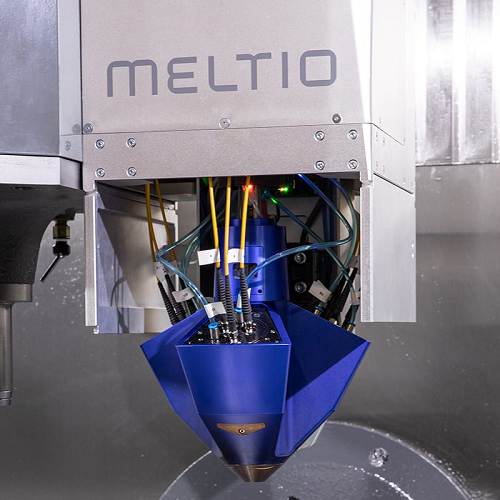
Meltio, always on a mission to disrupt the status quo of the industry with its metal deposition technology, is also clearly a fan of hybrid manufacturing, so this new partnership makes a lot of sense. The new Phillips Additive Hybrid solution, powered by Meltio’s multi-laser printhead and laser engine and situated on the standard Haas platform, pairs conventional subtractive manufacturing with an AM process that uses direct energy deposition (DED) technology—a combination we’ve seen before.
“Phillips Corporation is pleased to be joining forces with Haas and Meltio to harness the combined power of affordable subtractive and additive manufacturing. The commercial and federal industrial supply chains have accelerating interest, applications and demand for 3D printed parts. The Phillips Additive Hybrid solution integrated with the Meltio Engine is an optimal fit for customers seeking to add exceptional capability to their subtractive tools while also entering or expanding upon their additive manufacturing capability – all in one machine,” said Alan M. Phillips, the CEO of the Phillips Corporation.

The solution is said to be an affordable way to both produce and repair parts, and uses Wire Laser DED technology to fabricate high-density parts with good resolution. Other advantages of the new Phillips Additive Hybrid Solution include the ability to 3D print and complete a part with just one machine, modifying 3D printed parts by adding material and then machining them to their final shapes, using different materials on the same part for the best design, strength, and weight, and faster lead times, which enable a quicker reaction to evolving market needs.
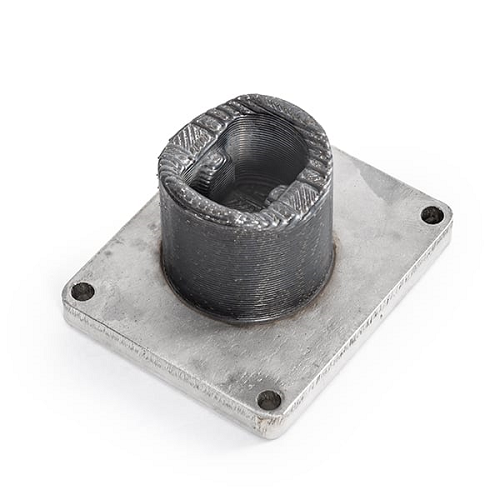
Automotive piston
This hybrid manufacturing solution, which is backed by the applications engineering, service, and training teams from Phillips Corporation, can be put to use in a wide range of industries, such as aerospace, automotive, education and research, medical, oil and gas, and more.
Subscribe to Our Email Newsletter
Stay up-to-date on all the latest news from the 3D printing industry and receive information and offers from third party vendors.
Print Services
Upload your 3D Models and get them printed quickly and efficiently.













You May Also Like
UniFormation S10 Heads to Kickstarter with an Integrated Resin Printing and Post-Processing System
UniFormation will launch its S10 desktop resin 3D printer on Kickstarter on October 22, 2026, with pledges starting at $999. The S10 integrates printing, washing, and drying, allowing a print...
Creality Goes Pro with Sermoon P1S 3D Scanner
From making millions of value-engineered Prusa clones, Creality really has aggressively pivoted to more complex machines. The company has made strides forward in software, and the Ender’s of yore is...
Stratasys Showcases 3D Printed Automotive Applications & New Printer at IMTS 2026
Just ahead of last week’s International Manufacturing Technology Show (IMTS) in Chicago, Stratasys launched the F870, a new large-format, production-grade FDM 3D printing platform designed to drive industrial manufacturing at...
Creality Launches SPARKX i8 on Indiegogo, Bringing Fastest, No-Purge-Waste Printing
Creality announces the launch of the multi-color 3D printer SPARKX i8 on Indiegogo, at an early-bird price of $309 (MSRP $399) starting from Sept. 21. Designed for ultimate user experience,...