DTI & Partners Developing 3D Printed Electronic Space Robot Skin


Robotics is among the most intriguing long-term prospects for the additive manufacturing (AM) industry, something I recently wrote about in the context of BLT and China’s buildup of industrial robotics for use in supply chains such as electronics and power grid repair. That piece highlighted how 3D printing can be leveraged as something of a “swing production method,” capable of alternating between producing end-use components for consumer goods, as well as parts for other industrial equipment.
There are a number of additional factors which make AM a good fit for the robotics market, as a new use case from the Danish Technological Institute (DTI) highlights. In a project funded by the European Space Agency (ESA), and building on earlier work completed in 2024, DTI and its private sector partners are exploring how to make 3D printed ‘smart skin’ for robots deployed on space missions.
The researchers designed the skin to solve several different challenges faced by robotic systems during space exploration, including thermal management, protection from dust, and the optimization of human-robot interface (HRI) scenarios. DTI worked with three companies on the project: PIAP Space of Poland, Redwire Space, based in Luxembourg, and Hungary’s Admatis, which specializes in the sort of advanced materials enabling the entire project.
In addition to the performance objectives already mentioned, using wearable electronics also made it easier for the researchers to engineer other aspects of the robot’s structure: for instance, AM’s bespoke design capabilities allowed the team to create the ideal shell to route the robot’s data and power lines. The 3D printed skin also enhances the durability of the robot’s design, as it gave the partners the opportunity to incorporate sensors improving the robot’s motion control system.
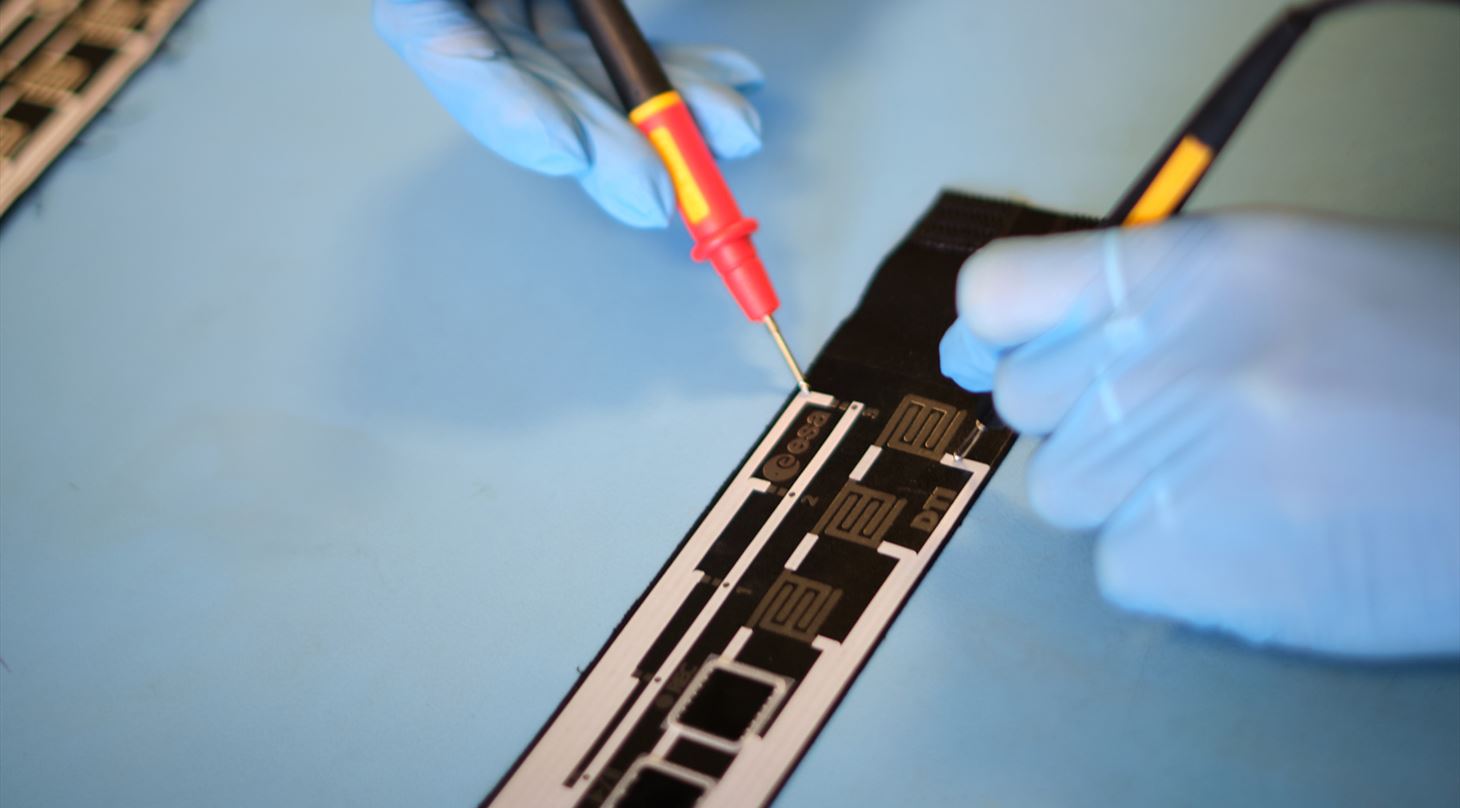
In a post on LinkedIn, AM design specialist Andreas Weje Larsen, one of the individuals who worked on the project, said, “Central to this is computational design of the space grade scaffold structure, using compliant mechanism synthesis — essentially applying conventional use of topology optimization ‘in reverse’ to design flexibility instead of stiffness. This is a key innovation for AM in space and beyond.”
That last point in the quote above about “in space and beyond” is what I love most about DTI’s approach to the project. Along with the rationale behind the primary, space-oriented angle for the case study, DTI put just as much thought into the ‘dual use’ angle, i.e., the potential to use the same innovation for applications based on Earth.
In particular, DTI’s summary of the terrestrial possibilities for the smart skin project focuses on the sorts of jobs in harsh environments which would seem to be the best candidates for future deployment of robotic workers. Some of the examples the researchers have in mind include “wet agricultural fields,” electronics recycling sites, and, generally, extreme environments that are remote from population/infrastructure hubs.
This specific line-of-thinking is ingenious in itself, but even more importantly, I’m impressed that the DTI researchers gave that much consideration to the precise dual use possibilities for the R&D work, and incorporated that thinking into the foundation of the design. Too often, when we see the phrase ‘dual use’ in a project like this, the researchers seem to just be taking for granted that someone will come along at some point and leverage the relevant (typically, defense) application for commercial purposes. I think that leveraging 3D printing as a dual use technology would be a far more feasible undertaking if researchers were given more freedom to explicitly structure their work in a dual use direction from the outset.
Finally, returning specifically to the viability of AM for the robotics market, the product-market fit between the quantity of parts that AM is currently best suited for, and the quantity of parts needed by robotics manufacturers, is perhaps the most compelling reason why we should expect to see these technologies more and more closely linked as they both continue to evolve. In terms of the present case study, it’s easy to envision the emergence of a market for on-demand skins that fulfill various functions requested by the customer. That’s exactly the sort of output level requirement which allows AM to thrive.
Images courtesy of DTI
Subscribe to Our Email Newsletter
Stay up-to-date on all the latest news from the 3D printing industry and receive information and offers from third party vendors.
Print Services
Upload your 3D Models and get them printed quickly and efficiently.













You May Also Like
50,000 Orders and Counting: EPlus3D & Chinese AM Services Provider Are Scaling Liquid Cooling Solutions for AI Servers
An under-appreciated story driving the additive manufacturing (AM) industry this year has been the divergence between what’s driving the market in China and what’s driving it everywhere else. Let’s start...
Additive Manufacturing Has a Major Growth Opportunity; Trust Will Decide Who Captures It
After years of overpromising, the next phase of AM growth will be won by companies that consistently deliver what they say. When I entered additive manufacturing in 2014, after 15...
Seven Trends Reveal What’s Next for 3D Printing at TCT Shenzhen 2026
TCT Shenzhen 2026 opened on October 14 in Hall 15 of the Shenzhen World Exhibition & Convention Center in Bao’an, and ran through October 16. The event brought together equipment...
AM Investment Strategies 2026 Sets the Stage for AMS 2027
AM Investment Strategies 2026 Nov. 5 · 12 p.m. ET · Free online event RESERVE YOUR SPOT ↗ A one-hour online discussion featuring some of the biggest names in 3D...