Will Growth in Robotics Spawn More 3D Printing?


The bankruptcy of Roomba contains within it a story of value engineering, relentless innovation by Chinese firms, and a novel segment that became ho-hum. At the same time, robot lawn mowers are still rare, even though they seem like a handy time-saving thing that is a logical extension of a robot vacuum. Other household robots are largely absent.
Interest in humanoid robots is growing again. Cycles of disillusionment around humanoids have gone through boom-and-bust cycles for many decades now. I still think that humanoid robots are a stupid idea. Rather than having two walking upright robots just so they can climb stairs, a rolling bot would suffice for the billions of people living in apartments. For those blessed with multiple floors, it would still be cheaper to buy two-wheeled bots to serve a home, or indeed buy a chair lift that the robot can also use. Techno optimism aside, there are a few robot trends and events happening that could fundamentally affect additive manufacturing.
- Ocado Robot. Ocado’s use of a custom-developed swarm-type logistics robot made 50% out of 3D printed parts, was a very important moment. The lightweight Ocado Storage and Retrieval Systems (OSRS) travels at 4 meters per second and takes less than a minute to charge. This showed just how a company can innovate by producing the specific robot it needs and then selling it to others. The use of additive in this robot and the integration is really inspiring, and it sets a lot of minds to using 3D printing to make specific robots.
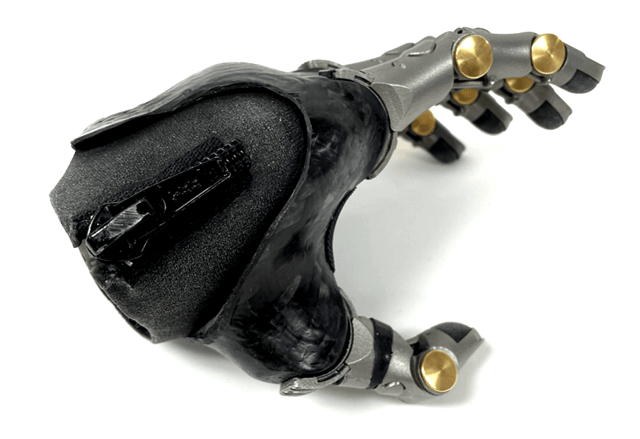
- Hands. In humanoid robot hands, hand like grippers, prosthetic hands, assistive hands and more 3D printing is used for digits, whole fingers, joints, hydraulics, soft robotic hydraulics, cushioning, dampening and more 3D printing is being used. Compact, conformal, low-volume, specific design components are being chosen by engineers. Rapid iteration and part count reduction, as well as overall mass reduction, are driving adoption.
3. Investment in Humanoids. Investment in humanoid robots is accelerating. Alibaba just put $100 million in X Square Robot, while generally, people believe that there is a humanoid robot bubble. Many robot videos are actually robots powered by remote workers wearing VR headsets, opening up a dystopian hell where a guy from India will fold your laundry remotely. Progress is elusive and difficult as well. Now, a lot of this money is flowing to additive. Many of these firms are making prototypes using 3D printing and going to production with 3D printed parts. There are intriguing things happening in the field, with a vat polymerization lattice structure being included in the Xpeng Iron robot, for example.

Humanoid robots.
4. Cobots and low-cost robots. Industrial robots were previously expensive. They are now being gradually reduced in cost and made available. Cobots are easier to use around people and more affordable still. These lower the barrier to adoption while also being easier to manufacture. They’re causing more new entrants in the robot industry as well. Grippers and low-cost 3D printed parts for these robots are growing in number. More motor and other components are also being used in this category.
On the whole, there is a boom in robotics at the moment. With aging populations, reduced populations, smaller workforces, rising labor costs, and worries about immigration, robotics looks like a very good long-term play for investors and companies using it. We don’t know how long the current boom will last. But so far, many firms are turning a superabundance of investor cash into 3D prints, and that’s a good thing for us.
Subscribe to Our Email Newsletter
Stay up-to-date on all the latest news from the 3D printing industry and receive information and offers from third party vendors.
Print Services
Upload your 3D Models and get them printed quickly and efficiently.












You May Also Like
The New Dental Lab: “Three Technicians Can Handle a Hundred Arches,” Says Digital Dentistry Expert Josh Jakson
Josh Jakson’s path into digital dentistry started long before he had a job title. He grew up around it. His father, a Polish immigrant, started the family’s dental laboratory in...
AM Asia Watch: China’s HeyGears Lands $44M to Expand Beyond Dental 3D Printing
Chinese 3D printing company HeyGears raised more than 300 million Yuan (roughly $44 million) in a new Series C funding round as it looks to expand beyond its industrial and...
Asia AM Watch: China’s SHINING 3D Restarts IPO Review Process
SHINING 3D is moving forward again with its plans to go public in China, after restarting its Beijing Stock Exchange (BSE) initial public offering (IPO) review process and filing updated...
3D Printing Financials: Align’s Growth Runs on Volume
Align Technology (Nasdaq: ALGN) kicked off 2026 with steady financial results, with most of the growth coming from its core high-volume 3D printing business. The maker of Invisalign reported first-quarter...