Conexeu Sciences Wishes to Make a Regenerative Breast Matrix Solution (and sell shares)


Conexeu Sciences wants to commercialize a regenerative breast matrix solution. For years, Australian firm BellaSeno and Lattice Medical have been working on similar solutions. In 2018, Lattice came out with Osteoconductive lattice structures that bioabsorb. BellaSeno started clinical trials in 2022. The company is said to be doing well in those areas and can offer some products in Europe as it opens a European manufacturing facility.
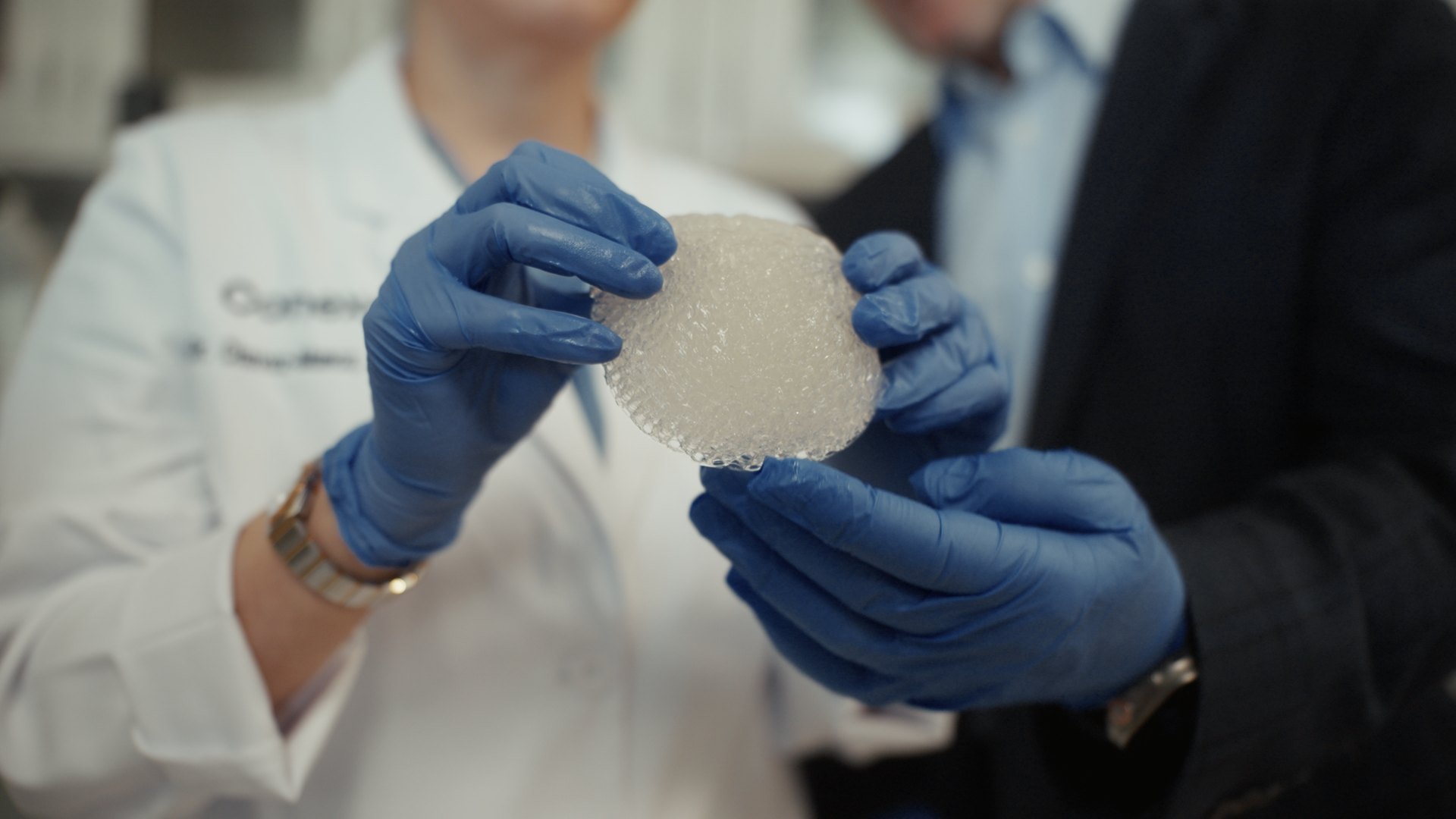
Conexeu’s 3D printed breast matrix or “B.R.E.A.S.T.” Image courtesy of Conexeu.
Now Conexeu is developing what it calls the B.R.E.A.S.T. platform, short for Bio-Regenerative Ergonomically Architected Smart Tissue. The company says the technology uses 3D printed extracellular matrix (ECM)-based biomaterials designed to support soft tissue regeneration after breast reconstruction procedures. The broader regenerative platform is being developed under the CXU regenerative brand.
Conexeu CEO Miles D. Harrison said,
“For more than 50 years, breast reconstruction has been defined by substitution, replacing what was lost with a foreign body. We are fundamentally shifting the paradigm from substitution to restoration. Conexeu was founded on the belief that the promise of regenerative medicine is real, but only if it is supported early, advanced with rigor, and translated into clinical practice. The field has accepted repair and implants as the ceiling. We refuse to. If we settle for those limitations, true bio-regeneration will remain out of reach.”
While the firm’s Chief Scientific Officer, Dr. Claudia Chavez-Munoz, stated,
“We did not set out to design a better implant. We set out to eliminate the need for one. By combining controlled 3D architecture with a biomimetic extracellular matrix, we are developing a structure that the body can recognize, integrate, and ultimately replace with its own living tissue.”
Conexeu director Dr. Z. Paul Lorenc added,
“The Conexeu platform is grounded in more than ten years of preclinical evidence across eleven peer-reviewed publications and proprietary preclinical data. Nothing can be more beneficial to a patient than knowing their own body could have the ability to repair and regenerate itself. Whether for reconstructive purposes or for aesthetic autologous breast and body enhancement, Conexeu’s 3D bioprintable matrix offers the potential towards true regenerative medicine.”
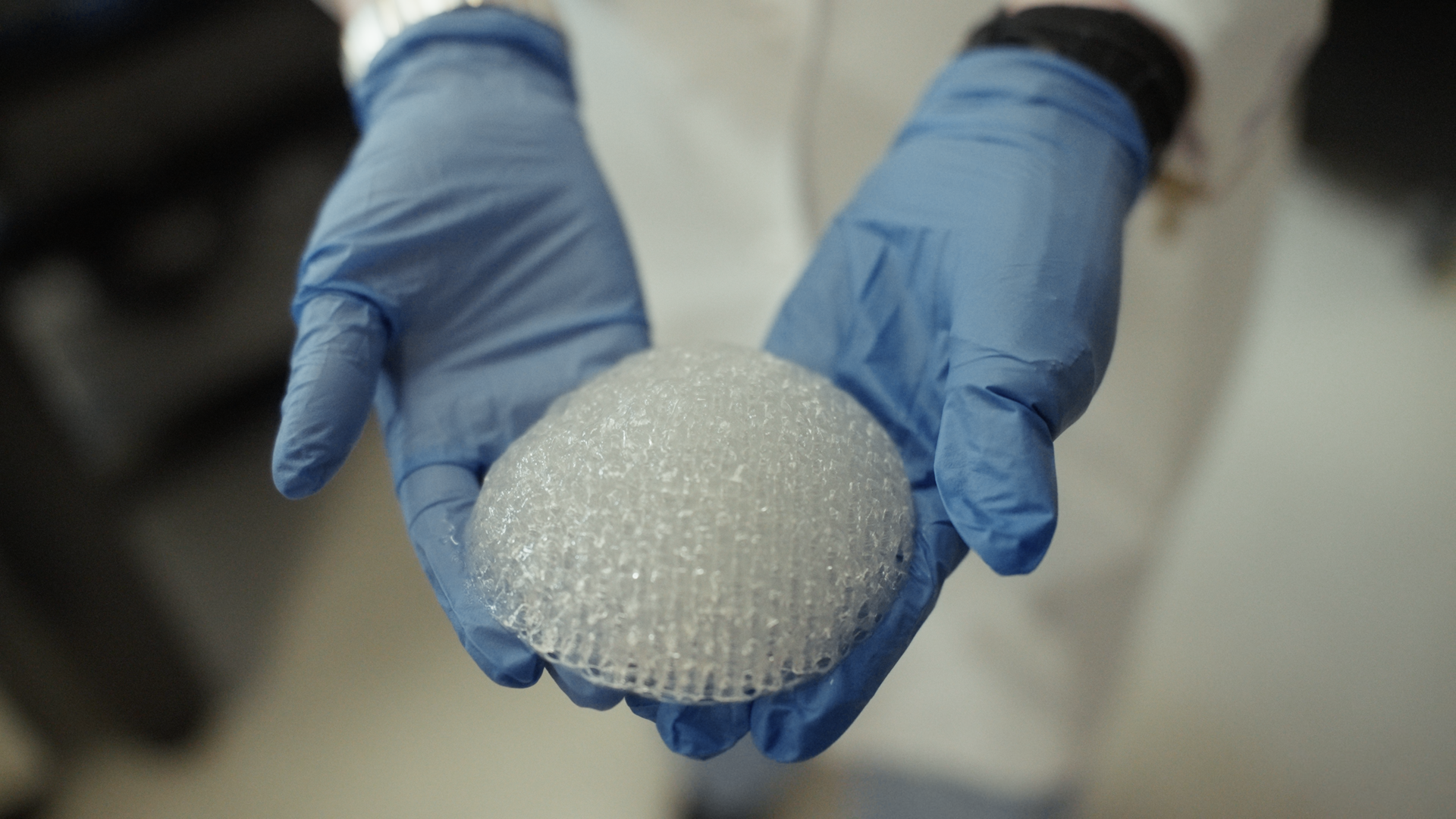
Conexeu’s 3D printed breast matrix or “B.R.E.A.S.T.” Image courtesy of Conexeu.
The implant will act as a temporary scaffold that guides the body to gradually replace the structure with its own tissue. The company contrasts this with traditional breast implants made of plastic that remain permanently in the body. The company is printing a regenerative, bioresorbable structure made out of extracellular matrix proteins. This seems different from the polycaprolactone-seeded with cells approach that BellaSeno uses, or the PLLA/PLA that Lattice uses. Conexeu says that its solution is “designed to provide both mechanical support and biological support intended to facilitate direct tissue remodeling rather than merely occupying space.” I’m not sure what this difference actually means, but a new approach could give them a different path to their own IP and solution. But it’s also unclear how this process is actually supposed to work.
Generally, an extrusion-based bioprinter can make a custom structure, and the resulting material is gradually replaced with the body’s own tissue. The differences could lie in the extent of remodeling. With remodeling, the tissue can be simulated much more realistically than simple grown tissues previously have been. It’s unclear which technology or approach actually enables the firm to do this.
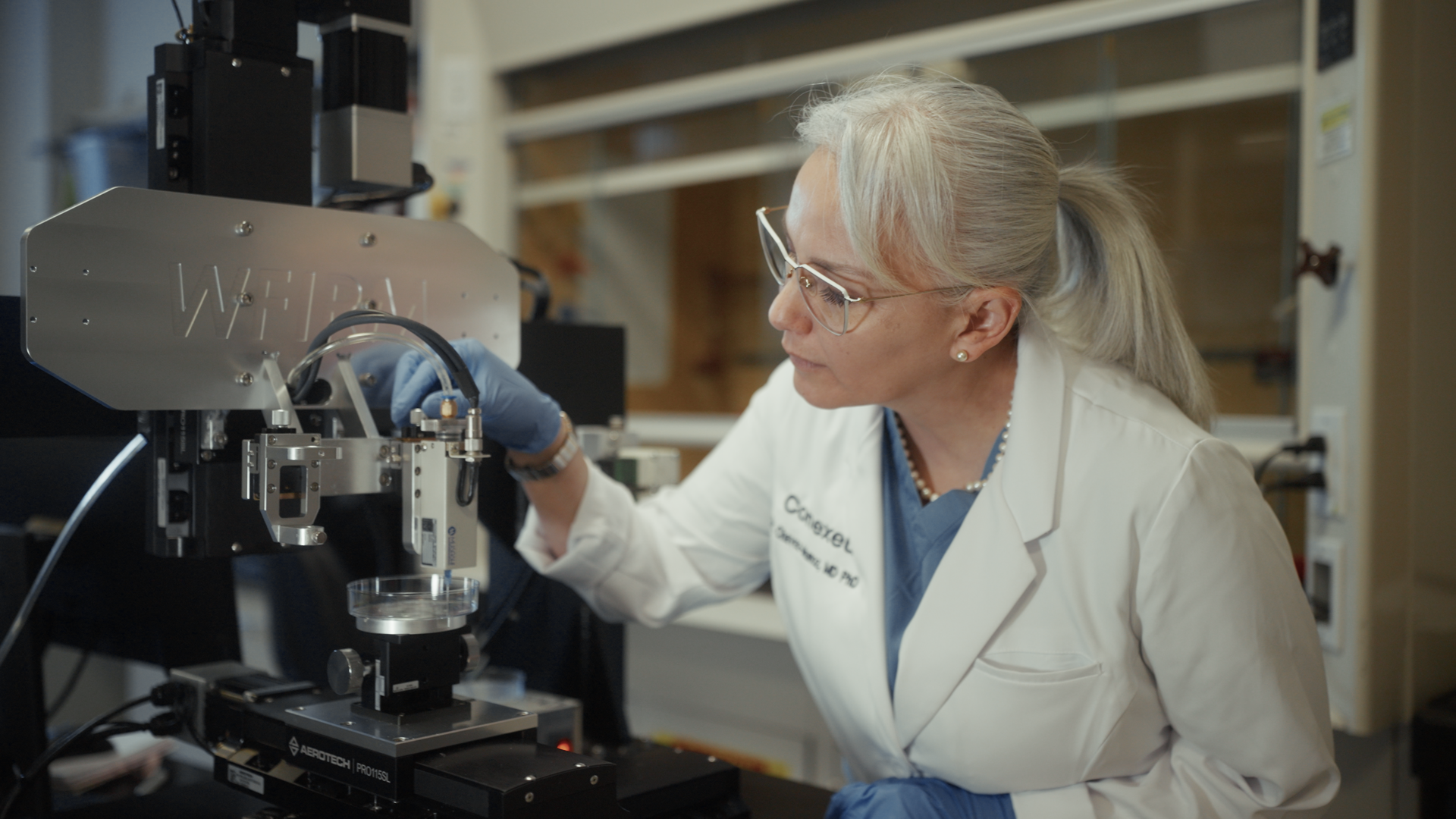
Dr. Chavez 3D prints Conexeu’s breast matrix or “B.R.E.A.S.T.” Image courtesy of Conexeu.
The company also has a Ten Minute Tissue product that lets you inject room-temperature ECM into a patient. The company has raised $5 million on an online equity raising platform called Equifund, explaining, “What if we could repair skin like we repaired drywall?” The company there disclosed that it has previously raised $2.6 million. Conexeu is commercializing a University of British Columbia collagen solution and has had an IPO. The company is pre-revenue and has spent $3.9 million in 2025 and $1.7 million in Q1. The firm now holds over $6 million in cash, which should see it through this year. The company is planning a direct listing on Nasdaq on the 21st of May. This listing of 9.4 million shares by current investors will result in their shares being sold, but not provide the firm with additional capital. This is worrying. It is unclear how the company wants to raise additional money after this offering. It is also unclear why the current listing is a sale by investors rather than a capital raise.
Conexeu’s claims seem to be rather optimistic. I can’t really map what they want to do with the current 3D prints and how this will easily and quickly lead to a solution. The company also says it plans to pursue the FDA’s 510(k) pathway for certain indications, despite presenting the technology as a highly novel regenerative solution. I’m rather skeptical about their claims.
Subscribe to Our Email Newsletter
Stay up-to-date on all the latest news from the 3D printing industry and receive information and offers from third party vendors.
Print Services
Upload your 3D Models and get them printed quickly and efficiently.













You May Also Like
3D Printing News Briefs, October 24, 2026: Spinal Implant, Digital Dentistry, Recycled PLA, & More
We’re starting with a little business in this weekend’s 3D Printing News Briefs, and then moving on to FDA 510(k) clearance and digital dentistry. We’ll end with 3D printing waste...
3D Printing News Briefs: October 17, 2026: Affordable Housing, Bone Implants, Rubber Gloves, & More
In this weekend’s 3D Printing News Briefs, we’re starting off with quality assurance in metal additive manufacturing (AM), a new 3D printer, and 3D printed housing. We’ll finish up with...
AM Investment Strategies 2026 Sets the Stage for AMS 2027
AM Investment Strategies 2026 Nov. 5 · 12 p.m. ET · Free online event RESERVE YOUR SPOT ↗ A one-hour online discussion featuring some of the biggest names in 3D...
3D Printing News Briefs, October 10, 2026: Drones, WAAM, Ceramics, & More
We have a packed 3D Printing News Briefs for you this weekend! First, America Makes celebrated the recent National Manufacturing Day with 3D printed drones, and then it’s on to...