Harvard SEAS Engineers Develop 3D Printing Method for Soft Robotic Components with Programmable Shapes


The world of soft robotics is still largely in its pure research phase, but the R&D landscape has started to produce examples of early-stage commercialization. Researchers have started to refine their focus towards the genuine advantages of soft robotics over their more rigid counterparts, and the open-ended design capabilities of additive manufacturing (AM) have been pivotal to this evolution.
Not long ago, researchers from Harvard’s School of Engineering and Applied Sciences (SEAS) published a study in Advanced Materials detailing a novel process they developed, which relies on a rotating printer with a multimaterial nozzle. Users print a hard polymer shell first, then layer a gel-like polymer on top, resulting in a channel when the shell fully hardens, after which the softer substance is washed away.
Once the end product is inflated, the built-in design (“programmed shapes”) fully emerges, yielding bio-inspired shapes whose production would otherwise require casts and molds. Some of the example patterns detailed in the Advanced Materials article include flowers and human hands, addressing one of the most intractable problems associated with design for the robotics industry.
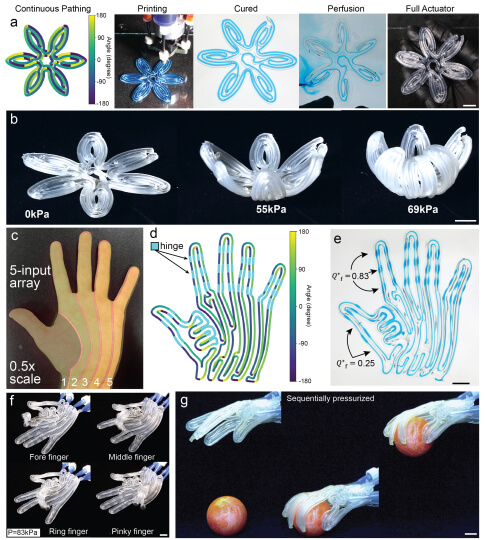
Image-based print-path planning for generating complex soft robotic matter
The researchers completed their work in the lab of Jennifer Lewis, Hansjorg Wyss Professor of Biologically Inspired Engineering at SEAS, who was the lead author on the first study based on the underlying process, published back in 2022. That earlier project demonstrated how helical shapes could be leveraged to make joints and hinges for soft robotics.
In a press release about the study on using rotational multimaterial 3D printing to produce soft robotics components with programmable shapes, Jackson Wilt, a graduate student who worked on the project, explained, “We use two materials from a single outlet, which can be rotated to program the direction the robot bends when inflated. …In this work, we don’t have a mold. We print the structures, we program them rapidly, and we’re able to quickly customize actuation.”
There are plenty of reasons to be optimistic about the long-term growth potential of the robotics industry, but I’m not sold on the near-term potential of the humanoid robots market, and I often wonder if humanoids have scalable commercial potential, at all. There just seem to be way too many obstacles — whether technological, economic, sociological, regulatory, etc. — standing in the way.
However, I think that if the progress that’s being made in soft robotics can catch up to, and synchronize with, all the progress made thus far with more rigid robotics components for humanoid systems, the idea of a mass humanoid market at some point in the future starts to make more sense. This would extend the timeline for humanoid commercialization much farther out than the forecast of 2026 that some who are working on the problem have floated, though I don’t know if the people touting those forecasts can even believe them. But who knows what kinds of progress they’re seeing behind closed doors!
In any case, I think the biggest selling point for the direction soft robotics R&D seems to be headed in, and the biggest selling point for the role of 3D printing in this research area, is the potential for maximizing functional design. The logical extreme for this would be typing in a desired function, and having a program respond with a design that fits the purpose, which is a concept that has attracted a significant amount of VC money in the last few years. Soft robots built with 3D printers could be a perfect use-case for testing all those text-to-design applications.
Again, while I acknowledge that technological acceleration cares nothing for my feelings, I think that the mid-2030s “feels” like a more realistic target for meaningfully commercializing the sort of tech under discussion here. That may sound too slow to minds who seem to be itching for a singularity, but I think such minds have already been given far too much influence over the direction of human affairs.
Images courtesy of SEAS
Subscribe to Our Email Newsletter
Stay up-to-date on all the latest news from the 3D printing industry and receive information and offers from third party vendors.
Print Services
Upload your 3D Models and get them printed quickly and efficiently.













You May Also Like
3D Printing News Briefs, October 10, 2026: Drones, WAAM, Ceramics, & More
We have a packed 3D Printing News Briefs for you this weekend! First, America Makes celebrated the recent National Manufacturing Day with 3D printed drones, and then it’s on to...
3D Printing News Briefs, October 3, 2026: Hypersonics, Hotends, & More
We’re starting off with defense in this weekend’s 3D Printing News Briefs, as Titomic was awarded a $5 million U.S. defense contract, and VulcanForms announced a partnership with Specter Aerospace...
The Part Is Only Half the Story: Why 3D Printing Needs a Digital Thread
A 3D printed part can generate a lot of information. The challenge is keeping track of it. Manufacturers need to know which design was used, what material went into the...
Advanced Manufacturing at IMTS 2026: 3D Printing and AI and Drones, Oh My!
Last week’s International Manufacturing Technology Snow (IMTS) in Chicago welcomed over 90,000 attendees to the jungle that is McCormick Place. With over 1.17 million square feet of exhibit space, and...