3D Printing News Briefs, February 14, 2026: Project Call, Maritime Construction, Prosthetics, & More

Happy Valentine’s Day! We’re starting this weekend’s News Briefs off with a Project Call award, and then moving on to a business growth program. We’ll end with research in underwater construction 3D printing and structurally complex 3D printed replicas, and finally, a dental industry veteran is working to make better 3D printed dental prosthetics.
UDRI Receives $450,000 for America Makes Project Call

In the fall of 2026, America Makes and the National Center for Defense Manufacturing and Machining (NCDMM) announced the Affordable and Agile Composite Additive Manufactured Structures (AACAMS) project call, funded by the Air Force Research Laboratory’s Materials and Manufacturing Directorate (AFRL(RXN)). AACAMS is meant to assess the current continuous fiber additive manufacturing (CFAM) landscape, find any technology gaps that limit adoption, and define attributes that system integrators need to successfully deploy CFAM in commercial and defense applications. Now, it’s been announced that the University of Dayton Research Institute (UDRI) is the awardee of the $450,000 AACAMS project call. The DoD has prioritized CFAM because it can produce lightweight, robust, high-performance parts; these are needed for critical weapons and support platforms. Under the AACAMS project, UDRI will develop a comprehensive set of reports and roadmaps to inform DoD and industry of investments that can help mature and scale CFAM technologies.
“Today’s warfighter faces a dynamic landscape that demands increased speed, agility, and precision. This project is a strategic step to integrate additive manufacturing technologies into production, enhancing defense capabilities. We are excited to support our members who bring in-depth expertise pivotal to addressing these real-world challenges,” said John Martin, Additive Manufacturing Research Director at America Makes.
Innovate UK Chooses E3D for Business Growth Scaleup Program
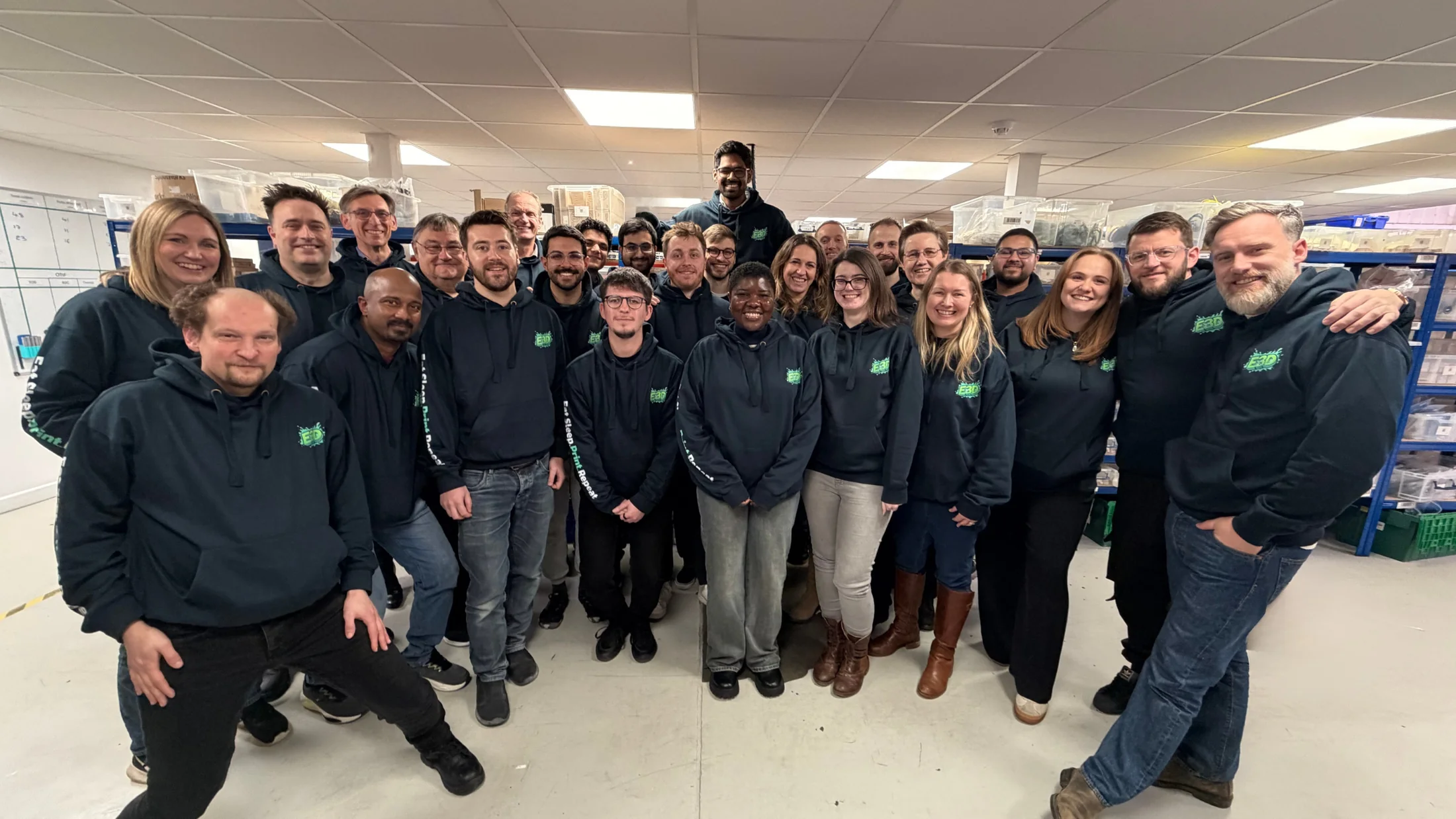
UK-based E3D, which develops and supplies hotends, extrusion systems, nozzles, and other components for FDM 3D printers, has grown from a couple of 3D printing enthusiasts in a chicken shed to a whole team of experts working towards the goal of Print Better. The company recently announced that it was selected for Innovate UK Business Growth’s Scaleup Program. It’s a targeted scheme focused on helping innovative, scaling UK companies get past challenges inherent with rapid growth, such as intellectual property (IP) laws and entering new markets. The program only supports less than 100 of the UK’s fastest growing, most ambitious companies, and they have to be invited to apply, so for E3D to be included is a big deal. Application criteria includes innovation-led businesses that are capable of achieving about 50% annual growth each year, and have the potential to disrupt markets. E3D will now receive one-on-one, director-led help from the program, tailored to its own scale-up priorities and challenges. Considering how big the desktop market currently is, E3D definitely has the potential to be a major disruptor.
“Being invited onto Innovate UK’s Scaleup Programme is a milestone moment for us at E3D. It recognises not just where we are today, but where we can go next: scaling world-class extrusion technology, investing in our people and capabilities, and helping manufacturers around the world push the boundaries of what additive can do,” said Dave Lamb, Founder and CEO of E3D. “With the backing and expertise of the programme, we are better equipped than ever to turn our ambitions into impact.”
Cornell’s Underwater 3D Printing Could Transform Maritime Construction
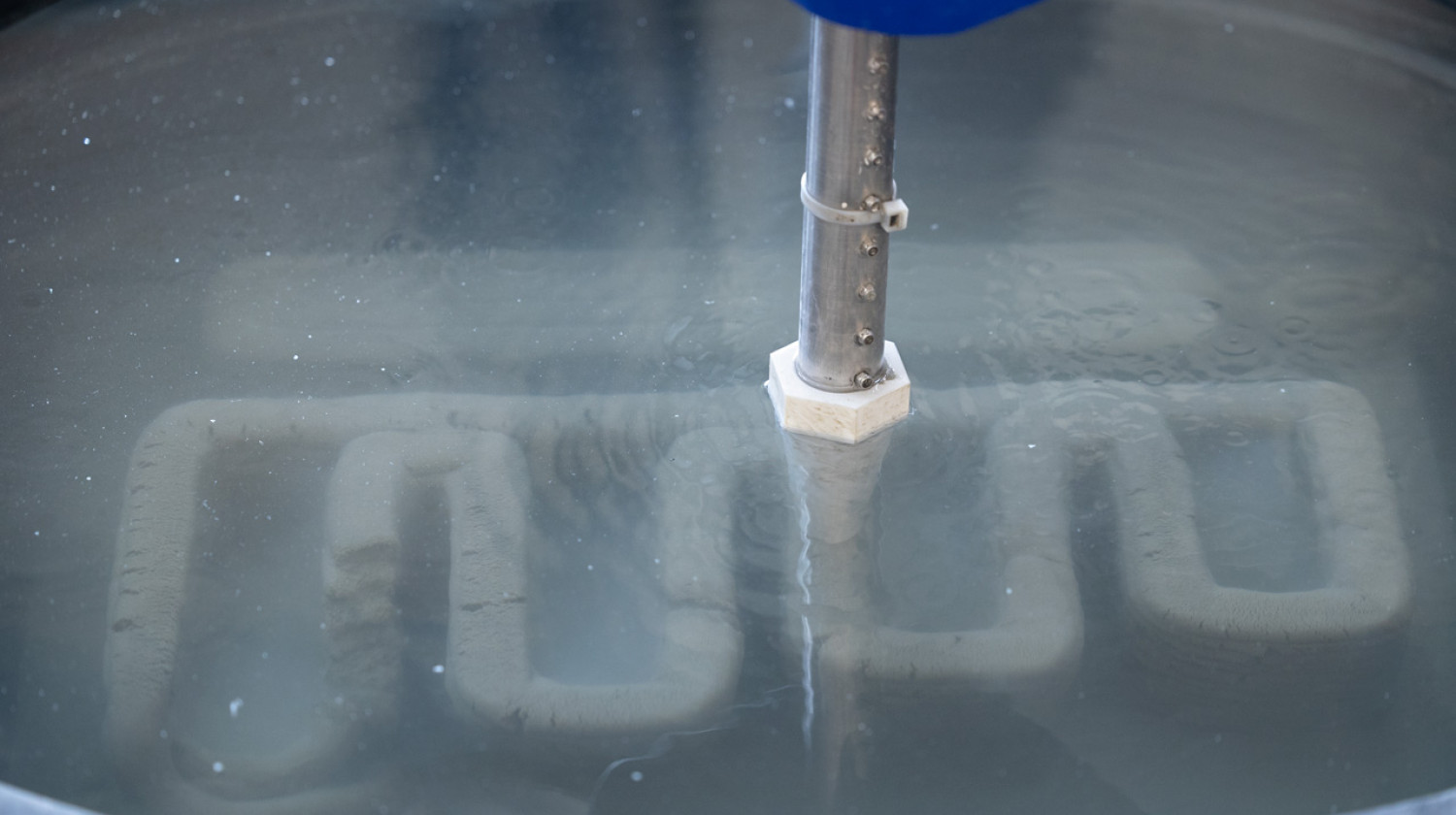
For months, the team has been conducting test prints in a large tub of water, monitoring how the layers are deposited and the strength, shape and texture of each sample. Image: Ryan Young, Cornell University
In 2024, the DoD’s Defense Advanced Research Projects Agency (DARPA) sent out a request for proposals to design concrete that could be 3D printed at a depth of several meters underwater. Additionally, DARPA said the concrete could only include a minimal amount of cement, and had to primarily be made of seafloor sediment, to decrease material transportation logistics. Researchers from Cornell University took on the challenge, and are working on a better way to 3D print concrete underwater, which could revolutionize maritime construction and the repair of critical infrastructure. The interdisciplinary group features a sub-team for material design, and another for fabrication, and collaborators from electrical and computer engineering, civil and environmental engineering, and architecture. Last year, they demonstrated to DARPA officials that they were close to meeting its high sediment target, and received a $1.4 million grant contingent on meeting several benchmarks.
Now, it’s time for phase two: several teams 3D printing an arch underwater. The Cornell team, led by Sriramya Nair, assistant professor of civil and environmental engineering in the David A. Duffield College of Engineering, has been conducting multiple test prints in a tub of water in the university’s Bovay Civil Infrastructure Laboratory Complex. Working in a lab setting enables the team to monitor how the layers are deposited and the properties of each arch, but this monitoring can’t be done underwater. As Nair explained, they “have to be able to detect those things and adjust our tool path in real time,” without relying on a scuba diver. So they also designed a control box with multiple sensing systems, which can be integrated with a robot arm to track the underwater printing in real time. The final DARPA demonstration will be held next month.
CRAFT 3D Printing Makes Structurally Complex, Realistic, Affordable Replicas
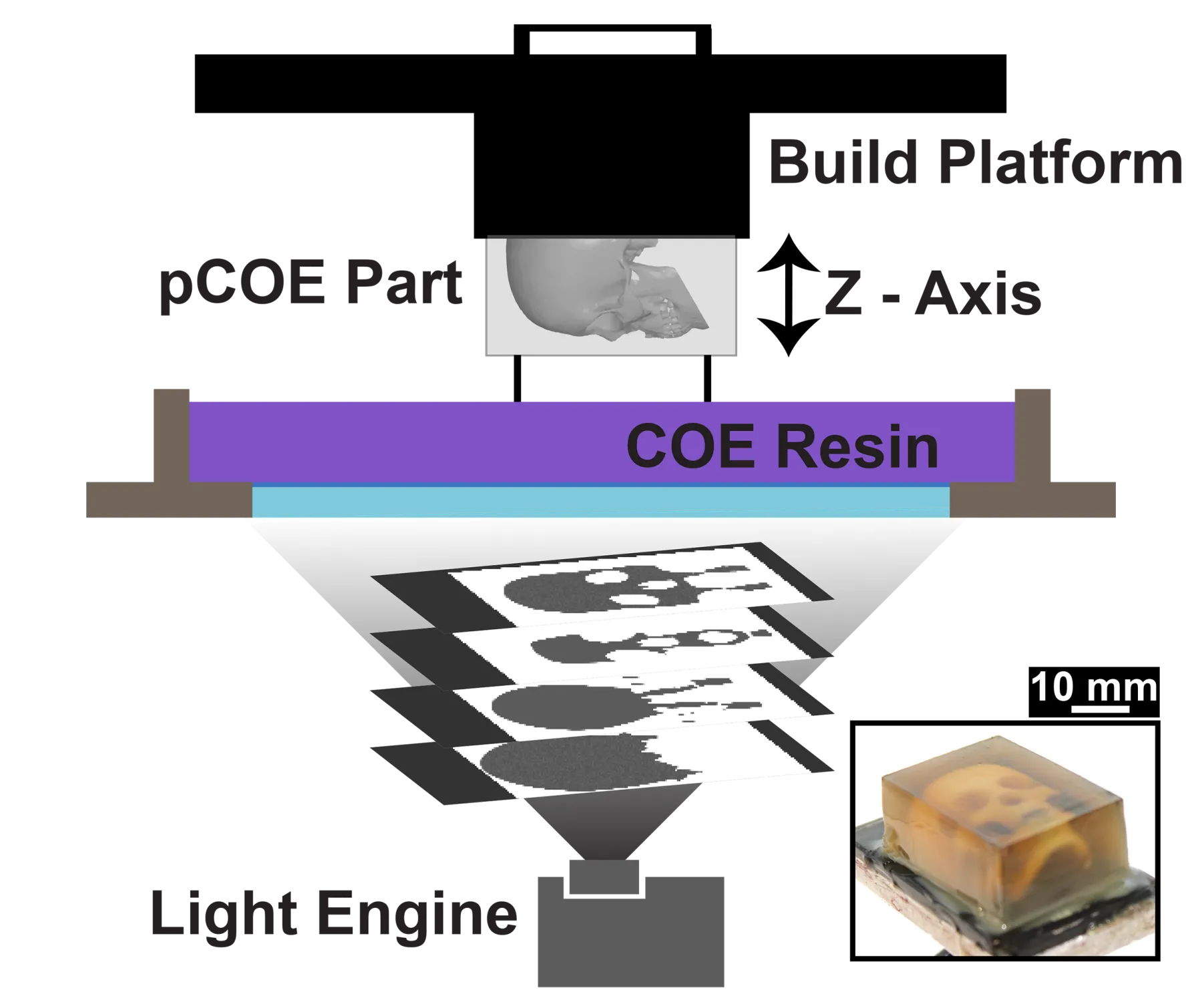
Schematic of the CRAFT method, illustrating the printing of a crystalline skull embedded within a more amorphous matrix. The method uses a commercial printer with varying patterns of light to transform a widely available liquid resin called cyclooctene into a solid plastic object. It involves projecting a series of grayscale images onto a platform that moves up and down in the liquid, building the object up from a series of microscopically thin 2D layers of polymeric material. Credit: University of Texas at Austin.
A team of researchers from the University of Texas at Austin, Sandia National Laboratories, Oregon State University, Lawrence Livermore National Laboratory (LLNL), and Arizona State University recently published a paper on their new method for 3D printing objects that have very different properties, like transparency and levels of hardness, using inexpensive printers and common materials. Called Crystallinity Regulation in Additive Fabrication of Thermoplastics (CRAFT), the method uses varying patterns of light to transform a liquid resin called cyclooctene in a solid plastic object. Using a commercial printer, a series of grayscale images is projected onto a platform that moves up and down in the liquid, which builds up the object. Because CRAFT can realistically simulate interconnect structures of different materials types, it could be used to make structurally complex replicas of body parts for medical students to practice on, with realistic and different ligament, muscle, and bone models. The method would also be good for energy damping applications, like sound proofing and personal protective gear.
“We can control molecular level order in three-dimensional space, and in doing so, completely change the mechanical and optical properties of a material. And we can do that all from a really simple, inexpensive feedstock by just changing the light intensity. It’s the simplicity at the heart of it that’s really exciting,” explained Zak Page, a UT associate professor of chemistry and author on the paper.
“DLP or LCD 3D printing, which this method is compatible with, are some of the cheapest printers that you can buy. You can get one of these printers with the capability to do grayscale projection for $1,000 or less and be off to the races printing.”
Dental Industry Expert Develops Multi-Material 3D Printing for Prosthetics
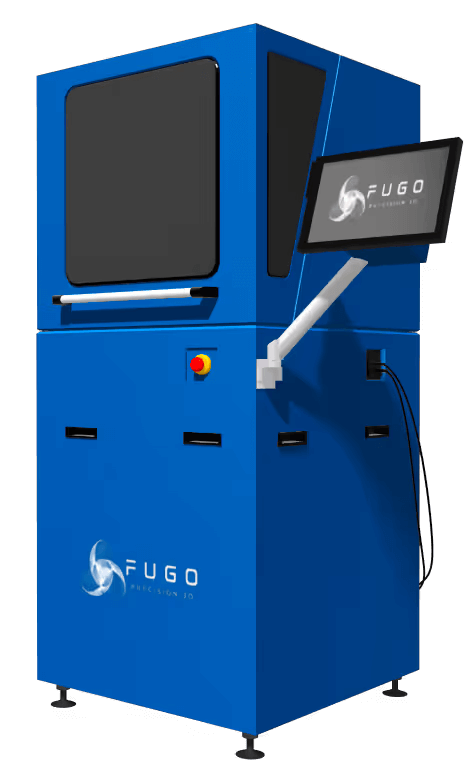
Mart Goldberg, founder and CEO of BH PRINTELLIGENCE, has over 25 years of experience in owning and operating dental laboratories, and is working to enable high-precision, multi-material 3D printing for the dental industry. After witnessing the frustration of others in his field at the inability to easily print multiple materials in one automated cycle, he decided to solve the problem, and developed a patented multi-material 3D printing method for dental prosthetics. Traditional AM methods can have a lot of interruptions, like changing materials and repositioning parts, and Goldberg’s technology supposedly eliminates these issues using intelligent functional region mapping, seamless material transitions, and automated deposition sequencing, all in one print cycle. His method was developed specifically to integrate with FUGO Precision 3D’s centrifugal vat photopolymerization system, which offers high speed, sub-30 micron repeatability, and integrated printing, washing, drying, and curing in one machine. At the upcoming LMT Lab Day in Chicago, Goldberg will demonstrate his technology live. FUGO will be demonstrating with its strategic partner Graphy Inc. at the event, and while I can’t confirm that Goldberg will be in the same room, it seems likely.
“I spent decades watching skilled technicians perform the same manual interventions over and over – changing materials, cleaning equipment, repositioning parts. The automation we’ve achieved can reduce manual labor in a printing cycle by approximately 90%. But it’s not just about efficiency. The stable chemical bonding between dissimilar polymers and natural-appearing material transitions – that’s what will change patient outcomes,” Goldberg said.
“There are 120 million Americans suffering from tooth loss. This isn’t a prototype or a concept – we’re showing production-ready technology that dental laboratories can implement today. The methodology works, and we’re ready to help manufacturers transform their operations.”
Subscribe to Our Email Newsletter
Stay up-to-date on all the latest news from the 3D printing industry and receive information and offers from third party vendors.
Print Services
Upload your 3D Models and get them printed quickly and efficiently.











You May Also Like
Stratasys Partners With Defense Prime Heavyweights to Qualify SAF PA12 for Industrial 3D Printing
Perhaps the most valuable lesson that the additive manufacturing (AM) industry has learned in its technical maturation era over the last five years or so is that you can’t really...
Via EOS Partnership, Texas’s ACMI Is the First Customer for the AMCM M 8K 3D Printer
EOS’s two major announcements in the last few months have been the launch of the EOS M4 ONYX at Formnext 2025 and the news from a couple of weeks ago...
Reuniting ExOne and voxeljet: An Investor’s View on Building a Global Industrial Sand Printing Leader
Authored by Whitney Haring-Smith, Chair of the Board, ExOne Global Holdings & Managing Partner, Anzu Partners At Anzu Partners, we invest with conviction in industrial technologies that create categories—and then...
VulcanForms Raises $220M as Investors Back Scaled U.S. Metal 3D Printing
VulcanForms has closed a $220 million Series D funding round, a large vote of confidence at a time when investment in 3D printing has become more selective. Investors are backing...