
VulcanForms Raises $220M as Investors Back Scaled U.S. Metal 3D Printing

VulcanForms has closed a $220 million Series D funding round, a large vote of confidence at a time when investment in 3D printing has become more selective. Investors are backing fewer companies, but writing bigger checks for businesses that are already delivering real production at scale. And VulcanForms is one of them. The round, led by Eclipse and 1789 Capital, was oversubscribed.
1789 Capital President, Omeed Malik, said, “1789 Capital is thrilled to support VulcanForms, a company revitalizing America’s industrial strength and sharply reducing our dependence on foreign suppliers. By restoring high-skilled manufacturing jobs to American soil, VulcanForms is helping to drive the next great chapter of American prosperity.”
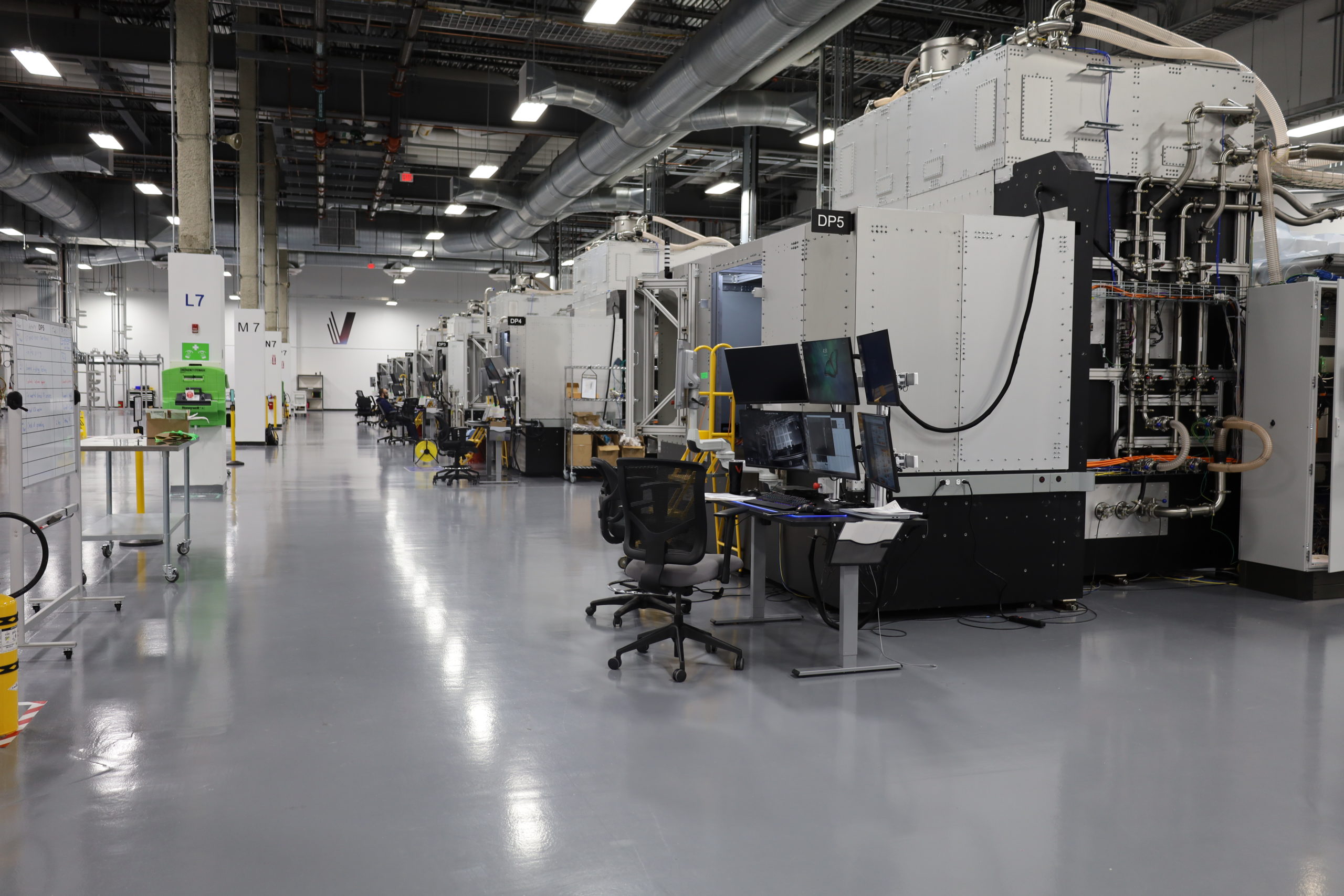
VulcanForms metal 3D printing factory. Image courtesy of VulcanForms.
VulcanForms builds and operates fully integrated digital factories for metal parts in the United States. These factories combine metal 3D printing, precision machining, automation, inspection, and software into a single production system. And the goal is to replace long, fragmented metal supply chains with one domestic production workflow.
Traditionally, metal parts move between many suppliers and countries before they are finished. But that strategy adds cost, time, and risk. So VulcanForms keeps the entire process in one facility, cutting time and risk.
Demand Exceeds Capacity
According to the company, this funding round comes at a key time. For the first time in its history, customer demand has exceeded VulcanForms’ available production capacity. Customers are already placing large, long-term orders and now want more volume than the company can currently produce. So the new capital will be used primarily to expand manufacturing capacity and scale its U.S. footprint.
The company says it is already supporting large commercial programs across medical devices, aerospace, defense, consumer products, and industrial markets. In these sectors, parts must meet strict standards and perform the same way every time.
For example, in 2025, VulcanForms also began producing advanced test parts for aerospace applications. The company reported that it had additively manufactured the first test components for a 2 kN rocket thruster, designed using AI-driven engineering software, demonstrating its production capabilities for complex, mission-critical parts. VulcanForms also showcased its production-scale metal manufacturing capabilities at the AIAA SciTech 2026 conference in Orlando, where 3DPrint.com visited the company’s booth.
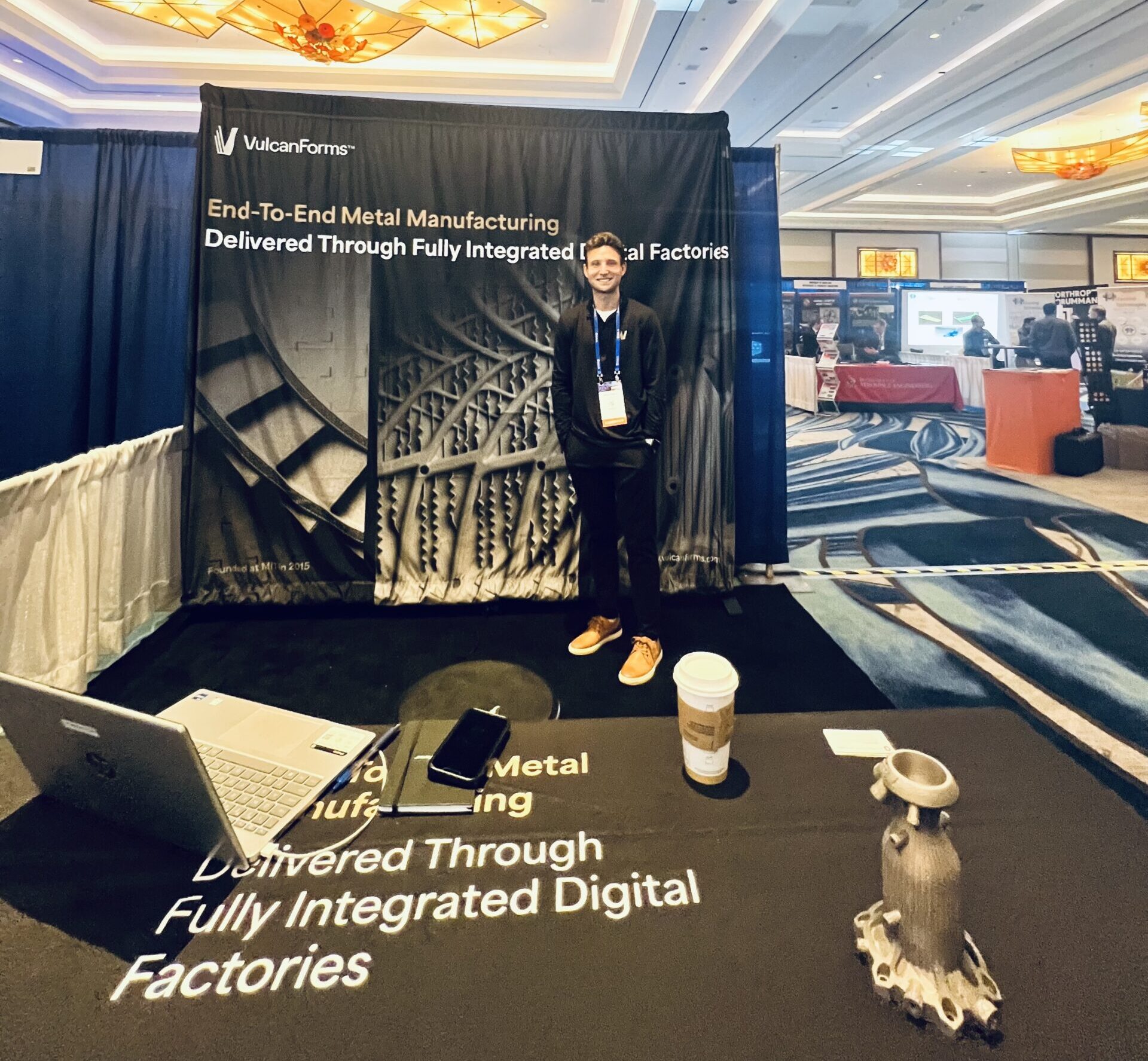
VulcanForms booth at the AIAA SciTech Forum 2026. Image courtesy of 3DPrint.com.
This funding also says a lot about where investment in 3D printing stands today. As 3DPrint.com noted in a recent year-end look at mergers, acquisitions, and exits in 2025, the industry has moved past its expansion phase. And investors are backing companies with clear customers, focused markets, and a path to profitability, like VulcanForms, which focuses on metal parts, operates at production scale, and supports domestic manufacturing of mission-critical components.
What’s more, this funding round is different from many of the deals seen in 3D printing last year. While some companies were restructuring or selling assets, VulcanForms is raising money to expand, driven by existing customer demand.

Medical implants 3D printed at VulcanForms. Image courtesy of VulcanForms.
“American manufacturers need a domestic alternative that can compete with global production at scale with superior speed and precision,” said Kevin Kassekert, CEO of VulcanForms. “This financing enables us to meet surging demand and expand our role as a critical partner to companies rebuilding resilient domestic supply chains.”
With this funding, VulcanForms plans to expand its U.S. manufacturing capacity to meet customer demand, pointing to continued investor interest in production-scale metal 3D printing and domestic manufacturing.
Subscribe to Our Email Newsletter
Stay up-to-date on all the latest news from the 3D printing industry and receive information and offers from third party vendors.
Print Services
Upload your 3D Models and get them printed quickly and efficiently.













You May Also Like
Solid Rocket Motors: the First Big Scaling Test for AM in the US Defense Sector
The additive manufacturing (AM) industry has become obsessed with the opportunity for drones, and there’s certainly good reason for that. But before drones, the big focal point in AM for...
Why the AM Industry Should Pay Attention to Schneider Electric’s $22.6B PTC Acquisition
By late 2024, there was already enough signaling of the additive manufacturing (AM) industry opportunity in the data center infrastructure market for AM Research to write a report on the...
AM Demand Signals: Reshoring the Robotics Supply Chain
The Federal Communications Commission (FCC) recently banned the sale in the US of “almost all” new mobile robots sourced from foreign countries. IEEE Spectrum (the link in the first sentence)...
3D Printing Financials: $28M in China, U.S. Deals and a Metal AM Comeback
Money continues to go into additive manufacturing (AM). From a $30 million raise for a Chinese metal 3D printing company to new funding for naval AM and a European company...

























































