3D Printing Predictions 2026: Industrial Production in Metal Additive Manufacturing

“In 2026, what I expect to get better in AM is cost performance: printer productivity will increase, printer prices will decrease, and thicker layers will finally start driving component costs in the right direction. We will also start to admit that the “religion of the round” powder (or extra super‑duper round) belongs in the same bucket as the things we joked about as teenagers: it works, but once we move out of the basement and get real jobs, we cannot afford to worship at that altar anymore. All of these are necessary to increase applications until clean‑sheet designs become more frequent and designing for AM earns you bonus points for making a value proposition with your program manager.”
“I think that 2026 will see steady growth relative to application development, qualification, and scaling. The focus from many machine OEMs has been on increasing production capabilities with advances that support both increases to part quality as well as increases in productivity. These advances support the perspective that the focus is on qualification and production. I see aerospace leading way in terms of the breadth of new part qualifications in the US. Laser powder bed fusion will continue to be the dominant printing technology in this space, but I see significant growth in directed energy deposition usage in the next few years as the Maritime Industrial Base initiative in the US builds momentum.”
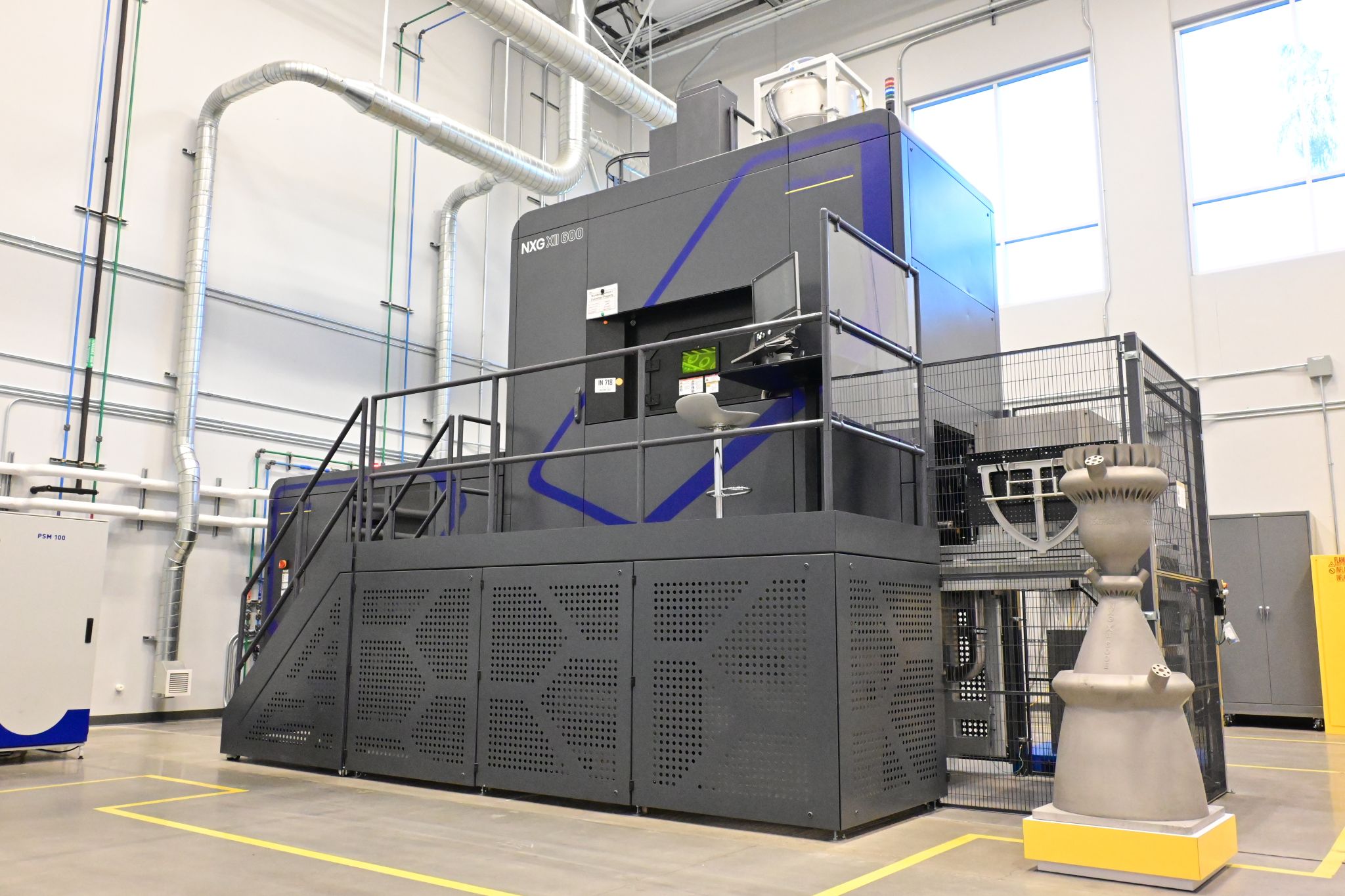
A Nikon SLM Solutions NXG XII metal 3D printer located at the Long Beach facility. Image courtesy of Nikon Advanced Manufacturing.
“Over the next year, industrial metal additive manufacturing will shift more clearly from Proof of Concept, and LRIP to a true Full Rate of Production. We will see a measurable increase in metal AM being used in weapon systems and munitions. We will expect a growing number of certified flight hardware across multiple platforms, and more materials data sets and qualified materials beyond the conventional alloys. I believe we will see factory level digital integration and emergence of metal AM farms. Production orders will come from defense, aerospace, and energy, with munition, satellite components, heat exchangers, RF applications, UAV, AUV, UAS, industrial gas turbines and marine applications leading the way.“Materials innovation will focus on aluminum for lightweighting (more CP1 aluminum alloys will be integrated into new designs and replace existing alloys), high-temperature alloys, corrosion resistance marine alloys, and tool-steel families that enable mold and die production at scale. The winners in 2026 will be the companies that treat AM not as a novelty, but as a manufacturing system, and use high productive AM systems optimized for throughput, consistency, and total cost. Additive is no longer about what can be printed; it is about what can be produced, repeatedly, with confidence, in a short period of time, cost effectively, and with higher functionality.”
“Additive manufacturing will continue to move away from capability talk and toward industrial readiness and scaling. Progress will be measured less by new machines and more by whether AM is accepted in regulated environments, driven by clearer qualification, repeatable processes, workable economics, and evidence chains that procurement, insurers, and regulators can live with. Attention is moving from novelty to maturity and certification thinking. In metals, LPBF will remain the main production workhorse, but growth will be incremental. DED will continue to gain ground in repair and large-scale applications, where cost, productivity, and material efficiency matter. Electron Beam PBF will strengthen its position in high-temperature alloys, titanium, copper, and energy-related materials. Buying behavior is changing accordingly: decisions are increasingly based on trust, evidence, long-term support, and whether AM can realistically be integrated into manufacturing capacity. China will continue to scale AM aggressively, iterating and improving faster than many European and US manufacturers.”
It’s interesting to see so many focus on alloy development, now much easier and cheaper to do. It’s telling to see that Ulf sees a high-temperature component leadership role for E-Beam; this, in and of itself, would have far-reaching consequences for the market. Ulf also says the quiet part out loud, with China’s progress being seemingly relentless over the past few years. Many machine makers will be in serious trouble if Chinese firms continue to improve while offering machines at very low cost. One alternative development is low-cost machines made in the US or Europe, with Xact Metal and OneClickMetal showcasing examples where easy-to-use machines could drive growth. We’re witnessing rapid adoption of low-cost systems in defense, suppressors, and industry.
“The growing number of consumer metal 3D printing applications in the market is leading to that the LPBF technology is gaining traction among end users and will increasingly be considered for producing a wide variety of products. With production-ready, easy-to-integrate, and affordable solutions, we are driving this development forward.”
I would personally recommend that any and all LPBF firms create a skunk works to make an accessible sub-$100k system that could grow the market to tens of thousands of new entrants a year. To me, it’s the only answer to increased competition and a sound strategy for expanding the market and creating your own customers. Yes, the Bentley Blowers were nice, but let’s make a Model-T if we really want everyone to drive. If we want increased adoption in economically uncertain times, lowering capex or part cost is the main lever. Likewise, lower-cost LPBF parts are great, but what about all those cases where DED parts could work as well as a tenth of the cost? One of the possible primary recipients of the DED gain that Ulf and Justin mention is Melanie Lang’s Formalloy. She believes that,
“Accelerated growth in additive manufacturing primarily driven by the rising adoption of Directed Energy Deposition (DED) for real-world production and repair. As industries push for greater component longevity, supply chain resilience, and sustainable manufacturing practices, DED will play a central role, especially in aerospace, defense, and energy. Expect wider use of multi-material and functionally graded structures, automated robotic DED cells for large-format builds, and rapid expansion of DED-based repair for high-value components. With increased investment in process monitoring, qualification, and digital integration, DED will continue adoption to a mainstream manufacturing solution delivering measurable performance and cost benefits. Current customers that utilize this technology include the Department of Defense, aerospace primes, turbine blades manufacturers, and consumer goods, to name a few.”
Melanie is understandably more bullish than most about DED, but it has long been a well-kept secret. Hundreds of thousands of turbine blades have already been repaired by DED and the “buy-a-cell” approach with on-board scanning and QA, making adoption much easier. Repair and straight-up production of low-cost parts could make 2026 a breakout year for DED. We’re seeing real momentum there.
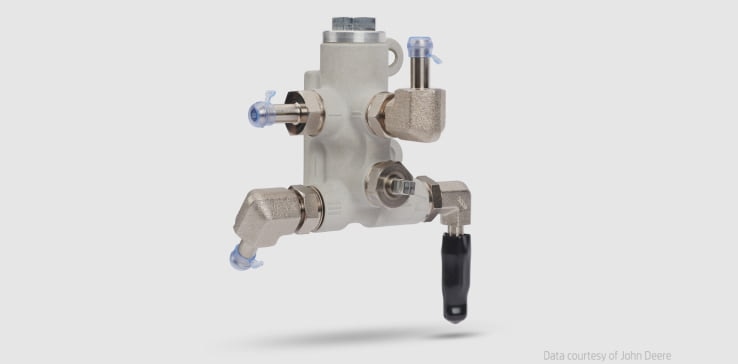
John Deere uses HP Metal Jet to 3D print valves. Image courtesy of John Deere.
Another technology, binder jet, was previously overhyped and seen more in PowerPoint presentations than on the factory floor. HP’s Alexandre Tartas, Head of Metals Global Sales and Go-To-Market for the 3D Printing Solutions Business, is trying to change this. He told us that,
“The consensus within the industry is clear: the future growth of industrial AM will be primarily driven by serial production, with a significant focus on metal applications. As manufacturers shift towards producing larger quantities, the demand for robust and scalable AM solutions continues to rise. LBPF will remain at the forefront of the industry, maintaining its leadership and expanding its domain of excellence, processing super alloys and delivering high-value applications, especially in relatively small to medium production series. The only question from my perspective is whether the geopolitical situation will affect the LPBF business structure. DED will be interesting to track over the next 12 months, as it is carving out a strong position within defense applications. It’s simple, the technology meets sector needs for specialized components and complex operations. Metal Binder Jet is in the process of maturing the higher volume applications. As the technology continues to evolve, larger production volumes and the introduction of new materials are set to drive increased demand. Significant progress is anticipated, with MBJ poised to overcome previous limitations and make notable advancements in the market. I predict that an application at vast scale will prove the case for MBJ and accelerate adoption significantly.”
Subscribe to Our Email Newsletter
Stay up-to-date on all the latest news from the 3D printing industry and receive information and offers from third party vendors.
Print Services
Upload your 3D Models and get them printed quickly and efficiently.











You May Also Like
SPARC: Authentise Makes AM-Optimized Workflow Software Available for U.S. Military Surge Production
Earlier this year, Authentise, the manufacturing workflow software provider based in the UK and Philadelphia, announced that it was working on a collaborative engineering platform called Project DDNA, a defense-oriented...
New Materials and Curing Unit at Formlabs
Formlabs is showcasing new SLA materials and a new curing solution. The new Tough 1000 Resin, with a tensile modulus of 1000, a Tough 1500, and an improved Tough 2000...
Metalysis, Skyrora & Thermo-Calc to Develop Tanbium Alloy Powder for ESA-Funded Project
Metalysis is to develop Tanbium alloy powder for launch vehicle manufacturer Skyrora. Metalysis uses an FFC solid-state electrolysis process, originally developed at Cambridge University and known as the FFC Cambridge...
AMS Quotes From the Host: An Interview with 3DPrint.com’s Joris Peels
Maybe you assumed you already hear enough from Joris Peels on 3DPrint.com and the 3DPOD. Well, that’s why you should never assume! The most opinionated man in the AM industry...