3D Printing Used to Make Prototype Plasma Camera Measuring Charged Particles in Space

Space is a vacuum, we’ve all heard that before. But that doesn’t mean it’s completely empty, just that it has an extremely low amount of particles and matter. Stars emit winds of charged particles, specifically the electrons and ions that make up plasma, and this can get pretty intense during solar storms. Researchers at the Laboratoire de Physique des Plasmas (LPP) have developed a new device to measure the flow of charged particles in space, and 3D printing was used in its creation.
In outer space, plasma particles interact with the surroundings of planets with magnetic fields, like our own, which can result in breathtaking atmospheric displays like auroras. But, these particles can also negatively affect satellites, as well as the crew of flights going over polar regions. Just like on Earth, weather in space can be hard to predict accurately, but as we continue to use more delicate equipment and technology in orbit, it’s becoming more necessary to anticipate these phenomena.
The LPP is a joint research unit between the French National Centre for Scientific Research (CNRS), École Polytechnique, Sorbonne Université, Université Paris-Saclay, and Observatoire de Paris-PSL. With support from the French space agency CNES, the “Space Plasmas” team at the LPP created the compact 3DCAM, which they say is the first plasma camera that can measure particles in space.
Gwendal Hénaff recently defended his thesis at the LPP, and together with his fellow researchers, published a paper on the work, titled “A Compact Ion-Electron Plasma Camera Spectrometer With an Instantaneous Hemispheric Field of View.”
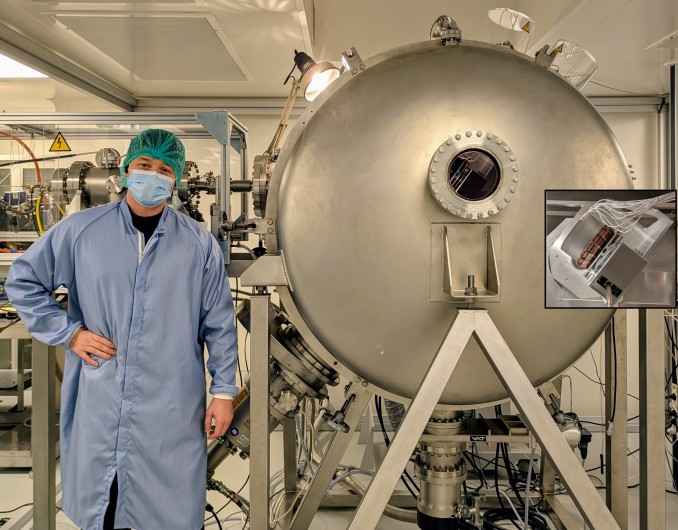
Gwendal Hénaff worked during his thesis on the development of a miniaturised plasma camera (shown in the insert photo). This camera underwent calibration tests in a vacuum chamber.
“Using additive manufacturing and a selective metalization technique, we have developed a compact ion/electron plasma camera based on the donut topology,” the research team wrote in the abstract of their paper.
Hénaff, with supervision by Matthieu Berthomier, CNRS research fellow at the LPP and chair of the CNES working group on the Sun, the Heliosphere, and Magnetospheres, worked on a new optical topology in his thesis, with the goal of achieving a field of view that covered an entire hemisphere, as well as an accurate measurement of plasma particles in just a few tenths of a second.
The team was focused on counting these particles at high speed, and measuring their density, energy, and velocity—scientists refer to this as “the distribution function of ions and electrons.” While traditional instruments take a few seconds to capture all this, Hénaff’s goal was to use the 3DCAM to capture a hemispheric measurement that’s near instantaneous.
“Conventional instruments have a field of view limited to a plane around the satellite. Since they need to measure in three dimensions, these instruments proceed in stages, using deflectors to widen their field of view,” Hénaff said.
Additionally, researchers often need to carry multiple instruments in order to achieve accurate measurements, which adds bulk in an environment where the less weight, the better. This is one area in which 3D printing can be very helpful: making space equipment more lightweight. In fact, this project couldn’t have been completed without the use of 3D printing, though not just for its ability to make objects less heavy.

Figure 4. Donut optics after electroless copper coating.
“The idea of this optical topology, forming interlocking donuts, emerged more than ten years ago, but it was complex to implement,” Hénaff explained. “Our team realized that it could only be implemented using recent advances in additive manufacturing through 3D printing.”
As the team explained in their paper, it would be difficult to manufacture the donut electrostatic analyzer (ESA) using conventional methods, because you’d have to make dozens of individual parts, potentially degrading the optics performance and quality of the electrostatic environment. They decided to go with SLA 3D printing for the ESA prototype, because it enables high-resolution objects, and used a resin with low out-gassing properties and high mechanical and thermal performance.
The completed print was cleaned in sonic baths, before the optics were chemically etched on and activated. Finally, a commercial plating bath was used to selectively deposit a layer of electroless chemical copper on the optics. This selective metallization process enables electrodes to be deposited on the 3D printed, non-conductive resin part; these electrodes are what make the optics functional, so charged particles can be deflected toward a detector “on which an image of the plasma surrounding the probe is formed.”

Copper: optics with “Donut” topology. On top, electronic cards. Dimensions: 17 cm diameter, 12 cm high.
Thin carbon foils are used to operate the 3DCAM for both low-energy ions and electrons sequentially. This had nothing to do with 3D printing, but everything to do with operating the plasma camera, which has already gone through an initial testing and calibration phase. The team is now developing a qualification model of the 3DCAM, which should be closer to an instrument that could actually be used on real-life space probes. This model will complete environmental, mechanical, and thermal testing by the end of 2026, and the team is planning for an in-orbit demonstration of the 3DCAM in 2028.
“We proved that the donut analyzer can be manufactured using AM and selective electroless plating, which is, to our knowledge, a first in plasma instrumentation development. These new techniques allow us to approach these new topologies without requiring complex machining and assembly, therefore potentially reducing the production cost,” the researchers concluded in their paper.
“Overall, this research has demonstrated the feasibility of using the donut topology concept for in situ characterization of space plasmas.”
In addition to Hénaff and Berthomier, co-authors of the paper include Frédéric Leblanc, Jean-Denis Techer, and Yvan Alata with the LPP, and Carla Costa with CNES.
Subscribe to Our Email Newsletter
Stay up-to-date on all the latest news from the 3D printing industry and receive information and offers from third party vendors.
Print Services
Upload your 3D Models and get them printed quickly and efficiently.











You May Also Like
3D Printing News Briefs, November 6, 2025: Filament Drying, Personalized Medicines, Cricket Arm Guard, & More
In today’s 3D Printing News Briefs, Thought3D has upgraded its filament drying system. Moving on to dental and medical news, LuxCreo received a strategic investment to help develop next-generation 3D...
Korean Doctors Use 3D Printing to Replace Entire Ankle Bone in Groundbreaking Surgery
A team of orthopedic surgeons in South Korea has successfully replaced an entire ankle bone — the talus — with a custom 3D printed titanium implant. The study, published in...
China Builds World’s Largest 3D Printed Drug Factory in Nanjing
In the Jiangning high-tech zone of Nanjing, China, a new kind of pharmaceutical factory is emerging, except that this is not the usual conveyor belt or assembly line pharma factory....
Measuring Excellence: On the Ground at Hexagon Live in Fabulous Las Vegas
Two weeks ago, I drove approximately 66 miles from Dayton, Ohio to the Cincinnati airport in northern Kentucky. I then flew about 595 miles to Minneapolis, Minnesota, switched planes, and...