UK’s Base Materials Launches Large-Format 3D Printing Service


Tooling has been one of the additive manufacturing (AM) industry’s biggest success stories for quite some time, but the market is still in its early phases. One factor giving this market a renewed boost lately is the growth of AM platforms that leverage robotic arm systems.
Large-format tooling applications are poised to benefit most from the combination of AM and robotic arms. The UK’s Base Materials, for instance, has just launched a 3D printing service dedicated to the market for large-format tooling, backed by ProXtrude, a proprietary printable paste.
According to Base Materials, the company achieves a near 60 percent reduction in material waste with ProXtrude compared with conventional manufacturing methods, thanks to the minimization of post-processing requirements. In addition to using ProXtrude for its service capabilities, Base Materials is also selling the paste as a standalone product to companies with in-house AM divisions.
While tooling is Base Materials’ primary focus for the 3D printing service, the company also makes end-use parts for a variety of industries, including those that require subsea buoyancy, like unmanned underwater vehicles (UUVs). Earlier this year, Base Materials became the first company to gain DNV certification for its syntactic foam subsea buoyancy materials, which Base sells under the brand name Subtec.
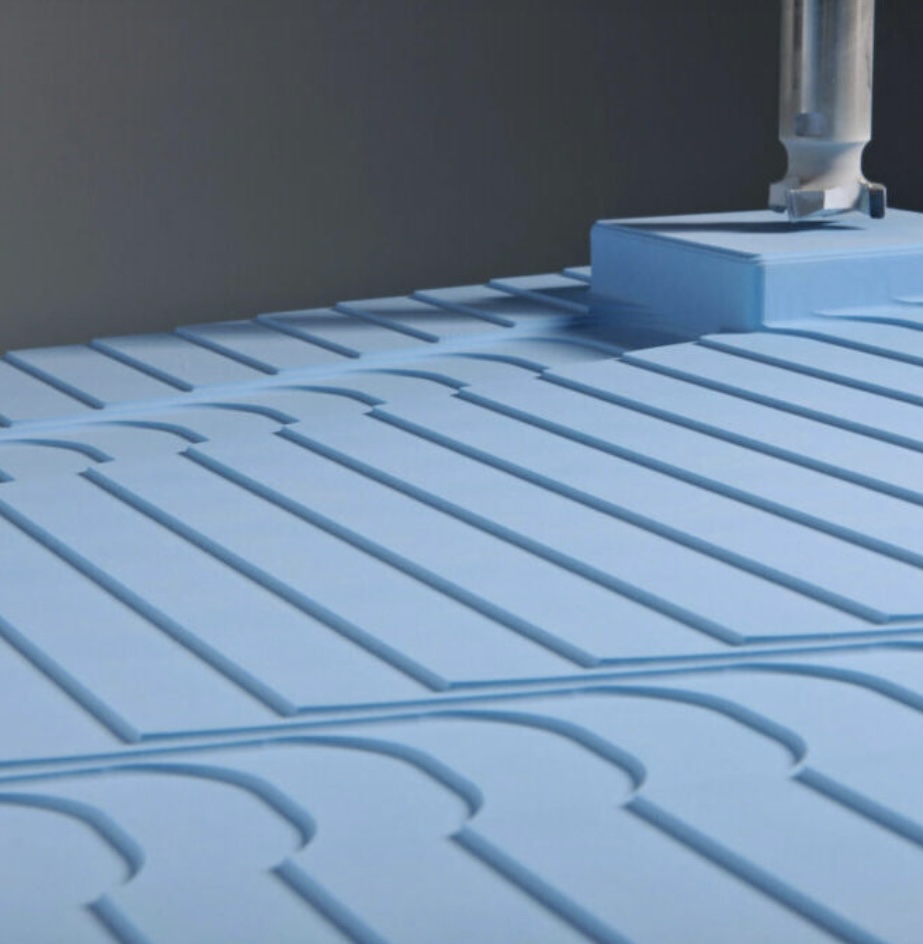
High-performance epoxy tooling materials engineered for the manufacture of patterns for tooling and moulds for the production of carbon fibre parts. Image courtesy of Base Materials.
In a press release about Base Materials’ launch of a 3D printing service targeting the large-format tooling market, the company’s Managing Director, John Miller, said, “This investment marks a significant milestone for Base Materials. Our large-format 3D printing service combines material innovation with digital manufacturing to deliver faster, cleaner and more efficient tolling solutions. With the ability to print complex, full-scale models in a single piece — and do so using our new ProXtrude, high-performance printable paste system — we’re helping our customers embrace new levels of design freedom and speed.
“We see this as a pivotal innovation for industries where the demand for lightweighting, rapid prototyping and reduced material waste to support ESG commitments are growing every year. By offering precision [AM] in addition to traditional tooling methods, we’re not only pushing the boundaries of what’s possible in tooling design but also supporting manufacturers in their innovation journey.”
I haven’t done any sort of in-depth look into the topic, but purely in terms of what’s been evident from this year’s AM industry press releases, service bureaus seem to be gaining some amount of traction in the UK. Back in April, service bureau 3D People launched a cloud-based digital inventory platform, and Additive Manufacturing Solutions recently joined a government-funded project led by Airbus, aiming to reduce waste in the AM value chain for aerospace parts.
I’ve always thought that the UK is a perfect place to cultivate a robust national AM ecosystem: it has an unusually high concentration of top-tier R&D institutions, it’s situated between the European continent and the U.S., and it has strengths in the strategically critical industries that are ideal AM adopters. The nation doesn’t have too many home-grown OEMs aside from Wayland Additive, and that, added to everything just mentioned, suggests that the UK could really excel at AM contract manufacturing.
Similarly, tooling is a perfect application for accelerating growth in the UK service bureau market. As described in this recent AM Research/Stratasys white paper on the tooling market, new life is being breathed into the world of AM tooling with the drastic, ongoing reorganization of global trade arrangements.
A company like Base Materials is well-positioned to take that starting point and, if it succeeds, quickly branch out into a variety of other areas. The company could certainly benefit, for example, from all the cooperation between the U.S. and the UK on issues where industry and national security overlap.
Subscribe to Our Email Newsletter
Stay up-to-date on all the latest news from the 3D printing industry and receive information and offers from third party vendors.
Print Services
Upload your 3D Models and get them printed quickly and efficiently.













You May Also Like
$51 Million Revenue VMP Wants to Become a Leading Additive Manufacturing Metal Powder Producer
Chinese powder producers have traditionally had little impact on the additive manufacturing market. Typically, they offer low-cost powders without much in the way of settings or application support. But China’s...
SprintRay Releases Midas Restore
SprintRay‘s new U.S. Food and Drug Administration (FDA)-cleared Midas Restore is a material for restorative dentistry. The ceramic-doped resin is meant for definitive inlays, crowns, and veneers. The resin has...
Alibaba Selling Fiber Optic Military Drones for $200
Ukraine was saved by Turkish-made Baykar Bayraktar drones and many brave soldiers in the first stages of the conflict. Then hobbyists and their DJI Mavics showed how drones could be spotters...
The Formlabs Shuffle
For the latest development on 8/31/26, please see an update at the end of this article. Formlabs is doing a management shuffle, pointing the firm even more surely towards an...