
Safran Buys Three Lithoz 3D Printers for Casting Cores

Safran Aircraft Engines has bought three Lithoz CeraFab System S65 for its Gennevilliers site. Gennevilliers is a main site for Safran to make cast and forged parts for aero engines. Safran itself is a $27 billion French aerospace and defense giant that was an early 3D printing pioneer. Safran is one of the first firms to press additive manufacturing (AM) into service for aeroengines, and before it became cool, it was already making parts at scale, far ahead of many other companies. Safran makes helicopter engines, solid rocket engines, landing gear, optics, cabin interiors, and much more. This is truly a significant win for Lithoz because Safran could, if this process works for the firm at scale, deploy it much wider across many different business lines.

Close-up of a jet engine turbine. Image courtesy of Cyril Abad / CAPA Pictures / Safran.
Lithoz CeraFab S65 features a 10–200µm layer thickness, a 102 x 64 x 320mm build volume, and a WQXGA display, capable of building up to 150 layers per hour. Lithoz actually has a similar system, with five times the build platform, in the same lineup, but instead, Safran opted to buy three of these. This goes to show that flexibility, redundancy, and enmeshing with shifts are key in industrial production. The printer uses Slurry SLA or what Lithoz calls LCM (Lithography-based Ceramic Manufacturing), which involves the vat polymerization of a doped resin, together with debinding and sintering, to make a part.
“Increasing the high pressure turbine inlet temperatures is key for future engine generations, meaning that the components must withstand those increased temperatures. This can be achieved by implementing more complex cooling channels during the casting process used to manufacture the turbine blades. With its operational and resource-based efficiency, Lithoz’s ultra-precise LCM technology has reached a level of complexity for casting cores previously unattainable with traditional ceramic manufacturing processes.”
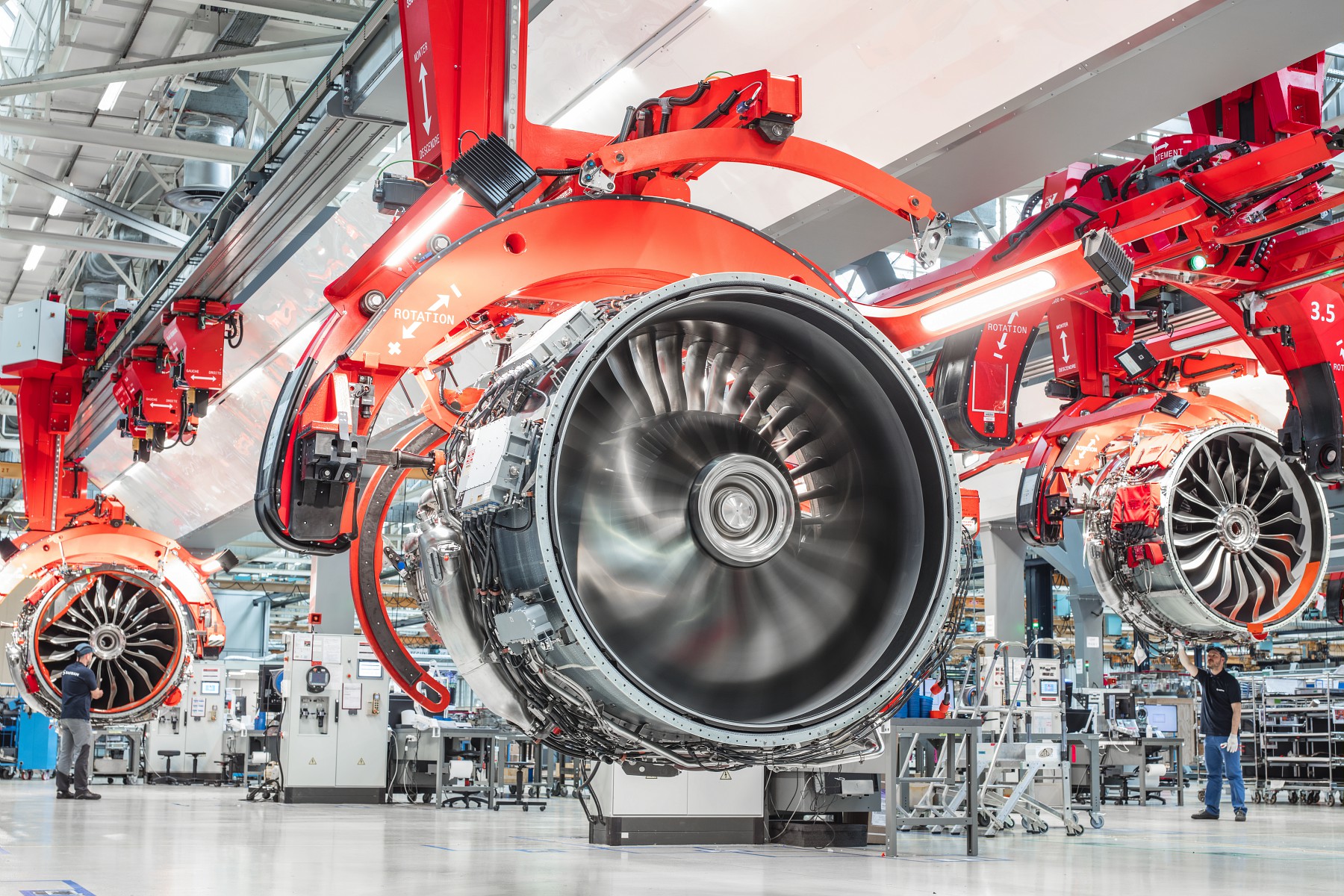
Jet engine fan modules undergoing assembly and inspection. Image courtesy of Adrien Daste / Safran.
I love this so much because throughout the most demanding industries, from rocketry to satellites and much of aerospace in between, a similar approach could be used for cutting-edge parts. Similar concerns are also at play in rocket engines, missiles, hypersonics, and other types of engines. This means that, with just this one process for this specific application, Lithoz could generate a lot more business.
Lithoz CEO Johannes Homa said,
“The installation of these three CeraFab S65 printers is a true milestone for both Lithoz and the aerospace industry. As Safran Aircraft Engines move forward to further develop their serial additive manufacturing process for ceramic casting cores, Lithoz remains strongly committed to providing our constant support in this important project.”
Of late, casting cores seem to be one area of additive manufacturing that is doing exceedingly well. We recently broke the news that BMW may be making one million sand casting cores with ExOne, DesktopMetal, Laempe, and Loramendi for its engines. Using up to 4,000 parts per working day, these components are used at scale in engines. We know that others in aerospace are doing the same. Ford, GM, Volkswagen, and others have bought binder jet or other 3D printing equipment to do similar projects. The paths to these industrial processes took many years. But with several technologies, we are now making serious inroads in day-in-day-out production of critical parts using several different 3D printing processes. This, and all the hard work it took to get there, should be celebrated. It is not promises made by PowerPoint, but rather diligent work behind the scenes, that is the future of our industry. In the future, we can expect more firms to adopt Lithoz’s processes or explore using Slurry SLA for casting cores. A lot of people are probably reading this and thinking, “Well, whatever we’re doing, it can’t be harder than this.”
Subscribe to Our Email Newsletter
Stay up-to-date on all the latest news from the 3D printing industry and receive information and offers from third party vendors.
Print Services
Upload your 3D Models and get them printed quickly and efficiently.













You May Also Like
Foundation Alloy Raises $22M in Series A for Solid State Molybdenum
Foundation Alloy has just raised $22 million in Series A financing. The alloy company is trying to create a platform that will enable the solid state manufacturing of alloys. In...
Aerospace Giant IHI Bets on Freemelt E-Beam 3D Printing for Next-Gen Turbine Alloys
IHI Europe has purchased a Freemelt electron-beam powder-bed fusion (E-PBF) system. Previously, parent IHI bought two Freemelt systems, bringing the total to three. IHI is a Japanese engineering conglomerate. The...
Goldilocks’ Flywheel: Refractory Complex Concentrated Alloys (RCCAs) & The Race for the Future
Recently, Metalysis, Skyrora, and Thermo-Calc Solutions started to try to commercialize Tanbium. This alloy has been created for use in combustion chambers and rocket nozzles. Tanbium is a Refractory Complex...
3DPOD 236: AM Materials Science & Applications with Nick Sonnentag, Sunnyday Technologies & Oshkosh Corporation
Nick Sonnentag is a Senior Principal Engineer at Oshkosh, where he contributes to the development of some of the world’s toughest vehicles using additive manufacturing (AM). Drawing on experience from...























































